
Trump Administration Approval of Abortion Drug Infuriates the Right
Natalie Allison and Paige Winfield Cunningham The Washington Post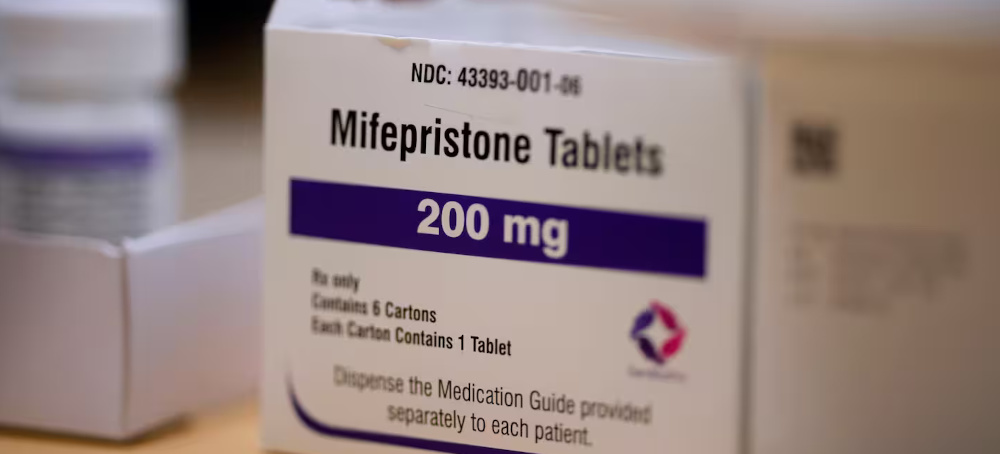 The Trump administration has approved a new generic version of the mifepristone abortion pill. (photo: Charlie Neibergall/AP)
 Trump Administration Approval of Abortion Drug Infuriates the Right
Natalie Allison and Paige Winfield Cunningham The Washington PostALSO SEE: FDA Approves a New Generic Mifepristone Abortion Pill
The approval prompted an outcry from abortion foes, who rejected HHS’s claim it has little wiggle room to slow generic drug approvals.
The approval of the drug on Tuesday comes less than two weeks after Health and Human Services Secretary Robert F. Kennedy Jr. and FDA Commissioner Martin Makary said the department was conducting a review of the safety of abortion pills, a decision that antiabortion activists welcomed.
Now, those same activists are questioning the administration’s commitment to their cause, marking the first significant pushback Trump has received from his otherwise loyal base of social conservatives.
“This is a wildly disappointing decision. We are extraordinarily disappointed,” said Kristi Hamrick, a spokeswoman for Students for Life of America, in an interview with The Washington Post. “This has to be addressed.”
Hamrick referred to the FDA’s decision as “the opposite of the gold standard review” that antiabortion leaders believed the Trump administration was conducting into mifepristone, and the organization is among those questioning why the FDA would green-light the approval before launching the safety study.
“It’s a total goat rodeo,” said Marjorie Dannenfelser, president of Susan B. Anthony Pro-Life America, in a dig at how the Trump administration has handled the drug approval.
Dannenfelser also said it would be an “easy lift” for the administration to restore restrictions on the drug’s distribution that were lifted by President Joe Biden during the coronavirus pandemic.
“‘Powerless’ is an adjective no one uses to describe this administration when facing trouble,” Dannenfelser said.
Sen. Josh Hawley (R-Missouri) said in a social media post about the decision that he has “lost confidence in the leadership at FDA.” Former vice President Mike Pence said the decision was “a complete betrayal of the pro-life movement that elected President Trump” and called on Kennedy to be fired.
A White House spokesman did not respond to questions about Trump’s position on the drug approval but provided a statement from HHS spokesman Andrew Nixon, who said the FDA “has very limited discretion in deciding whether to approve a generic drug.”
Nixon said the HHS secretary, by law, must approve an application if it demonstrates that the generic drug is identical to the brand-name drug, and generic applications aren’t required to provide evidence proving safety or effectiveness. He noted that HHS is “conducting a study of the reported adverse effects of mifepristone to ensure the FDA’s risk mitigation program for the drug is sufficient to protect women from unstated risks.”
“The FDA does not endorse any drug product and directs prescribers to follow all labeling,” Nixon continued.
But the FDA has the ability to slow approvals of generic drugs, such as requesting more data from manufacturers. The agency took 10 years to approve the first generic version of mifepristone, made by GenBioPro. A similar outcry arose among abortion foes when the first Trump administration approved that medication in 2019.
The drug application in question was submitted by Evita Solutions on Oct. 1, 2021, and the approval took effect on Tuesday, according to a letter the FDA sent to the company. Antiabortion activists noted that the company’s mission statement says it exists to recognize “the utility and freedom that medical abortion provides patients” and to “normalize abortion.”
Some top antiabortion activists in recent days had caught wind of an expected approval of the drug and had begun sounding alarms on Capitol Hill, according to two people with knowledge of those conversations. It’s unclear whether the White House was aware of the pending approval.
Antiabortion activists focused in recent years on mifepristone, a drug now used in more than 6 in 10 of all abortions nationwide. Women have increasingly used it to terminate pregnancies, especially in states that banned abortion after the Supreme Court struck down Roe v. Wade in 2022.
Sixteen states have near-total abortion bans, according to the Guttmacher Institute, which supports abortion rights. But groups providing abortion pills still mail them to women in many states with bans, prompting a massive legal battle over whether states can criminalize the mailing of an FDA-approved drug.
The FDA cited a large body of research showing mifepristone is safe and effective when it first approved the drug more than two decades ago.
Conservative activists have pushed the Trump administration to reinstate stricter rules around how and when the drug can be dispensed. The Obama and Biden administrations had relaxed those rules, allowing it to be prescribed later in the pregnancy and without an in-person doctor visit.
Last month, Kennedy and Makary wrote to 22 Republican state attorneys general — who had asked the FDA to take another look at mifepristone — saying the agency would conduct a fresh review of the drug’s safety and efficacy.
They cited a study released over the summer by the conservative Ethics and Public Policy Commission, which used insurance claim data to claim more women are experiencing adverse effects from the drug than previously thought. Abortion rights advocates have noted that the study wasn’t peer-reviewed.
On Thursday, EPPC President Ryan Anderson called the FDA’s approval “a giant mistake.”
“Why approve a generic before conducting the safety review?” Anderson said in a statement.
Before learning the news Thursday, Students for Life sent a letter to Kennedy, Makary and other top Trump officials seeking information on how the mifepristone study would be conducted — and by whom.
Trump has referred to himself as “the most pro-life president in our nation’s history,” a superlative that antiabortion activists have overwhelmingly embraced. Trump is credited with securing the reversal of Roe v. Wade after appointing conservative justices to the Supreme Court during his first term, and more recently, he included in his signature spending legislation a ban on Medicaid funding to clinics that provide abortion services.
But Trump, who is not motivated by the same conservative religious fervor that animates many in the antiabortion movement, has at times pushed back on those activists’ demands. He rebuffed calls during the 2024 presidential race to endorse a 15-week national limit on abortion, and he diluted the antiabortion language in the GOP’s platform.
Top antiabortion leaders, meanwhile, have continued to appeal to Trump as diplomatically as possible.
“It’s a delicate situation, because I think the intelligent people in the pro-life movement don’t want to go to war with the administration. What they want to do is find a reasonable solution,” said a consultant who works with antiabortion organizations and spoke on the condition of anonymity because they were not authorized to speak about the situation publicly.
“If you do something that embarrasses Trump and the HSS secretary and the high-profile people, then you wind up with Trump digging in his heels — and you don’t want that.”