
TPS for Haitians Officially Ends, Putting Thousands Out of Work and in Limbo
David Nakamura and Maria Sacchetti The Washington Post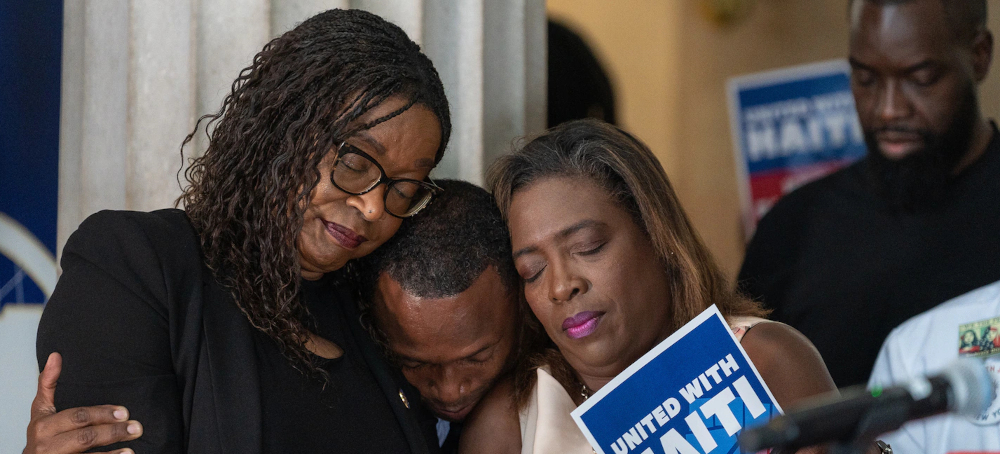 Immigration activists and members of the Haitian community are joined by elected officials for a rally to protect temporary protected status in Brooklyn on July 9. (photo: Steve Sanchez/AP)
 TPS for Haitians Officially Ends, Putting Thousands Out of Work and in Limbo
David Nakamura and Maria Sacchetti The Washington Post
A federal judge took the final step in allowing the Trump administration to terminate humanitarian protections for 350,000 Haitians in the United States.
U.S. District Judge Ana C. Reyes of the District of Columbia had enjoined the administration in February from ending TPS for Haitians, and a federal appeals court had refused to lift the ban. Reyes reversed her decision after the U.S. Supreme Court ruled 6-3 in June that federal law bars judicial review of TPS determinations.
The high court’s ruling means TPS “is no longer in effect,” Reyes wrote in her new order Wednesday. However, the judge said she would allow attorneys to continue seeking discovery and litigating their underlying claims that the Trump administration terminated TPS because of their clients’ race.
The Supreme Court’s ruling left open a narrow path for TPS holders to challenge the loss of their status on constitutional grounds. An attorney representing the immigrants involved in the Supreme Court case said the team is considering filing a new lawsuit.
Immigration experts said that even before Reyes’s amended ruling, companies had begun large-scale layoffs of Haitian TPS holders, who now face the possibility of detention and deportation. Another federal judge in New York is expected to soon allow the Trump administration to formally end TPS for an estimated 6,000 Syrians to comply with the Supreme Court.
About 200,000 Haitians with TPS hold jobs, with large concentrations of workers in health care, food service, warehousing, retail and long-term caregiving, according to an analysis of government data by the immigration advocacy group FWD.us. Business owners have been preparing for weeks by raising sign-on bonuses, cutting shifts and making inroads at community colleges and high schools to hire new staff, industry leaders said.
In Ohio, the Department of Homeland Security has recently begun summoning Haitian immigrants to check-in appointments and requiring them to wear ankle monitors, in what appears to be a new enforcement effort after the Supreme Court’s decision.
In Springfield, Ohio, which has more than 10,000 Haitians, residents awoke Wednesday to group messages relaying worry and a sense of dread. Though Reyes’s order was expected, the reality of its implications is only starting to feel real, community members said.
Haitian parents of U.S. citizens are now asking for help with power-of-attorney forms to ensure their children will be cared for if they are detained or deported. Some Americans have been preparing their own children in case they have to say goodbye to Haitian friends.
Not all Haitians are immediately vulnerable to arrest, said Katie Kersh, senior attorney with Advocates for Basic Legal Equality, a legal nonprofit, because some have pending immigration cases. But the possibility of immediate detention at mandatory check-ins with U.S. Immigration and Customs Enforcement this week is now greater, she said.
“The way this group has been specifically targeted is symbolic of the administration’s efforts to criminalize immigrants of color,” Kersh said. “In targeting people who had TPS, they are targeting people who followed the law.”
The termination is expected to weigh most heavily on certain major metropolises, such as Miami and Boston, as well particular midsize cities, such as Columbus, Ohio, and Allentown, Pennsylvania. Those local economies will see a reduction in consumer spending and tax revenue, experts say.
DHS has called TPS a “de fact amnesty program” and said Congress never intended for it to offer permanent protections for foreigners.
Most TPS holders have lived in the U.S. for years, some for more than a decade. The Obama administration first granted TPS to Haitians in 2010, after a major earthquake destabilized the country, and to Syrians in 2012, amid a violent civil war in their country.
The prospect of migrants being sent back home is particularly worrisome, experts said, because those countries remain dangerous and politically unstable. The U.S. State Department maintains a “do not travel” warning for U.S. citizens to both countries, citing the threat of kidnappings, violent crime and terrorism.
The Haitian Legal Defense and Education Fund, in a court filing last week, asked Reyes to implement a 90-day ban on the federal government from deporting Haitians who lose TPS status, citing systematic violence in Haiti that “demonstrates a pattern of crimes against humanity.” The judge did not grant that request.
“This is an embarrassment for the United States of America,” Sen. Chris Murphy (D-Connecticut) said in a conference call with reporters Monday. “There is no safe place to return for TPS holders from places like Haiti and Yemen and Venezuela and Syria. In fact, in those places I just mentioned, the situation is not stabilizing, getting better, it is getting worse.”
Some Haitian TPS holders may have other pending immigration claims, including applications for asylum, that allow them to remain in the U.S. Others will be left without any legal status, putting them at risk of being detained, whether through a targeted ICE operation or a traffic stop that leads to questions about their status in the U.S.
Immigration attorney Ira Kurzban, who helped represent the Haitians in the Supreme Court case, said he is bracing for a rush of arrests by the Trump administration. But he is urging his Haitian clients to continue pursuing applications for asylum or another form of legal status, even if they are detained. The alternative, he said, is returning to a country where they could be harmed or killed.
“I tell my clients to fight, fight and fight,” Kurzban said. “Nobody is telling a client to make up anything, but if there is a claim, I think the worst thing they can do is just give up.”
The high court’s decision, which was issued along ideological lines, is expected to eventually affect all of the estimated 1.7 million people from 17 countries who had been granted TPS. President Donald Trump’s administration has sought to eliminate the humanitarian protections for people from 13 of the 17 countries in the TPS program, though litigation in lower courts had slowed the government’s effort.
TPS is reserved for people from designated countries that are in the midst of armed conflict, natural disaster or other crises. The protections allow immigrants in the U.S. to work legally for up to 18 months and seek to renew their status after that. Applicants are required to pay fees and pass a background check and cannot have serious criminal records.
Many Haitians and business owners have been making plans to prepare for the sudden loss of thousands of workers. Nursing home leaders warned they would have fewer beds to offer if health aides were forced to leave the country. Business owners started calculating how many days they could continue to employ TPS holders. Immigrants began making plans to sell or rent their homes and secure bank accounts.
It is up to employers to verify who has a valid work authorization, and some companies do so only once a year. So how quickly someone might lose their job will vary.
A plurality of Americans oppose ending TPS and deporting those who have been protected by it, according to a Washington Post-Ipsos poll conducted last month. The poll found 44 percent oppose terminating the program, compared with 32 percent who support doing so.
Trump has long signaled that he wants to deport many of the immigrants previously protected through TPS. He falsely claimed during his presidential campaign that Haitian residents in Springfield, Ohio, were killing and eating their neighbors’ pets — and said that immigrants were “poisoning the blood” of the country.
After the Supreme Court ruling in June, Stephen Miller, White House deputy chief of staff and the architect of much of Trump’s immigration policy, said that he expected people who lose TPS status to be deported.
Those who lose TPS can seek asylum if they apply within what the law calls a “reasonable period” of time after losing their status, which is evaluated at the discretion of the immigration judge.
The Trump administration recently announced a new rule that could make it more difficult for asylum seekers to remain in the country. The provision allows asylum officers to send applicants directly into deportation proceedings in immigration court without granting them an interview to determine whether they are eligible for protection and permission to stay permanently.
U.S. Citizenship and Immigration Services, which announced the new rule, said it aims to wipe out 31 percent of an asylum application backlog totaling 1.4 million cases.
The Trump administration already has deported some former TPS holders after revoking their status, including Venezuelans, said Emi MacLean, a senior staff attorney at the ACLU of Northern California. Her organization represents Haitian and Venezuelan TPS holders in a separate legal case that remains active as the ACLU and its partners seek to amend their complaint to be in line with the Supreme Court’s ruling.
MacLean said that the large number of Haitians who stand to lose TPS could have deep impacts in some labor industries, including health care, where many of them worked.
“It will be a huge loss to many people and communities,” she said.