
Too Many No Longer Believe Elections Are Fair
The Economist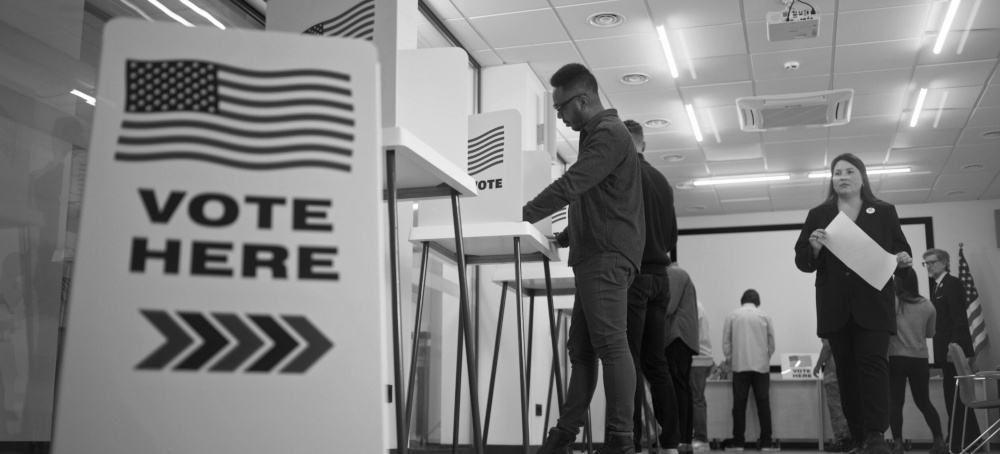 Voters complete their ballots. (photo: AP)
 Too Many No Longer Believe Elections Are Fair
The Economist
Too many no longer believe elections are fair
Each party has come to see the other lot as cheats. Repeated meddling in election machinery by the president and his party, and their false claim that victory was stolen from them in 2020, have undermined voters’ belief that elections are fair. The degrading contest to gerrymander congressional seats, the most intense in memory, further tells Americans that their politicians want to rig outcomes rather than compete.
Some Democrats worry that Mr Trump will steal the midterms. That is unlikely. But you don’t have to expect the worst to fear the trend. Elections are not just about voters picking a winner; they are also a device for persuading the losers to accept the legitimacy of their opponents’ claim on office. Sooner or later, the losers’ loss of faith will cause a crisis.
Midterm worriers can point to motive and opportunity. Losing the Senate as well as the House would sting Mr Trump. The closeness of the Senate contest gives him a chance to meddle again. The midterms could also be a dry run for an attempt to steal the presidential election in 2028. Mr Trump’s constant efforts to weaponise the courts against his domestic enemies suggest he believes more than ever that rules are for losers.
The worriers can also point to the president’s behaviour. He has issued executive orders to take bits of election administration away from the states and put the federal government in charge, supposedly to make the system more trustworthy. That is a familiar Trump move: first, identify a real flaw (a lack of trust he helped engender), then propose a plan that makes the problem worse (grabbing more power for himself). His scheme is unconstitutional and will probably fail. But it reveals his intent: if he could seize the running of elections, he surely would.
If Mr Trump cannot change the rules, he could still try to interfere on election day. In some places conspiracy theorists will be in charge of ballot boxes; some may believe the election in 2020 was stolen. Some maga loyalists have suggested he should dispatch ice agents to polling stations to stop foreigners from voting illegally (which almost never happens). That would be illegal and the courts would swiftly say so. The administration has been ambiguous. But, should the temptation arise, it would not be hard to work out where to direct them: Democratic areas of Alaska, Maine or Ohio, where control of the Senate will be decided, and where scaring minorities into staying at home could help Republicans. Even if this did not change the result, it would sow distrust, which could provide a platform for post-electoral mischief.
After the votes are counted, the president’s party could once again file lawsuits, as it did the last time he lost. In 2020 judges threw them all out, a reminder that Americans can have confidence in their courts. But maga World is litigious and has plenty of money. Never conceding defeat has become its organising principle. The cases could drag on well past November 3rd. A loss in the courts is likely eventually, but the idea that someone, somewhere, has stolen the election may grow.
Given such a litany of risks, you can understand the predictions of imminent doom. So it is worth underlining that, although America’s electoral system is untidy and frequently confusing, with rules that vary from place to place, it still works. The constitution says that elections will be administered by the states, not the federal government. That limits any president’s ability to mess with them. Even within states, election administration is decentralised, relying on county officials who take their jobs seriously, and on the sort of doughty volunteers usually found at bake sales. Across the country, officials committed to the integrity of the vote are preparing to repel attempts to undermine it.
Instead, the damage is more likely to be further vandalism rather than outright theft. The world’s democratic superpower, whose idealistic system of government was long admired elsewhere, is now also a cautionary tale about how fragile trust is. Only 25% of voters say they are confident the midterms will not suffer interference. A majority in both parties think the other side is too extreme. Only 10% say both parties are honest and ethical. In a recent poll, more than half of Americans reckoned their fellow citizens were morally bad; only 17% of Britons and 7% of Canadians did so. That is a gloomy way for America to celebrate its 250th birthday this summer.
This mistrust is not all the president’s doing. Polarisation predates him; changes in media and technology matter. But a lot of it is. Trust in elections dipped after the Supreme Court decided Bush v Gore after the vote in 2000. Then it recovered, until Mr Trump came along. He has relentlessly sought advantage by casting doubt on the good faith and honesty of anyone who opposes him, from whichever party. Politicians like to claim that the election they are competing in is the most important of their lifetime, but Mr Trump raises the stakes by framing each contest in existential if not apocalyptic terms.
Daylight robbery
That may turn out to be this president’s most enduring domestic legacy. Although he probably cannot steal the midterms, he may well further damage democracy. Dangerous ideas are taking root. If the other side are thieves and traitors, as he often suggests, partisans may once again feel that rising up after an election is their patriotic duty. If the result is close, they may reason that treachery is what got the other side over the line. If the other lot stole the election, to impose their policies on all Americans would be wrong. By taking away Americans’ trust in each other, Mr Trump is making it easier for future would-be strongmen to exploit their loathing.