
Three Deaths, Three States, 24 Hours: One Day in ICE’s Quiet but ‘Gruesome’ Surge
José Olivares Guardian UK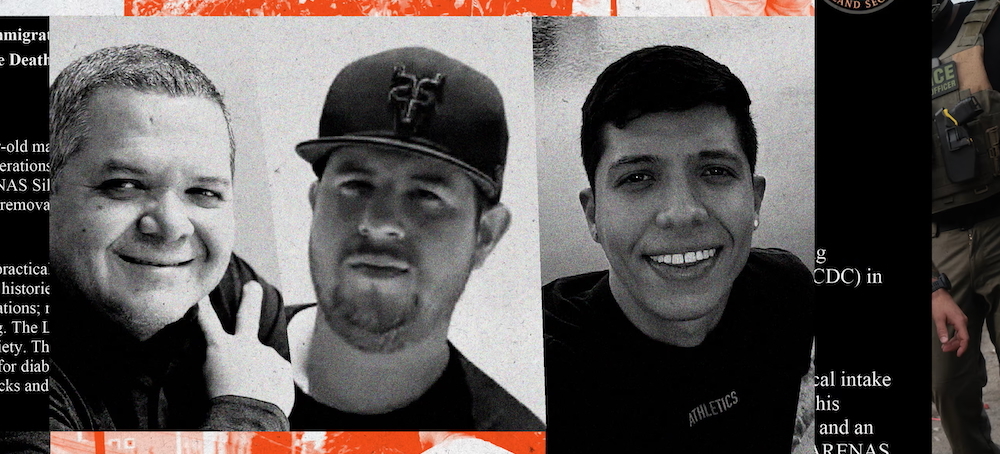 'Three people dying in one day is an amplification of what we’ve already seen,' says Andrew Free, a former immigration attorney and investigative journalist. (image: Rita Liu/Guardian UK/Getty Images/GoFundMe)
 Three Deaths, Three States, 24 Hours: One Day in ICE’s Quiet but ‘Gruesome’ Surge
José Olivares Guardian UK
These men in Maine, Georgia and Florida shared no ties – until they became casualties in the latest phase of Trump’s anti-immigration campaign
More than 1,200 miles (1,900km) away in Ocilla, Georgia, Jesús Manuel Arenas-Silva was shuffled on to a bus. Private sector guards and Immigration and Customs Enforcement (ICE) officials were beginning the process of transferring him and several other immigrants from one detention center to another nearly two hours away. Ten minutes into the ride, he became unconscious. Doctors at a nearby hospital pronounced him dead.
Less than 24 hours later, Juan Jairo Coronilla Durán, pulled up to a gas station near a busy highway in St Augustine, Florida, as the sun was rising in the bright sky. Soon after, he would lie dead on the road nearby, hit by a semitruck when running away from immigration officers.
There were no ties between Durán Guerrero, Arenas-Silva and Coronilla Durán, but within those 24 hours, the three men suddenly became connected as casualties in the latest phase of Donald Trump’s aggressive anti-immigration campaign.
Twenty-four hours. Three states. Three people dead. Countless lives changed in seconds.
The men in Maine and Florida were not even ICE’s intended targets for arrest – they became “collaterals”, as agency officials call them.
“Three people dying in one day is an amplification of what we’ve already seen,” said Andrew Free, a former immigration attorney and investigative journalist who has for years extensively worked on ICE-related death cases. “The choices that the Trump regime has made since January 2025 have had the consequence of increasing the numbers of people who die in the field and in custody.”
Throughout 2025 and into early 2026, federal immigration officials descended on cities including Los Angeles, Chicago and Minneapolis. They swaggered in militarized gear and brandished their weapons and crowd-control sprays, while engaging in raids and arrests in a high-profile attempt to show that Trump’s promise of “mass deportations” would be fulfilled.
An explosion of protests and public backlash grew, reaching a climax after the January 2026 fatal shootings of two US citizens in Minneapolis as they protested against what local leaders called “an invasion” by federal immigration officials.
Since then the flashy immigration enforcement mass operations have all but disappeared. Throughout the rest of 2026, the Department of Homeland Security (DHS) has switched strategy: more low-key arrest operations by small groups of officers and more 287(g) collaborations with local and state police and sheriffs deputized to make immigration arrests. Also, quicker processing with less representation in immigration courts and White House-directed collaboration to target undocumented children are fueling enforcement that is quieter but just as ruthless.
A summer surge of enforcement means arrests are at a record high, with the majority now being people with no criminal history. And deaths keep ticking up “even though ICE’s current tactics have been less visible than the chaos in Minneapolis at the start of the year”, said Austin Kocher, an assistant research professor at Syracuse University and an immigration data and policy expert, in his Substack posts. At least 31 people have died in 2026 during interactions with immigration officials. Four people have been shot, 25 have died in detention and at least two people, including Coronilla Durán, have died while fleeing officials.
The 24 hours between the mornings of 13 and 14 July stand out as exceptionally deadly.
When contacted for comment, a DHS spokesperson sent along the three previous statements they had issued when the deaths originally happened in Maine, Georgia and Florida.
Much remains unclear about the three deaths in that period, but some crucial details are still known.
Joan Sebastián Durán Guerrero, 25, shot while driving
On the Monday morning of 13 July when Durán Guerrero left his home in Biddeford, a city in southern Maine, ICE officer David Brouillette and other officers were reportedly looking for a different person, whose last known address was where Durán Guerrero had just exited.
Brouillette, 37, had recently been hired by ICE amid the immigration agency’s push to increase arrests by bringing on more officials. With a blond-brown beard, baseball cap, sunglasses and a green tactical vest marked “POLICE ICE” over a navy T-shirt, Brouillette sat in a federal vehicle and watched the streets.
As Durán Guerrero got into his white car and drove away, Brouillette and the officers spotted him, gave chase and attempted to stop the car.
The next few moments are still unclear, but neighbors suddenly heard the “pops” of gunfire in the quiet neighborhood. Brouillette had fatally shot Durán Guerrero.
A statement from DHS at the time said that the ICE officers attempted to stop the vehicle, but that Durán Guerrero “attempted to flee”. DHS added the official fired at Durán Guerrero “fearing for public safety”.
It has not been verified whether Durán Guerrero drove his vehicle in the way that DHS stated.
Surveillance footage obtained by the Associated Press appears to show a white car slowly driving in circles at an intersection. The footage was recorded after the shooting, with Durán Guerrero either dead or dying at the wheel.
The video then shows one of ICE’s vehicles ramming into the white car to stop it. Two officers open the driver’s door and Durán Guerrero’s body slumps on to the asphalt. Two more ICE officers rush over.
“He had blood on his head, blood on his face. It was gruesome, just gruesome,” a neighbor told Maine Public Radio. “I believe it was [Durán Guerrero’s] wife that was sitting on the curb across the street, just crying hysterically.”
The Colombian man was 25, with a dazzling smile that lit up his face below closely cropped dark hair. He lived with his partner, Karolina Rojas, and their three-year-old daughter, and he had authorization to live and work in the US. He was a food delivery driver and is remembered by his neighbors as a good man and hard worker.
“My son was a person who left his country to make a future for his family,” Omar Durán, Durán Guerrero’s father, told BluRadio, a Colombian news outlet.
Brouillette, the ICE officer, was hired by the agency after years of employment instability, according to reporting from the Associated Press, the Portland Press Herald and other outlets. He was recruited even though family members have made allegations of a history of violent behavior, including accusations of domestic violence and threats.
Attempts to reach Brouillette for comment were not successful.
About ICE’s recruitment policies, DHS said: “The ICE Office of Professional Responsibility diligently applies the proper personnel vetting regulations, including guidelines for national security, and evaluates all available information for every applicant based on these factors.” The ICE office of professional responsibility internally investigates any alleged misconduct.
DHS has still not publicly confirmed Brouillette’s identity as the official who shot Durán Guerrero, nor commented on his alleged personal history. The agency has criticized the media for publishing his name, saying it put officers and their families in danger.
Jesús Manuel Arenas-Silva, 45, died in ICE custody
Meanwhile, in Georgia, just after 7am on 13 July, Arenas-Silva sat in an ICE transport bus, surrounded by other ICE detainees.
The Venezuelan man had been held for a few days at the Irwin county detention center, a privately owned facility operating under contract with ICE. He and the other detainees were being transferred to the Folkston D Ray facility, another privately run detention center in the state.
Arenas-Silva, 45, had a myriad of physical and mental health conditions, including hypertension, diabetes, anxiety and depression, according to a preliminary death investigation report released by ICE. He relied on several medications to survive, his family and the ICE report said. He had been in the US since 2021 and an immigration judge ordered his removal in April 2026, a DHS spokesperson said.
Days before his death, ICE arrived at Arenas-Silva’s home to arrest him.
“We implored ICE not to take him due to his medical needs, but they didn’t listen to our pleas,” Sonimar Arenas, his sister, later said.
While cuffing Arenas-Silva, the ICE officials only allowed him to take one of his medications with him, according to Sonimar. In a phone call from ICE detention, Arenas-Silva told his sister that ICE had not yet given him the medication he needed, according to a statement she later released.
The preliminary ICE death report confirms Arenas-Silva did not have all of his necessary medication on 10 July during his medical intake screening at the Irwin facility. A nurse noted that the only medication he arrived with was for anxiety, the ICE report says. That same nurse later confirmed he had other active medical prescriptions he never received.
Three days later, Arenas-Silva was shuffled on to the transport bus, where staff saw him interact with other detainees at 7.34am. But about 10 minutes later, Irwin detention center staff saw Arenas-Silva was unconscious. As staff dialed 911, the bus began driving to a nearby hospital, the report said.
Fifteen minutes later, Arenas-Silva arrived at the emergency room, “unresponsive and pulseless”, the ICE report says. The medical staff worked on Arenas-Silva, but at 8.31am he was pronounced dead.
“While in custody, Arenas-Silva received medical care and was seen by medical professionals,” a DHS spokesperson said in a statement. “ICE is committed to ensuring that all those in custody reside in safe, secure and humane environments. Comprehensive medical care is provided from the moment individuals arrive and throughout their stay.
“At no time during detention is a detained noncitizen denied emergency care,” the statement added.
Juan Jairo Coronilla Durán, 28, hit by truck while fleeing ICE
In Florida, Coronilla Durán, a 28-year-old Mexican tourist, had been enjoying a few weeks traveling in the US. Before 14 July, he had reportedly been in Atlanta, Georgia, and then traveled to St Augustine, the northern Florida city with beaches on the Atlantic Ocean.
Coronilla Durán and his wife, who had been married for 10 years, lived in the central Mexican state of Guanajuato with their then seven-month-old daughter and a seven-year-old son, according to reporting by the Miami Herald.
He was visiting friends and relatives in the US, while his wife was at home in Mexico. On the fateful July morning, Coronilla Durán and three other men pulled up to a convenience store at a gas station just before 7am. It is unclear who exactly he was with when he arrived there, next to a busy highway.
Details of exactly what unfolded next remain unclear, but a number of federal immigration officials spotted the men and approached them. For unknown reasons, Coronilla Durán and the three others took off running.
As Coronilla Durán ran away from the federal officials, he continued to look back to see if they were giving chase. He ran into the busy highway, at first avoiding vehicles speeding by, witnesses told the Miami Herald.
But when Coronilla Durán arrived at the grassy median, he lost his footing, slipped and fell. He stood up, looked back at the immigration officials and continued to run into the next lane of traffic.
According to a bystander, as Coronilla Durán began to cross the other highway lanes, he lost his footing again and fell in front of a tractor-trailer. The witness said he immediately knew Coronilla Durán had been hit.
“The tractor trailer immediately stopped and attempted to render aid to the victim,” a statement by Florida highway patrol said.
DHS has still not formally identified Coronilla Durán as the victim and only said homeland security officials “conducted an operation near St Johns, Florida. Florida Highway Patrol and HSI are investigating an incident resulting in the death of a Mexican national. We will provide an update when available.” Homeland Security Investigations (HSI) is part of ICE.
‘At what time does this become indefensible?’
All three men’s deaths are still under investigation by local and federal officials.
Durán Guerrero’s parents traveled to the US from Colombia to collect his body. His killing in Maine led to protests there, especially since another deadly ICE shooting had taken place a few days earlier in Houston, Texas.
Durán Guerrero’s death, and the subsequent reporting of allegations about Brouillette’s personal history, led to calls for ICE to improve its hiring practices and to equip officers with body cameras. ICE officials were briefly instructed to stop pulling over vehicles.
The FBI referred all questions about the case to the Maine attorney general’s office and the DHS inspector general’s office. The Maine attorney general’s office said it could not comment further because it is still investigating the shooting death. The DHS inspector general’s office did not respond to a request for comment.
The Georgia bureau of investigations (GBI), a state-level agency, was asked by local county officials to investigate Arenas-Silva’s death, according to a statement provided to the Guardian. A GBI spokesperson confirmed the investigation is open and active.
Arenas-Silva’s sister continues to press for answers: “I am 100% certain that he did not receive proper care,” she said in a statement. “I will seek justice for him and for everyone else who goes through this, so that other families do not have to endure what we are going through. No one deserves this.”
In Florida, Coronilla Durán’s wife flew into the US days after her husband’s death to make arrangements with a funeral home. The Mexican government was assisting the family in transporting his body back to Mexico to be buried.
“The Florida Highway Patrol Traffic Homicide Investigation is currently ongoing,” a spokesperson said in a statement. “There are no updates currently regarding that case.”
Free, the legal expert on ICE-related deaths, fears that ICE involved deaths are going to continue rising. Just over a week ago, an ICE official shot another person – this time in Austin, Texas. The man survived, but the shooting appears to have taken place during an attempted vehicle stop.
“Sometime soon, we’re going to have four people die in a 24-hour period. And then it’s going to be five,” Free said. “What happens when we get there? What’s the red line? For policymakers, for states, for companies – at what time does this become indefensible or unsustainable?”
In Durán Guerrero’s case in Maine, one detail stood out to community members.
As neighbors gathered at the intersection watching the federal and local officials attempt first aid on Durán Guerrero, they noticed a small girl nearby, wearing a pink backpack and crying. It was the couple’s daughter, who would never see her father alive again. Though, it turned out, she might have escaped an even worse fate.
Her mother recently collected some items from investigators and was told the girl’s car seat, from Durán Guerrero’s car, would not be returned. A bullet had pierced it during the shooting.