
Three Black Men Were Lynched. A Rural Virginia County Has Cleared Their Names.
Gregory S. Schneider Washington Post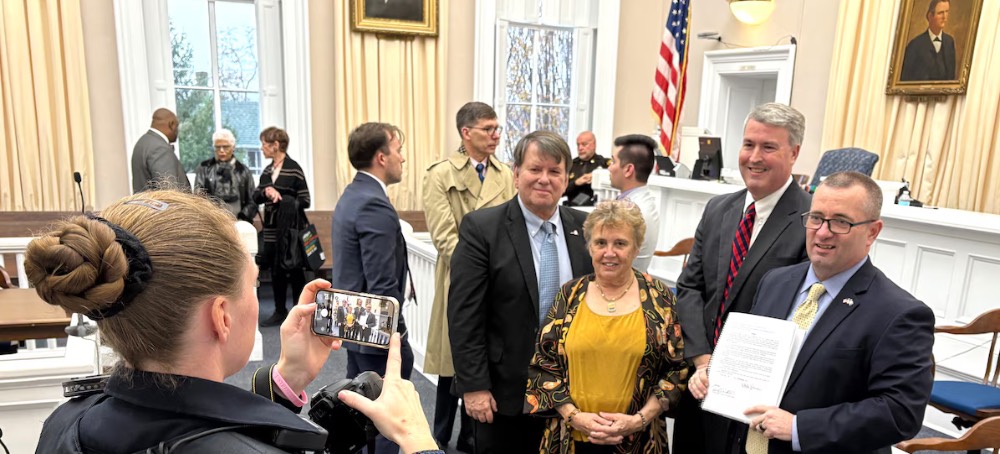 From left, Virginia State Bar President Michael York, researcher Zann Nelson, Commonwealth’s Attorney Russell L. Rabb III and Circuit Judge Dale B. Durrer pose for a photo after a Dec. 16 hearing in the Culpeper County courthouse. (photo: Gregory S. Schneider/The Washington Post)
 Three Black Men Were Lynched. A Rural Virginia County Has Cleared Their Names.
Gregory S. Schneider Washington Post
Zann Nelson worked almost 20 years to shed light on three lynchings more than a century ago in Culpeper, Virginia. A judge just deemed the men innocent.
But this week brought a measure of justice.
In a Reconstruction-era courtroom, Circuit Judge Dale B. Durrer granted a request from prosecutor Russell L. Rabb III to find that all three men “were and remain to this day innocent of their charges” because they were denied due process. The ruling mandates that documents about their horrific treatment at the hands of vigilante mobs remain unsealed in the Circuit Court’s records for future generations to see.
“The best history helps us recognize the mistakes that we’ve made and the evil corners in which humanity can dwell,” Durrer said in issuing his ruling. “This discomfort causes us to learn and grow and harness the great collective power we have as a community.”
Family members of Allie Thompson, who was lynched in 1918 after a White woman accused him of rape, joined about 50 local residents who burst into applause during the unusual court session Monday afternoon. The ruling brought a sense of peace to Otis Jordan Jr., 68, of Bealeton, Virginia, who traces his ancestry to Allie Thompson’s father.
“It was a long time coming, but justice is done. It took, what, 106 years?” Jordan said. “You’re always going to feel anger about it, that ain’t never going to change. But being that the community is acknowledging it, I appreciate that.”
While communities in the South have reckoned with the legacy of lynching in recent years, including establishment of the National Memorial for Peace and Justice in Alabama, Virginia localities have done relatively little to address the legal record. The Racial Terror: Lynching in Virginia project at James Madison University has identified about 116 lynchings across the state from 1866 to 1932. In a groundbreaking case last year, a prosecutor in Albemarle County dismissed an indictment against John Henry James, a Black man lynched in 1898 after being accused of raping a White woman.
In Culpeper, a largely White and conservative county, Rabb, Durrer and the family members credited one woman with making this week’s event possible: Zann Nelson, 76, who spent nearly 20 years researching the long-forgotten cases and pestering local officials to set the record straight.
“I think it was a good day,” Nelson said as the courthouse crowd buzzed around her following the hearing. “There are those who might say, well, it was so long ago, why is it so important? Well, because it brings closure. Not just to families, but to the community.”
Nelson, who is White, used to run the history museum in the town of Culpeper, a place with a complicated past. Surveyed by a young George Washington, Culpeper was notorious in the 1700s for imprisoning Baptist preachers who stirred up crowds against the Anglican establishment. That helped motivate James Madison of nearby Orange County to champion religious freedom in the First Amendment. During the Civil War, Culpeper was both home to Confederate Gen. A.P. Hill and a headquarters for Union Gen. Ulysses S. Grant.
In 2005, when Congress passed legislation acknowledging its failure to respond to Jim Crow-era lynchings, a local reporter called Nelson to see if there had been any in Culpeper.
“I figured this whole story would take about 15 minutes,” Nelson said in an interview with The Washington Post. “Twenty years later, I’m still working on it.”
Initially she knew of only one case — Allie Thompson — but had no details. Her research made it real: Thompson was 18 when he was accused of raping a 27-year-old White woman named Lelia Sisk. Thompson was held in the county jail for five days before a mob kidnapped him and hanged him on Nov. 25 — three days before Thanksgiving.
The governor at the time, Westmoreland Davis, telegrammed the local prosecutor for information about the lynching, but was told the whole affair was so “quiet” that “it is impossible to find any clue upon which to base an investigation,” according to documents Nelson found. County supervisors later allotted Thompson’s father $10 for a coffin and $15 for burial expenses.
Nelson and reporter Allison Brophy Champion teamed up for a three-part series on Thompson called “Buried Truth” that won awards for the Culpeper Star-Exponent newspaper. As she immersed herself in the subject, Nelson came across two more lynchings.
In 1877, a Black man named William Thompson (age not recorded, and no known relation to Allie Thompson) was accused of raping an 11-year-old White girl named Dollie Britton. Newspaper accounts from the time described a riot as Thompson was arrested, with one Black man throwing a stone that dislocated a White man’s jaw and someone shooting the rock-thrower in the neck.
Three days later, an account in the Alexandria Gazette described a “posse” of 50 men marching silently down Culpeper’s Main Street, dragging Thompson out of the jail and hanging him from a poplar tree near the Confederate cemetery. “The lynchers were not disguised, but owing to the darkness none could be recognized,” the news article said.
The oldest case Nelson unearthed was that of William Grayson, age unknown, a free Black man arrested in 1849 and charged with killing David Miller, who was White. Based only on testimony from another man, and even though that Grayson was known to have been elsewhere at the time Miller was killed, Grayson was quickly tried, convicted and sentenced to hang. His lawyer appealed the case to the Supreme Court of Virginia, which overturned the conviction.
Grayson was tried again with the same outcome. Again, the high court overturned it, writing that “the testimony is not only not sufficient to prove the guilt of the accused, but that it is hardly sufficient to raise a suspicion against him.”
With a third trial looming, a “lawless mob” marched to the jail, overpowered the sheriff and lynched Grayson, according to an account from the Fredericksburg Recorder. “Grayson we learn, avowed his innocense on the gallows. One minute was given him in which he was told to confess his guilt, this he refused to do, and told them to execute him at once which they did,” the newspaper reported.
Nelson spent years amassing court documents, newspaper accounts and even journal entries that illuminated the three cases, transcribing old handwriting to bring out the details. She worked to track down descendants or family members, succeeding so far only with Allie Thompson.
Kia Nickens, 50, of Bowie, Maryland, recalled how much it meant when Nelson first contacted the family around 2005. Her grandmother, who died in 2019, had been Thompson’s niece, though she was born a decade after his killing. “My grandma didn’t know a whole lot about it, but it was something she was very emotional about when she spoke of it. Back then, things were so hush-hush, so she just whispered about it in the household,” Nickens said.
“She had only heard kind of like family gossip as to what was going on,” said Monica Nickens-Sharpe, 72, Kia’s mother. “It was unbelievably sad, but she really wanted to know what happened.”
As Nelson realized the power of so much neglected information, she formed an organization called Right the Record to help others use research to pursue social justice. She got her bachelor’s degree in peace and conflict studies online from the University of North Carolina at Greensboro, and debated pursuing graduate school but decided she could do more good by working in the community.
But she was frustrated in her efforts to get attention for the cases. “I just kept failing,” she said. In 2019, she helped persuade the General Assembly to pass a public acknowledgment of the state’s dark history of lynchings. And finally, early this year, she got traction with Rabb, who had been elected commonwealth’s attorney last fall.
“At first, I wasn’t sure what we could do,” Rabb said in an interview. But after looking at other, similar cases, Rabb approached Durrer with the idea of a court order. The judge was enthusiastic.
“It was a very good idea, because it ensured that all the records related to these three cases would forever remain open to public inspection and scrutiny,” Durrer said in an interview. “It means this community can take a small step forward in telling truth and working toward reconciliation.”
They compiled Nelson’s extensive document collection into a thick binder that’s now part of the court’s records, with copies available to the public. And earlier this week, a crowd assembled at Culpeper Baptist Church for a ceremony and reception, with speeches, gospel music and a sing-along of “We Are the World.”
“We gather not just to remember these three men … but to tell their stories and in doing so, reclaim their humanity,” Kaleb Hackley, president of the regional branch of the NAACP, told the audience. “These are not just historical tragedies. These are unhealed wounds in the fabric of our community … This is not just our story, this is also part of America’s story.”
After watching from a pew in the front row, Raleigh Marshall, 41, of Herndon, said he feels strongly that acknowledging sins of the past is a step in building empathy among people today. An IT engineer, Marshall had never heard of the Culpeper lynching cases until Nelson contacted him a few years ago and pointed out a family connection to Allie Thompson. But he wasn’t surprised by it.
“Many families descended from slavery have these kinds of histories,” he said. “So these stories are important, because a lot of people will deny that they even happened.”
But if honoring the victims of lynching is healing, what about holding the perpetrators accountable?
Nickens-Sharpe said she’s not worried about that. “My focus is on telling Allie’s story, and the other two guys, and not so much what [other people] did or why they did it. I think that’s what’s important,” she said.
“This is not about vengeance,” Nelson said, adding that society at the time protected people who committed this kind of violence, so identifying individuals would be nearly impossible.
That’s part of the point of her work over the past two decades.
“It’s about righting the record and getting the truth out there,” Nelson said. “Which brings justice.”