
They Sat Atop a ‘Grandmother’ Tree for Months. Border Agents Knocked It Down.
Jake Spring The Washington Post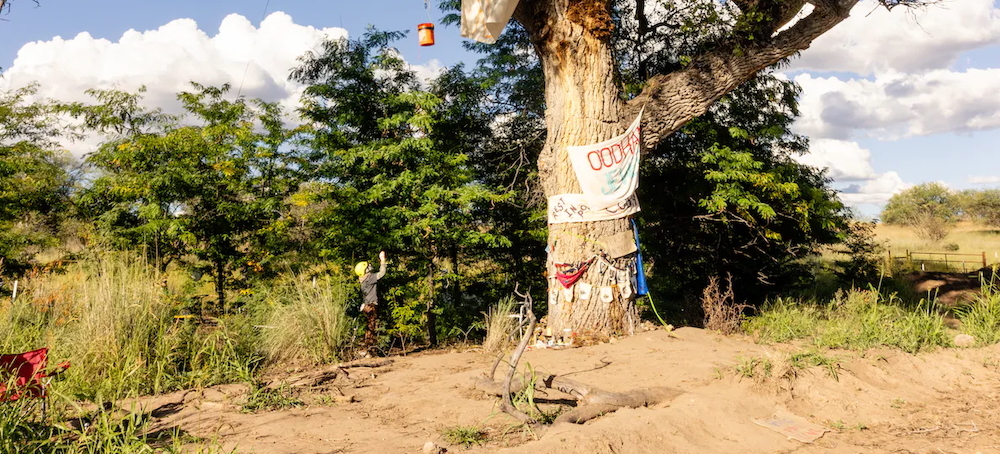 An activist is seen retrieving a bucket from the tree sitter in the "grandmother" cottonwood tree on Sept. 24. (photo: Cassidy Araiza/WP)
 They Sat Atop a ‘Grandmother’ Tree for Months. Border Agents Knocked It Down.
Jake Spring The Washington Post
Activists occupied a cottonwood tree in Arizona for more than two months in a standoff with U.S. Customs and Border Protection contractors.
But that standoff came to an end Monday when demonstrators say more than 50 Customs and Border Protection agents raided the activist camp and an excavator knocked down what they called a “grandmother” tree, estimated to be 150 to 250 years old.
Footage taken by protesters shows the massive tree crashing down as border agents look on, and the activists who worked to protect it wail.
“We have been raided, assaulted, battered, bruised, bleeding by the Border Patrol agents,” said Kate Scott, an activist who kicked off the group’s tree sit, in a call following Monday’s raid. As CBP cleared the area, about 10 people were arrested, the group of activists estimates, and another 10 received citations, including for “violation of a closure order” for being in the border-wall zone.
At least one activist showed images of scrapes and bandages on a Monday video call.
Customs and Border Protection previously identified cottonwood trees on federal land in Lochiel “that needed removal for planned border wall construction” and finished removing them as of Monday, the agency’s assistant commissioner Hilton Beckham said in a statement. Ask The Post AIDive deeper
“CBP recognizes the importance of protecting the environment, wildlife, and cultural resources during border wall construction,” Beckham said, adding that preconstruction surveys found no active migratory bird nests. The Department of Homeland Security has waived dozens of laws requiring rigorous review of environmental impacts, although Hilton said the agency was still conducting environmental and cultural reviews and seeking public input.
CBP did not respond to questions about the descriptions of the confrontation with activists.
The cottonwood tree had become a rallying point for anti-border wall activists, who opposed the destruction of a native habitat and major wildlife corridor, as well as the Trump administration’s immigration crackdown.
The scene Monday brought to close a confrontation that began on July 27.
Scott, who had been in Lochiel on and off for weeks to keep an eye on advancing border construction, had sped back to the tiny former border crossing town that day after hearing fellow activists were in trouble. Arriving just in time, she ran across a field and dove under a fence, popping up on the other side to block an excavator that had already knocked down three other “grandmother” cottonwood trees.
The operator banged the excavator’s bucket around the tree threateningly and came within six feet of Scott. But he could not knock down the tree without hurting her, she said. He backed off, churning up the dirt nearby before leaving the area, damaging some tree roots but leaving it otherwise intact.
The moment was the start of what became a 70-day standoff on the Arizona border, amid efforts to massively expand the border wall during Trump’s second term.
Wanting to stop contractors from moving forward, Scott and a small but rapidly growing group of activists saw only one option to protect the cottonwood that clearly was in the border wall’s path.
“We looked at each other and said ‘Who is going to go up in the tree?,’” Scott said.
At first, a tree-sitter just sat on a high branch with a yoga mat. But by night, a plywood platform — big enough for just one person at a time — had been rigged up to the tree, offering a bit more stability.
The group’s tree sit drew on a decades old tradition that became most famous in California and the Pacific Northwest as a way to block loggers from cutting down old-growth forests. In the late 1990s, Julia Butterfly Hill occupied a redwood tree in Northern California for more than two years to prevent loggers from cutting it down.
“i have been supporting from a distance, the efforts against the border wall construction,” Hill said on social media, resharing posts from the Arizona tree sit to her account and alerting her followers to the clash with border agents on Monday.
As of late September, the wall construction stopped short about 300 feet from the tree. The contractors rarely passed, choosing alternate routes.
Speaking to The Washington Post in Lochiel last month, Scott called the effort a success thus far.
“Any group of people that can prevent border wall ecocide for close to three months is a milestone achievement,” she said then.
Federal contractors have been building the wall at a furious pace at the other end of the San Rafael Valley, a rolling grassland where the 1955 musical “Oklahoma!” was filmed. About 10 miles east of the tree-sit, a newly built concrete plant continuously loads trucks pouring the footers of the wall, while dozens of trailers sit nearby to house contractors working in the otherwise remote area.
On Monday, the camp that held frenetic construction at bay for weeks descended into chaos. As the group held a “sunrise ceremony,” a regular camp ritual not long after daybreak, dozens of CBP officers stormed the area.
“We were holding prayer. We were all silent and in meditation when they originally started to come,” said one activist on a Monday video call, identifying herself as “Hoops,” showing a scrapped and bandaged arm.
“One of our comrades was literally handcuffed and they were kicking him as he was on the ground,” the activist said. “They were dragging our comrades on the ground. They were pushing us into barbed wire fences. They had knees on people’s necks. They shoved me — I’m a very small person — and multiple men shoved me to the ground and got on top of me.”
All except for Scott declined to give their names or have their faces photographed, speaking on the condition of anonymity to protect their privacy and for fear of retaliation. Many of the activists adopted nature-related noms de guerre like “Tidepool.”
The border wall construction has already changed the landscape in an area where no wall was built in Trump’s first term. One completed section with two 30-foot-high parallel walls — and 150 feet of no man’s land between them — bisects a landscape that until recently would have offered visitors a panorama view of near-pristine nature for miles on either side of the border.
In Lochiel specifically, the tree-sitters are defending one of Arizona’s last riparian ecosystems, or those that grow along waterways or water just below the surface, said Russ McSpadden, Southwest conservation advocate for the Center for Biological Diversity, an advocacy group. He estimates those ecosystems, which allow for larger plants like cottonwoods to grow, have been more than 90 percent wiped out in the state.