
They Commanded Israel’s Army. Now They Protect Palestinians From Settlers
Noa Limone Haaretz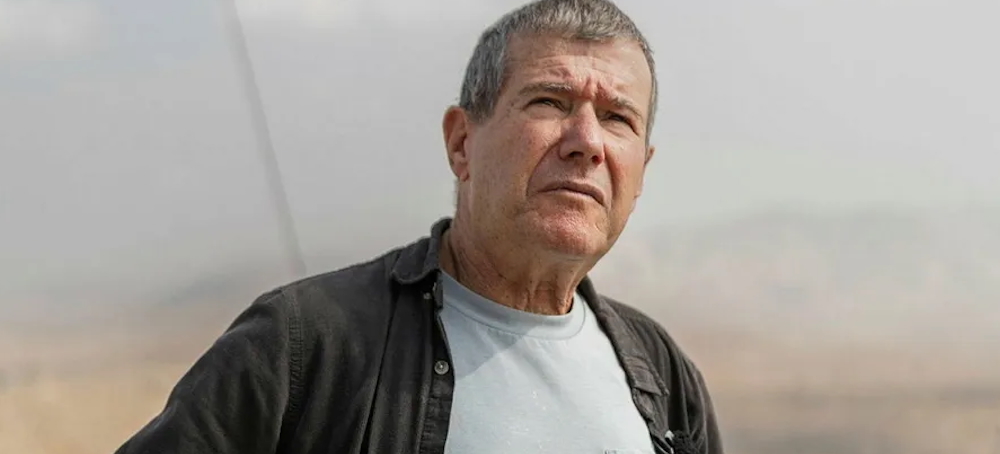 The group of former security officials, which has been growing in recent weeks, was founded by Maj. Gen. (res.) Eyal Ben-Reuven. “I realized this wasn’t the army I knew,” Ben-Reuven says. “If this continues, our country is heading for disaster.” (photo: Haaretz)
They Commanded Israel’s Army. Now They Protect Palestinians From Settlers
Noa Limone Haaretz
They were senior officials in the IDF, Shin Bet and Mossad who devoted their lives to Israel's security. Today, they are activists protecting Palestinians in the West Bank from troops and settlers. Have they had a change of heart? Quite the opposite
Feldschuh, 77, took part in the olive harvest as part of a new initiative launched in recent months by Maj. Gen. (res.) Eyal Ben-Reuven. Under its auspices, former senior figures from Israel's security establishment and business sector go out to protect Palestinians in the West Bank from settler violence. They include Israel Defense Forces major generals and brigadier generals, as well as former senior officials from the Shin Bet and Mossad – hardly the typical profile of human rights activists. Longtime activists who accompany Palestinian and Bedouin communities suffering from settler and soldier harassment and terror, and are often dismissed as "anarchists," are now receiving the backing of a group that can hardly be accused of subversion. These men are part of the security establishment itself, and they are taking to the field because they can no longer stand by and watch.
The initiative grew out of a one-man operation run by Maj. Gen. (ret.) Yaakov Or. For the past year and a half, Or has been taking former senior officials and other prominent figures on tours of the West Bank so they can see firsthand the cooperation between violent settlers in outposts and farms and the various arms of government. Or, 79, who held numerous positions during his career, including commander of IDF forces in the West Bank and Gaza and coordinator of government activities in the territories, says the experience comes as a shock to most participants. "They think they know what's going on, and they come back stunned."
Ben-Reuven, 72, a former Knesset member for the Zionist Union center-left party, took part in several tours and came away appalled. He felt compelled to act. He approached his friend Matan Vilnai, chairman of Commanders for Israel's Security, an organization that advocates a diplomatic arrangement with the Palestinians as essential to Israel's security, and proposed organizing protective-presence activities for its members and for those who had joined Or's tours and, like him, emerged ready for action. "They're old-timers," Or jokes. "They can no longer storm the fortress, but they still want to contribute."
Vilnai was supportive, and "people signed up on the spot," Ben-Reuven says. The group, which now has around 30 regular participants, is continuing to grow. Its members include former Defense Minister Moshe Ya'alon, former Mossad Director Tamir Pardo, former Knesset Member and General Amram Mitzna and former Mossad Deputy Director Amiram Levin.
"We don't come with guns, but with values," Ben-Reuven says. "If what we're seeing in the territories today isn't stopped, it will reach the Galilee, too," he warns. For him, helping Palestinians is tantamount to saving Israeli society from "the violence of ruthless criminals who are defeating every law enforcement body – the police, the Shin Bet and the army."
Don't you think this goes beyond "violence that is defeating" the authorities? In many cases, there is close cooperation between settlers, the police and the army. You commanded a division in Central Command. You know how things are supposed to work.
"For me and my friends, the army is home. It's an institution we love, where we grew up, where we educated and were educated. The values of combat are essential to its strength. When I go to the West Bank and see that the sovereign authority is failing to fulfill its duty, it hurts me personally. When soldiers wear masks, I find it insulting. I fought for 35 years in Lebanon, Gaza and everywhere else. We never wore masks. We didn't need to. We weren't afraid of the Hague."
During a recent visit to Jalud, as part of an effort to ensure that the army complied with a High Court of Justice ruling allowing a family to return to its home after it had been attacked, he watched as the army was driven out of the area in humiliation. "I realized this wasn't the army I knew," Ben-Reuven says. On another visit, to Burin, he saw army vehicles driving through the center of the village and throwing stun grenades for no apparent reason. "There are children and women there. What are you doing?" he asks. "If this continues, our country is heading for disaster."
Last month, early one morning, the group gathered at a meeting point in Rosh Ha'ayin. During a brief round of introductions, each participant gave his name and rank. Alongside the senior officers, many of them fighter pilots ("I'm beginning to feel like I have an entire air squadron," Ben-Reuven remarked), there were also several activists from the Looking the Occupation in the Eye organization and two international media crews.
Ben-Reuven opened with a short briefing. First, he announced that the original plan – to help with the olive harvest in Burin – had been changed because the village had been sealed off, with no entry or exit permitted. The new plan was to drive there, speak with one of the residents and look for another location where they could help with the harvest. He then outlined the objectives of the operation. As in the military, they were divided into three parts: "To send a message to the Israeli public and the world that there are people in this country who think differently from these criminals in Judea and Samaria"; to help Palestinians; and finally, to support solidarity activists as well, "the holy people who are out there on the ground all the time."
Ben-Reuven then asked which of the veterans was carrying a weapon. It turned out he was the only one. He considered this an advantage. "We don't engage in confrontations," he emphasized, laying down a hard-and-fast rule. "This is a group of people who have to act against their natural instincts and not charge into battle," he said, except in cases of life-threatening danger. "If someone comes running at you with a knife, I'll shoot him," he promised, "but we're not going to start a civil war." Their real strength lay in the contact list on his phone: in an emergency, he could call the head of Central Command, the divisional commander or the head of the Civil Administration directly.
After running through a few more ground rules (travel in convoy, don't split up, Ben-Reuven is in command in the field and his instructions must be followed), we divided into cars and set off. We joined the car of Brig. Gen. (ret.) Shaul Shefi, 81, a helicopter pilot who had, among other positions, commanded Palmachim Airbase. Sitting beside him was Prof. Eran Dolev, 87, an internist and retired brigadier general who had served as the IDF's chief medical officer.
Their previous operation had taken place in Khirbet al-Tawil, east of Aqraba, which had been cut off from its water supply for two months. Settlers had severed the main water pipe leading to the village, then broken the locks on its water cisterns and emptied them. Territorial defense troops accompanied them. The group helped residents bring in water tankers and refill around 40 cisterns. "We were ashamed," Dolev says of the experience. On another occasion, they visited a house in Qusra that settlers had demolished. Their presence enabled the owner to repair it, he told them. "They [the settlers] see us and they're more careful," Shefi says. "But we'll see what happens today."
They were familiar with the rampant Jewish terrorism before going into the field, but were surprised by the extent of the cooperation between the Civil Administration, the army and the police and the perpetrators. "It's not just cooperation," Dolev stresses. "It's a policy dictated from above."
"When the settlers cut the water pipe, the army declared the area a closed military zone, making it impossible to enter and repair it," Shefi explains. "And after they also cut the power line and the local council brought in a crane to fix it, the Civil Administration confiscated the crane."
I recently went back and read Smotrich's 2017 "Decisive Plan" for a full takeover of the West Bank. It seems the first stage has already been implemented: accelerated settlement construction in farms and outposts and the displacement of Palestinians from Areas B and C to prevent any possibility of an independent entity emerging.
"You were right to read it," Dolev says. "It wasn't read enough at the time. A huge mistake. Just as people didn't read Mein Kampf."
Despite their fierce criticism of the reality in the West Bank, these former security officials turned activists remain fundamentally committed to their faith in the IDF. Shefi is among those who used to cancel his subscription to Haaretz whenever Gideon Levy published an article that angered him, including his famous piece from 2014, lashing out at fighter pilots. He has since kicked the habit during the current government's tenure, but when I steer the conversation away from the West Bank and toward Gaza, his criticism of the army becomes more qualified. "Bibi has to go," Shefi says.
Is Bibi the only problem?
"Our army is different today," he admits, "but it's also true that the terrorists fight from behind civilians. I know that great care is taken, at least in our corps. As for what the rabbi does with the D9 bulldozer, I don't know. And I feel enormous pity for them, but they bear responsibility for their situation."
Dolev is more willing to criticize. "It's understandable that we started out with wild revenge, but the fact that revenge has become the guiding principle is very serious."
Asked whether what they encounter in the field has prompted any soul-searching about their own military careers, both reject the idea outright. "Everything I did was perfectly fine," Shefi says. Dolev explains: "We weren't in this army. There wasn't a single incident in which I abused an Arab or stole anything, and neither did any soldier under my command."
Nevertheless, he acknowledges that the seeds of what followed were already visible in 1967. After the Six-Day War, he took part as a medic in a trip to the Jordan Valley organized by Maj. Gen. (res.) Avraham Yaffe, who later headed the Israel Nature and Parks Authority and was one of the founders of the Movement for Greater Israel. Dolev recalls sitting around a campfire that evening when the conversation turned to politics. He shared his hope for peace in exchange for territory. "Yaffe said to me, 'Tell me, how did they even admit you to medical school? You're pretty stupid. We'll never give them anything back.' I went home depressed because I realized I wasn't part of the consensus. Since then, I've known I'm talking to myself."
Even so, he never imagined how far things would deteriorate. When Prof. Yeshayahu Leibowitz, his lecturer during medical school, spoke of "Judeo-Nazis," then-Maj. Dolev was deeply offended. "I couldn't understand how he could say such a thing about Jews after the Holocaust. 'The prophet Yeshayahu Leibowitz – you were right!'" he exclaims now.
Do you still have hope?
Shefi: "Yes, but I'm very worried. Not for ourselves, because we're already past our sell-by date, but we have children and grandchildren. I keep thinking about the book 'Alone in Berlin.' One day, when my great-grandson asks me where I was when all these atrocities were happening, I'll be able to tell him that I did the little I could – for his sake. So that he could live in a just and fair society, where everyone has the same rights."
The car passes Nablus' Luna Park, an amusement park whose faded rides seem to have been dropped there from another era. Further along, on the road near Har Bracha, there is a high concentration of signs reading "Messiah," some of them in Arabic. Dolev, ever the quizmaster, poses a riddle: "Who was the only government minister to turn down an invitation to visit the Lubavitcher Rebbe in New York?" It turns out to have been Avraham "Beiga" Shochat.
"They've contributed nothing to building this country apart from farms and outposts, and now they're waiting for the Messiah to arrive," Dolev says.
When we arrive at the entrance to Burin, we're greeted by Bashar Eid, the man we were supposed to help with the olive harvest. He is standing beside the yellow gate, which has been closed for a week. "What happens if someone needs to get out of here urgently to go to the hospital?" someone asks. The question hangs in the air. According to Eid, the army closed the gate on the grounds that youths from the village had thrown stones at Route 60. "Nobody threw stones," he says. "They closed it because that's what the settlers want."
Eid is 54, but his walking stick makes him look older. A year ago, settlers from Givat Ronen attacked him and the Looking the Occupation in the Eye activists who had come to help him with the olive harvest. He has been unable to work ever since because of his injuries and is struggling to pay for his daughters' university studies. The activists have raised money to help support the family.
Itay Eyal, a Looking the Occupation in the Eye activist accompanying the former security officials, was also injured in the same incident. "We'd been harvesting for about two hours when suddenly a swarm of 15 to 20 masked settlers appeared, wearing white Shabbat shirts.," he says. "They came running down from their outpost. We didn't stand a chance."
"When soldiers wear masks, I find it insulting. I fought for 35 years in Lebanon, Gaza and everywhere else. We never wore masks. We didn't need to. We weren't afraid of the Hague."
Eyal was injured while shielding another activist whom a settler had attacked with a club. "She was lying wounded on the ground, and when I rushed over to her, I was hit by a rock in the elbow. Another activist was hit in the head, and Bashar's leg was broken," he recounts. "We waited a long time for the army to arrive, but the Palestinian ambulance got there quickly and treated us on the spot. When the army finally arrived, they blamed us, even though they could see we were injured," he says. Eyal says the activist who was hit in the head had just returned from reserve duty in Lebanon. "When he showed the soldiers his dog tag, it made no difference. They told him he deserved it."
Burin has a long history of settler violence and harassment, but the situation has deteriorated even further recently. "This government wants all our land," Eid says. He describes a settler who regularly comes to his house, tells him the land belongs to him and orders him to leave. Eid's family has lived here for generations, for hundreds of years. Asked whether the settlers' harassment has made him consider leaving, he replies: "No, no, never. Not ever."
Now the group faces a dilemma: Should they walk into the village to see the houses attacked by settlers, or head to another location in the hope of helping with the olive harvest there? One of Ben-Reuven's considerations is that if the army is indeed responsible for closing the gate, he does not want to disobey its orders.
Meanwhile, an army pickup truck arrives carrying uniformed men. The group wonders whether they are reservists, settlers or territorial defense troops. It's hard to tell, but most guess the latter. Ben-Reuven approaches to introduce himself and is met with shouting and insults. "It's absurd and it's painful," he will later say of the humiliating treatment.
When it becomes clear that olive harvesting is possible in Duma, the group decides to head there, but not before several participants buy olive oil in Burin. "You should get some. It's duty-free prices," jokes Prof. Uri Bar-Joseph, 77, a scholar of Israel's wars. He joined the operation and also volunteers to drive Palestinian children to hospitals, "because it's the right thing to do, and it's what I can do." He is surprised that it is former military officers, rather than intellectuals or academics, for example, who have come together to organize protective presence activities. The phenomenon, he says, is "encouraging and depressing at the same time."
On the drive from Burin to Duma, the conversation in Shefi's car shifts from one subject to another. They talk about getting older, and Dolev complains that his daughters-in-law, who are themselves volunteers in the territories, are concerned about him. "They're worried about me," he says, "the grandfather." They also discuss racism toward Arab citizens of Israel. "If they went on strike for just one day, the entire health care system would collapse," Dolev says. Then they joke about Foreign Minister Gideon Sa'ar: "But he did do one good thing. He appointed Gali Baharav-Miara, the president of the State of Israel."
"I'm not sorry I served in the military," Dolev suddenly returns to an earlier conversation. "You're asking whether I'd stay in the service for even one day today? No. It's a completely different army. It's gangs."
As we pass Tapuah Junction, a reminder emerges of the differences between this group and most activists. We look at a row of tattered Israeli flags lining the road, and Dolev is appalled by their sorry condition, not by their presence in an occupied territory.
"I'm an unequivocal Kaplan protester," Shefi says. "But at the demonstrations, the people who showed up with signs about the occupation annoyed me. The point of the protest was to change the government in Israel."
Dolev agrees. "Don't get me wrong," he says. "I've been against the occupation from the beginning. But bringing it up at Kaplan divided our forces. Yair Golan didn't talk about the occupation during the election campaign either, so as not to drive people away from [Gadi] Eisenkot."
But do you see the connection between the occupation and the erosion of democracy?
"Of course," Dolev says, "but it's wrong to mix the two in this campaign."
Duma is a place still gripped by trauma. In 2015, the horrific attack took place here in which a settler, Amiram Ben-Uliel, torched a family's home, killing Saad and Riham Dawabsheh and their 18-month-old son, Ali. His defense attorney was Itamar Ben-Gvir.
Two years ago, some 200 settlers descended on the village, setting fire to homes, cars and agricultural equipment and attacking residents. According to eyewitness accounts, they were masked, some armed and some in uniform. Soldiers were present and even accompanied the assailants.
Duma has been inhabited for thousands of years and appears on maps dating back to the fourth century C.E. Most of its approximately 2,500 residents are farmers who harvest olives and dates. A few earn their living doing manual labor in Nablus or Jericho. In the past, some also worked in Israel, but no longer. Much of the village's eastern land has been confiscated for the Nahal Petza'el nature reserve, and Duma has no direct connection to other villages. It is surrounded by a deep ravine, and three outposts have been established within its boundaries: Giborei David, Michtam LeDavid and Gal Yosef.
In the past, there were three roads into the village. Today, only one remains, and even that is subject to settler terror. "It's terrifying," says Sharon Casper, a human rights activist who meets us at the entrance to Duma. "Settlers might show up and spray pepper spray or beat someone up. There might be a roadblock, or soldiers – some of whom behave decently and some of whom don't." When the village is sealed off to incoming and outgoing vehicles, as it was after October 7, she says, it is effectively under siege.
Giborei David is considered the most violent of the three outposts established within the village's boundaries. "They have a local security squad, and the boys walk around with automatic weapons. There are countless complaints against them for beating children, elderly people and women. They even hit my puppy," Casper says.
The outpost was established about a year ago on privately owned land belonging to Duma residents and is named after David Libi, a civilian contractor who worked on demolishing homes in northern Gaza and was killed in an explosion there. When it was being established, a Duma resident was shot dead by a settler as villagers tried to reach their olive grove. They have not returned since.
Uri Bar-Joseph, a scholar of Israel's wars, is surprised that it is former military officers, rather than intellectuals or academics, who have come together to organize protective presence activities. It's "encouraging and depressing at the same time," he says.
According to Casper, the southern outpost, Gal Yosef, is made up mostly of territorial defense personnel. "When something happens and we call the army, they tell us the army is already there. But who's there? A bunch of intimidating new settlers."
The Bedouin communities living in the area east of Duma have been expelled and displaced several times in recent years. Some of their members now live on the outskirts of the village. "These are the worst houses," Casper says. "Some are illegal and therefore demolished, while others are frequently attacked by settlers. The children are still wetting their beds since they were displaced, and they continue to live in fear. The settlers are the new sheriff."
Casper has been living permanently in Khirbet al-Marajim, a tiny village near Duma, since January. It has been gradually emptying out, and today just five families live there, crowded together. "Settlers who arrived in the area a month ago tell them, 'Get out of here, this is our land,'" she says. Eyal recounts an incident there six months ago, when settlers entered one of the village's homes and beat the family. "We arrived a few days later, and during a conversation someone said the word jaysh [army]. A 3-year-old boy heard it and raised his hands. That's a memory that stays with me."
We stop outside a vegetable stand in the village. It's difficult to find a family willing to risk harvesting olives, even with 20 Israelis present. The residents do their best to host us, offering pears and figs picked straight from the trees. After about half an hour, we find a brave enough family, and drive to its grove on the outskirts of the village. To enter the grove, we have to remove a stone barrier that has been placed across the way. Three Palestinian women hurry to harvest the olives. Two of them climb the branches with practiced ease, while the group members help using small plastic rakes. There are only a few tarps to collect the ripe olives. The trees are laden with fruit, but most of it will probably dry up. The trees being harvested now are a drop in the ocean – just two or three in total.
We've been there barely half an hour when a young settler appears on the opposite hill, herding a flock of cows and watching us. A moment later, a Ranger vehicle appears on the ridge. The Palestinian women immediately panic and call for everyone to pack up. "I'm very scared," one of them says in English. "Khalas, khalas, ya rabbi!" she cries, her face terrified. Another woman calls out in Arabic, then in English: "Home! Home!" "I've never seen fear like that," Bar-Joseph says. "It's heartbreaking."
We begin folding up the tarps when the teenager approaches, a phone pressed to his ear as he reports our presence. "Nobody's leaving. They have no way out," I hear him say. He approaches the harvesters and roughly shoves the oldest Palestinian woman, who has a sack of olives on her back. He won't leave her alone. Eran Ehrlich, a Looking the Occupation in the Eye activist, positions himself between the boy and the woman and tries to move him away from her. The teenager immediately shouts, "Don't touch me!" and unleashes a stream of curses. Feldschuh points his folded walking stick at him in warning, lightly touching him with its tip. "Get out of here!" the others shout. After several minutes of aggressive behavior, the teenager storms off.
But the incident isn't over. A few seconds later, the teenager returns accompanied by a settler in a Ranger, who spends several minutes shouting and hurling abuse. "Why are you hitting a 15-year-old kid, you idiot? You're all scared when a real man shows up, huh?" Ben-Reuven tries to speak to him calmly, but this only seems to make him angrier. "You insolent bastard, when you're in a nursing home, he'll be serving in a combat unit, protecting your life," he yells at Ben-Reuven. "You moron, I lost friends in Gaza. Why are you hitting a 15-year-old kid?" he repeats.
"Why is he hitting a 60-year-old woman?" someone shouts back.
"And what if it were your son?" the settler continues.
"And what if it were your mother?" comes the reply.
Meanwhile, the olives are loaded into a vehicle before the settlers can steal them. The Palestinian women climb into one of the convoy's vehicles and hide there until the incident ends, about two hours later. I look at their faces and see sheer terror.
A PBS cameraman is shoved by the teenager and falls backward. "This is the social product of an environment combining a sense of superiority, lawlessness and entitlement," Bar-Joseph says, "wild growth cultivated by the government."
A few minutes later, the army arrives. All the soldiers are masked, and several have messianic patches on their sleeves. They ask whether we're all Israeli and inquire about the presence of foreign journalists. More settlers approach from the other side of the path. Ben-Reuven asks the group to stay put – "Let the army handle this." The soldiers do approach the settlers, but only to hear and automatically accept their version of events. It is, as we hear at the time and as is later published on settler social media accounts, entirely false. The veterans are "extreme leftists," the olive harvest is a "provocation," and the elderly Palestinian woman "got close to the boy from the farm and started pushing him" after the activists "realized there were no cameras." The supposedly innocent teenager merely tried to move his attacker, after which he was subjected to a "lynching" involving "punches, kicks and beatings with clubs."
No one asks us to give a statement, although several of us offer to provide testimony and even show video evidence. Suddenly, amid the commotion, two reservists recognize Ben-Reuven, who used to command them, and approach him to speak almost in whispers. But the conversation is cut short: Their commander forbids them from speaking to the suspect. "Look where we've ended up," he says. "Everything is insane."
The wait at the scene is long, and the midday sun is scorching. The water we brought with us runs out, but no one complains. I use the time to talk with Brig. Gen. (ret.) Iftach Spector, 86, one of the Israel Air Force's leading jet-fighter aces, considered one of the finest fighter pilots ever to have served in the force. Spector is also known for the 2003 "Pilots' Letter," which protested IDF operations in the territories. His manner of speaking is gentle and soft, but his predictions are bleak. "In the long run, our fate is sealed," he says.
You mean that it will be impossible to dismantle the outposts that have been legalized?
Spector: "Let's assume the most optimistic scenario. Someone evacuates a settlement? There'll be a civil uprising. We're heading toward civil war, and they're armed. Weapons have been distributed to them. Not to us. And the army isn't ours, not all of it."
Not everyone here agrees with you. Some might say you're being too pessimistic.
"It's logical thinking: If a third or more of Israelis thought as we do, perhaps things could be fixed. But when a third of your body is infected with cancer, you're not going to make it."
Spector remains adamant in his bleak assessment even after the elections. "There will be no positive change in the near future," he says of Jewish terrorism in the West Bank. "Even if a government of change comes to power, it will act hesitantly, because it won't want to alienate a third of the country."
Ben-Reuven is less pessimistic. "As soon as there's a government that sets a policy and an action plan and reestablishes a Jewish Division in the Shin Bet, things will change, even if it takes time. Senior IDF officers have told me explicitly: 'We can deal with Jewish terrorism and stop it. To do so, we need political backing that will allow us to use force.' I'm convinced that under a government led by Eisenkot and Golan, both of whom I know very well, the directive will be completely different. Eisenkot will deal with this because he understands perfectly well that it's an existential threat to the state."
Meanwhile, the farce continues in Duma. A local security coordinator, apparently from Giborei David, arrives and starts issuing orders to the soldiers. The settler in the Ranger who shouted at us earlier walks among the group, photographing everyone. One activist says this is standard practice, and that settlers often obtain personal details about the people they photograph shortly afterward, including their home addresses and places of work.
The police arrive, too. Some of the officers are masked, and their uniforms bear an insignia of a skull and two crossed swords. They first arrest Ehrlich. Then they ask Feldschuh to get out of the car and detain him as well, on suspicion of assault. After being read their rights and subjected to body searches, the two are put into an armored vehicle and taken to the police station at the Binyamin regional headquarters. In a phone conversation two days later, Feldschuh will recount that the vehicle stopped midway through the journey and he was ordered to get out so that his hands could be cuffed. When they arrived at the station, both men had their legs shackled as well.
"Isn't it clear who attacked whom here?" Ben-Reuven complains in a phone conversation the following day. "We came to pick olives, not to attack anyone. This is a modus operandi that has developed between these terrorists and the police and army: They automatically accept the settlers' version of events. And now they've arrested a fighter pilot, a former El Al CEO, a man of extraordinary stature."
The rest of our group also heads to the police station. On the way, they discuss the need to reinstate administrative detention for Jews. "They should have arrested all of them, and instead they're walking around free," Shefi says. "Smotrich is the defense minister here," Dolev adds. "We got a pretty good demonstration of just how much the army grovels."
In the parking lot outside the station, a security guard approaches us. When he notices Eyal's Looking the Occupation in the Eye T-shirt, he curses at us. Ben-Reuven, Spector and Bar-Joseph go inside to give statements. The others wait outside. After a long wait, Spector emerges and tells us what happened inside. "At first they spoke to us in a very humiliating manner," he says. "Then one of the investigators recognized me. His brother-in-law, who was killed, had been a pilot under my command. At that moment, the whole atmosphere changed. Hugs and kisses, the detainees' handcuffs were removed, and we were told the investigation would move quickly. Everything here is personal," he concludes. Feldschuh and Ehrlich were released that evening on bail of 1,500 shekels each, on condition that they stay out of the West Bank for the next two weeks.
Back in Tel Aviv, it's impossible not to wonder whether the operation helped Duma's residents or instead caused them harm. The olive harvest yielded very little, and the confrontation with the settlers may have fueled their desire for revenge. Casper reports that after we left, the army closed off the village, which meant it was relatively protected. Another group of activists came and managed a small additional harvest there. They were accompanied by a British journalist who had been detained at the airport earlier that day. "I was very anxious," Casper says, "but the 'main' settler was at the police station with the boy, so there were no further incidents."
As for the harvest itself, she says this is the situation regardless. "In other villages, there's no olive harvesting at all this year, and when activists come, a limited harvest becomes possible. Two trees in two hours is considered excellent," she reassures us. "You need 20 former officers around you just to make sure it doesn't end with Palestinians being arrested," she adds. "What they did there, confronting a violent settler – that's impossible for us. We're not allowed to touch them. All we can do is run away and film."
As for the concern that the incident might provoke retaliation, she acknowledges that the fear is real. Nevertheless, she says, "Duma has become such a hell in recent years that it hardly makes a difference anymore." Still, she agrees that it would have been better to avoid physical contact with the attacking teenager. "We usually manage to help a woman who's being attacked without touching the assailants, and even defuse the situation. It's possible that the next time we encounter that boy, he'll be even more intent on revenge. There's something about this testosterone-fueled cycle that keeps us trapped. But when a brigadier general gets arrested in your village, it brings media attention, and that has significant value."
Ben-Reuven reached similar conclusions. He believes the group was too large and that they should have avoided physical contact with the young settler. Since they are military men of the old school, they conduct a brief debriefing and draw lessons after every operation.
In a phone conversation, Feldschuh describes his interrogation in a matter-of-fact tone. "What's happening there is usually much worse," he reminds me. "The people need to wake up and understand that we have to separate from the Palestinians, who just want to live their lives. We need leadership, and it doesn't exist. The only one who comes close is Golan. Right now, there's no one to restore order. The chief of staff can't even get rid of the messianic insignia. It's total anarchy. It's night and day compared with how things used to be. The soldiers who arrived in Duma recognized Eyal, and that didn't stop them from reporting that we were a bunch of anarchists."
With respect to the army's conduct in Gaza, Feldschuh, like most of the group, has mixed feelings. "I believe the air force acted professionally and according to established criteria, but on the ground you have [Avraham] Zarbiv," he says, referring to a rabbinical judge who served as a bulldozer driver in Gaza and boasted about the destruction in the Strip. "The conduct was probably not clean.
"It's true that this is a war, but it's hard to ignore the number of children killed. The incitement from above fell on fertile ground. I have no doubt that if you compare 'the purity of arms' today with what it was during the Six-Day War, it's like night and day. 'We shoot and we cry' has been replaced by 'Why didn't we kill them all?'"
Has what he sees in the territories prompted any soul-searching about his decision to pursue a military career? Feldschuh says his career was never planned; it simply unfolded. He doesn't regret it, "but I'm not sure I'd do it all over again today." He also expresses some remorse: "For not having been political enough in the past."
The arrest will not deter him from returning to protective-presence activities. "I'm named after my grandfather, who was shot in Belarus and thrown into a field. I grew up hearing stories of abuse and indifference to it. I cannot stand by and watch injustice."