
There Have Been 50,000 Alleged War Crimes in Ukraine. We Worked to Solve One
Tim Mak NPR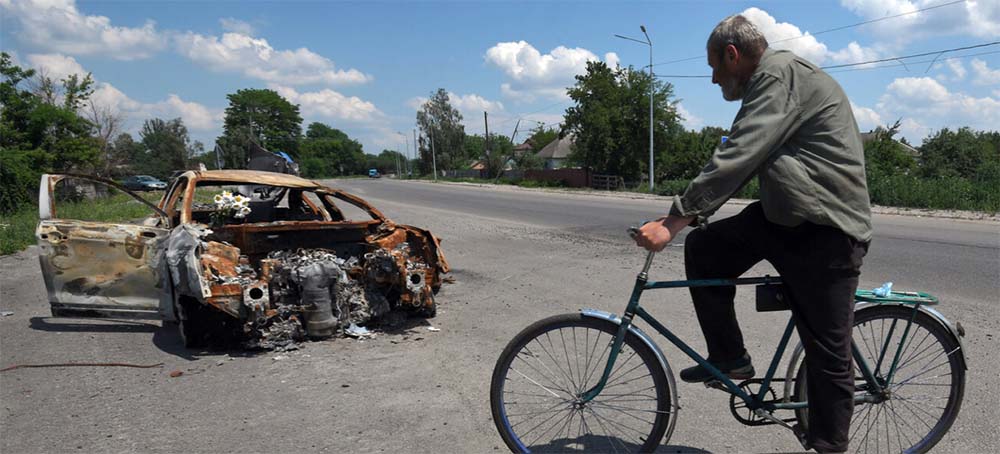 Oleksandr Breus, a Ukrainian and onetime French legionnaire, was killed next to his car during the Russian invasion. Oleksandr Holod, who says he witnessed it from his window, describes events as he rides his bike past the charred remains of the vehicle near Nova Basan, Chernihiv Oblast, Ukraine on June 28. (photo: Carol Guzy/NPR)
There Have Been 50,000 Alleged War Crimes in Ukraine. We Worked to Solve One
Tim Mak NPRIt was just a story, about a possible war crime, committed in the first days of the Russian invasion into Ukraine. The victim was a Ukrainian man, allegedly murdered by Russian soldiers and left dead in the street next to his blown-up car, near a place called Nova Basan.
At first the story about this man stood out because it was different. He'd apparently been a member of the French Foreign Legion at some point. And perhaps, I'd thought, that could mean clues and investigations — maybe even consequences — far beyond the tiny village where he died, 50 miles northeast of Kyiv.
But as I spoke with investigators and human rights advocates about this case and many others, I came to see, as they have, just how elusive justice could be for any of the 50,000 alleged war crimes in Ukraine.
Giorgi Gogia, a Human Rights Watch investigator who first told me about the case, said he'd been documenting so many crimes he didn't have time to investigate this case any more.
And Oleksandra Matviichuk, who heads the Center for Civil Liberties, one of the recipients of this year's Nobel Peace Prize, said she had started thinking of war crimes as mere statistics.
"I started to use numbers instead of names," she said.
I wanted to focus on a name instead of a number, to put a face to all the apparent crimes but also to gauge whether justice is possible. If I could solve even one murder — learn about the victim, what happened, who was responsible — maybe it would reveal how likely accountability is for all of them.
To understand that story, I decided again to focus on just one — the story of the dead man in the street, near Nova Basan.
The villages of Nova Basan and Bobrovytsia
I first visited Nova Basan in May, about a month after Ukrainian forces liberated the village from Russian control. It was a small community, surrounded by farmland, with a population of fewer than 3,000.
Before the war, families would leave their homes in Kyiv to spend their summers there.
Now, the burned-out hulls of Russian tanks lined the road.
It wasn't hard to find the scene of the killing: Everyone in the village knew where it was. Two men standing near an abandoned tank gestured down the road to where the man's car still sat along the highway, like a memorial to the violence inflicted by the Russian invasion in late February.
The car, a French-made Citroen, was a sickly white color, badly burned, with incinerated parts lying haphazardly around. Much of the front of the car was gone, torn away by an apparent explosion. Rust had begun to set in.
And the man's body was no longer there.
We headed into the center of the village, past the destroyed local café and a looted supermarket, to the town hall to see local administrator Mykola Dyachenko. In his office, where the window still had a bullet hole from the fighting, he told me what he knew.
It wasn't much. The man was killed as Russian forces entered the village on Feb. 28, Dyachenko said. He had, indeed, been a French legionnaire at one point, but he'd served his contract and returned home to Ukraine before the war began.
Dyachenko didn't know the dead man's name, but he knew his mother, Oksana Breus. She lived in another village, Bobrovytsia, about a 30-minute drive away. She invited us over to discuss her son.
When we arrived, she welcomed us into her home and put a photograph of her son on the table between us as we sat in the kitchen.
Her son's name was Oleksandr, she said. Oleksandr Breus. He had been killed in the first week of the war at the age of 28.
"He was going to Kyiv to pick up his sister and his fiancé. He wanted to take them to France," Oksana told us. She didn't know the details about how he died, and said she didn't want to know. But she had a video of the scene, taken the day of Oleksandr's death, which had circulated on social media.
She played it for us, then started to cry.
The video showed the same burned-out car we'd seen earlier, with a large hole in the back door on the driver's side. The camera pans right to show a man's body on the ground by the car, his right arm curled across what remains of his head. It looks like an execution.
"The Russians drove through, damn it," said the man recording the video. "Poor thing."
Oksana was too distraught to continue talking and suggested that we talk to Oleksandr's sister for more details. As she showed us out, walking into the yard, she stopped to show us one more thing.
It's a German shepherd with sad eyes, sitting inside an enclosure — Oleksandr's dog, Clifford.
"Such a handsome dog," she said. "Do you see how much he misses him?"