
The US Government Is Pillaging Our National Forests From Within
Greg Frazier The Hill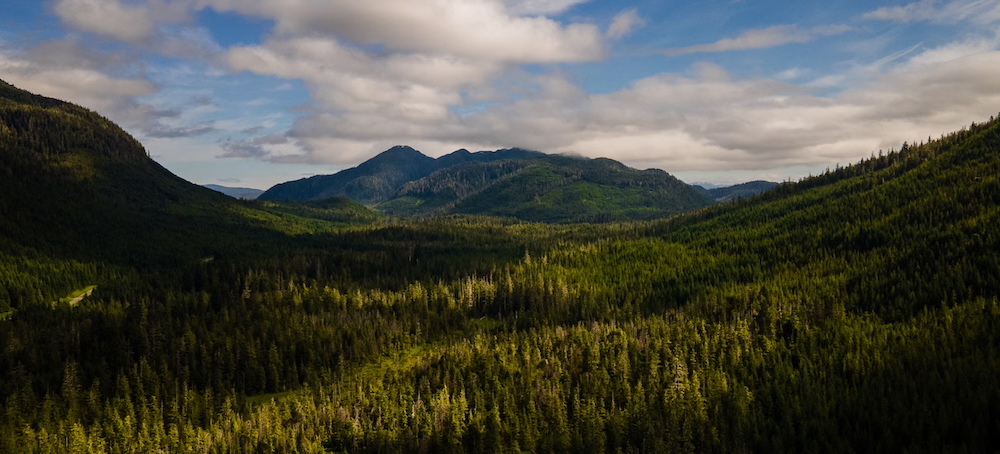 Tongass National Forest in Alaska. (photo: WP)
 The US Government Is Pillaging Our National Forests From Within
Greg Frazier The HillThat is sophistry — a failed attempt to justify an ill-advised, destructive reorganization plan to remove Forest Service headquarters from Washington and radically cut its research infrastructure.
Her fallacy implies that adjacent communities have a superior claim on national forests. By Rollins’s absurdly flawed logic, someone living near an airport should deserve pilot’s wings, or a person near to a courthouse a law degree. Forest Service professionals earned their expertise from years of education and experience — none of them came by it simply living next to trees.
If the reasoning were sound, Rollins would want those professionals in Washington, rubbing shoulders with other experts making public policy, but that would defeat her true aim. Sound forest policy doesn’t drive her agenda; glib, simplistic talking points disguise a proposal to gut the agency and turn public assets into private-sector money-makers. It is hand in hand with her plans to reorganize the whole department into oblivion.
Government nihilists and dismantlers have for years peddled the “proximity begets policy expertise” canard, without evidence. It’s the threadbare mantra the America First Policy Institute reached for when it fired its broadside at federal workers while Rollins was its head, between her job in President Trump’s first term and her current role.
“It’s time to downsize government. That’s a top-of-the-list priority,” she said after settling into office. Rollins aims to downsize by reorganizing — extreme ideology drives the Forest Service plan, not public support.
Like her proposal to unmake her department’s farm program delivery agencies, the Forest Service proposal is wildly unpopular, according to its own evaluation of public comments. Eighty-two percent oppose it; only 5 percent are supportive. Lawmakers’ verdict: “half-baked.” The Department of Agriculture’s food safety and nutrition assistance units are in her sights, too.
Secretary Sonny Perdue, Trump’s first secretary of Agriculture, moved key elements of the Agriculture Department’s research offices from Washington. It was a “nightmare.” Critical research was delayed or entirely halted. Valuable researchers left the department. One former employee said, “The agencies have been decimated and their ability to perform the functions they were created to perform — it doesn’t exist anymore.”
Non-white workers were hit especially hard by Perdue’s moves. The number of Black workers fell from almost one-half of the workforce to less than 20 percent, foreshadowing the agenda of one of the Cabinet’s most zealous anti-diversity crusaders.
The Perdue experiment hasn’t cautioned Rollins — it is her template. She has stopped, then erased, research she finds politically objectionable. Now she aims to shutter three-fourths of the Forest Service research facilities and strip millions from their budgets. That is not organizational efficiency — it is forest science extinction.
Meanwhile, Tom Schultz, the chief of the Forest Service, made clear his lingering allegiance to his former employer’s interests. Last month, he laid them out to House appropriators: “timber sales, critical minerals permitting, grazing allotment management.” That timber, he said, is “vital to the nation’s well-being.” In reality, only 6 percent of the total timber supply in the country comes from national forests.
Schultz testified that the country needs to increase energy production from Forest Service lands to ensure “a stable supply of energy for current and future generations.” But just 1 percent of the U.S. oil supply, and less than one-half of 1 percent of its natural gas, comes from national forests.
Recreational benefits from the Forest Service’s lands dwarf the value of resource extraction — more than $12 billion annually, according to the agency’s own research. Yet protecting environmental quality is an after-thought to the current administration.
National forests are just that: national, not neighborhood, assets. For more than a century, federal law has held them in public trust, to be managed to benefit the whole country.
Trump wants the NFL Hall of Fame to induct Teddy Roosevelt, to recognize his effort to improve the game’s safety to save it from extinction. If only saving the country’s forests from extinction were as important as football to the president, secretary, and the chief.
They should take a page from Roosevelt himself. In his eighth annual message to Congress, he admonished: “If there is any one duty which more than another we owe it to our children and our children’s children to perform at once, it is to save the forests of this country, for they constitute the first and most important element in the conservation of the natural resources of this country.”
While he was the Agriculture Department’s chief of staff, Greg Frazier led the team that negotiated the deal ending the last long-term timbering contract on the Tongass National Forest.