
The US Criminal Justice System Is Failing Sexual Assault Survivors. It Needs a Feminist Overhaul
Arwa Mahdawi Guardian UK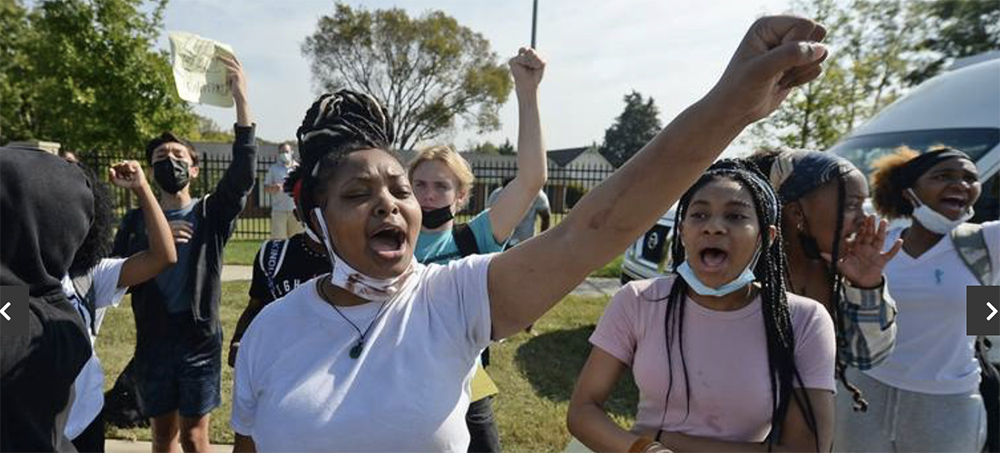 They demanded more protection after a teenager was charged with the rape of an Olympic student last month. (photo: Jeff Siner/Charlotte Observer)
The US Criminal Justice System Is Failing Sexual Assault Survivors. It Needs a Feminist Overhaul
Arwa Mahdawi Guardian UK
A woman in Kansas has had to recount her rape story to strangers and collect hundreds of signatures to get the legal system to take her seriously
Here’s a fun fact about consent: once you say “yes”, you can change your mind! Saying “yes” at the beginning of a sexual encounter doesn’t mean you give blanket permission for someone to do whatever the hell they like to you. Consenting to sex with someone doesn’t mean you automatically consent to being violently choked.
I shouldn’t have to say that, should I? That should be obvious to anyone with a brain. However, it seems the US legal system, which is supposed to be at home with complexity, has a problem understanding the fact that consent isn’t simply a matter of a one-off “yes” or “no”. The latest infuriating example of this being the case is that of Madison Smith, a former student at Bethany College in Kansas.
Back in 2018, Smith hooked up with a classmate called Jared Stolzenburg. To begin with, the sex was consensual. Then, Smith alleges, Stolzenburg started to choke her. “I tried to initially pull his hands off of my throat, and he squeezed harder every time,” Smith said in a court hearing reported by the Washington Post. “He would strangle me for 20 to 30 seconds at a time, and I would begin to lose consciousness. When he would release his hands from my neck, the only thing I could do was gasp for air.” She couldn’t, in other words, clearly announce that she was immediately revoking consent.
Smith reported what happened as a rape. The county prosecutor, Gregory Benefiel, decided that, actually, it was an “immature” sexual encounter. Benefiel told Smith’s mother in a recorded conversation that the case was complex because Smith didn’t verbally withdraw consent; Smith pointed out that she couldn’t breathe, let alone speak. Stolzenburg, for his part, has denied raping Smith, and said he was just trying out a “sexual kink” he’d seen on the internet. “I thought it would be something to try, and I was stupid to try it,” he told the BBC. In the end Benefiel did not file a sex charge against Stolzenburg but charged him with aggravated battery. In 2020 Stolzenburg was sentenced to two years’ probation and required to pay $793 to a victims’ compensation board.
Unsurprisingly, Smith wasn’t happy with the decision not to file a rape charge. She wasn’t happy with the fact that the prosecutor was essentially saying that you can’t be charged with raping someone if you make sure to shut them up first. What sort of precedent does that set? What sort of message about consent does that send?
Smith refused to give up. The traditional legal system had let her down so she turned to a 134-year-old Kansas law that allows citizens to petition for grand juries when they think prosecutors are neglecting to bring charges. Only six states in the US have a law like this; it has been used sparingly and this is believed to be the first instance it has been used in a sex crime charge. The jury can’t decide whether someone is innocent or guilty; they can just decide whether charges should be brought.
Convening a grand jury isn’t easy: you need to gather hundreds of signatures in support just to kick the process off. So Smith had to stand in a hair salon parking lot, tell strangers her story, and get them to sign a petition. On Wednesday, the grand jury convened for the first time. The case is being watched closely and could set a precedent for others to convene grand juries as a way of bringing rape charges.
While it’s not clear what the grand jury will decide, Smith’s legal battle has drawn attention to the abysmal way in which the legal system fails sexual assault survivors. In much of the world, rape is the easiest violent crime to get away with. In the US, only 19% of reported rapes and sexual assaults lead to arrests; only around 6.5% end in a conviction. It’s a similar story in the UK: in the year up to March 2020, just 1.4% of rape cases recorded by police resulted in a suspect being charged. The victim’s commissioner, Dame Vera Baird, has noted that the level of prosecutions in England and Wales has gotten so low that “what we are witnessing is the de-criminalisation of rape”.
Smith shouldn’t have had to recount her trauma to strangers in a parking lot to get the legal system to take her seriously. She shouldn’t have had to dredge up old laws that her mum had heard about on a podcast in order to have her day in court. Whatever the grand jury decides, one thing is very clear: the criminal justice system badly needs a feminist overhaul.