
The Thomas and Kavanaugh Hearings Restaged as a Theatre of Fact
Doreen St. Félix The New Yorker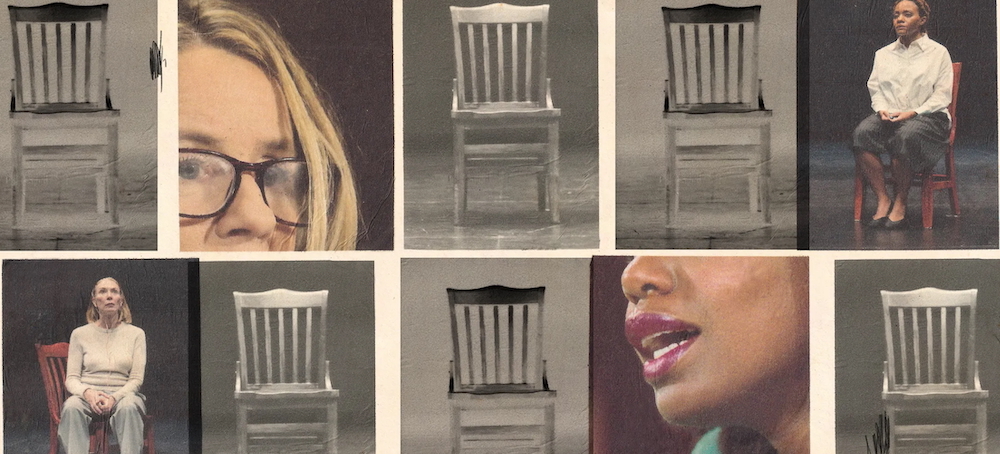 "Theatre and democracy have been in an uneasy symbiosis ever since the days of Sophocles." (image: Vanessa Saba/The New Yorker)
 The Thomas and Kavanaugh Hearings Restaged as a Theatre of Fact
Doreen St. Félix The New Yorker
“The Ford/Hill Project,” a documentary play, may capture recent events, but it’s a product of the present: activist theatre in a moment when the idea of civic urgency is losing purchase.
Onstage, at BAM Fisher, nine chairs form a faint semicircle. We watch as four actors, dressed in business casual, off to the side, prepare for their performance, inserting earbud headphones. The dangling wires give the actors a marionette-ish look. Marvel herself is one of the performers (while Evans directs), alongside Gabby Beans, Josh Hamilton, and Teagle F. Bougere. When the actors come “on,” they move around one another, in circles, a gravitational choreography. The work they carry out in this production, which runs a brisk sixty-five minutes, lies somewhere between acting and reënactment, interpretation and a kind of automatic playing of the tape. Generally speaking, Marvel is Christine Blasey Ford; Beans, Anita Hill; Hamilton, Kavanaugh; and Bougere, Thomas. (The actors sometimes toggle out of these roles to play varying senators.) Glimmers of one man’s red-faced bombast, another’s pomposity, one woman’s low tone, another’s careful speech, do arise, stirring sharp recollections in the audience of those interrogations. The aesthetic aim of “The Ford/Hill Project” is not to reduce the real person to character, to a theatrical entity, however. The performers are delivering verbatim testimonies fed to them through their earpieces, which include the stammers, the halts, the trip-ups that even the official transcript does not record.
Hill, and then Ford, have been brought to the Senate to attest to accusations of sexual harm against Thomas and Kavanaugh, respectively. Hill testifies that while working with Thomas at the Equal Employment Opportunity Commission, in the early eighties, she endured constant harassment by her boss: repeated invitations to go on dates; graphic references to porn; the now notorious comment about pubic hair on a Coke can. Ford, a psychologist, testifies that when she was fifteen, attending a party thrown by peers in her tony high-school world, a drunken, seventeen-year-old Kavanaugh had forced her onto a bed in a locked room, pinning her until she managed to escape. Hamilton’s Kavanaugh delivers his denial in bleats of indignation, and Bougere’s Thomas is rigid, stentorian, as he categorically rejects Hill’s claims. Because the stage is so empty, rid of the bureaucratic veneer of the so-called system, we start thinking about the state as an invisible force, everywhere and nowhere.
Black man, white man, Black woman, white woman: the cardinal points of our racial and sexual situation. None of the principals in this production can “talk” to one another, so to speak. But the constant movements of the actors into different pairings allow for some searing expository work, especially in the case of Clarence “high-tech lynching” Thomas, and Anita Hill, who was called a liar, a fabulist, a whore, and, above all, traitress of the advancing race.
Recordings of the hearings sometimes cut through the human performance in “The Ford/Hill Project”; we hear one senator’s voice speaking at both hearings. (I think it was the Democrat Patrick Leahy, of Vermont.) The recurrence of the voice across nearly three decades renders the government a frieze of unchanging agents, power entrenched. The years 1991 and 2018 are made to rhyme. We do not need to see the suits that Hill and Ford faced to understand this show’s argument against certain soothing myths about the inevitability of progress. The script emphasizes the fatuousness of procedure, how childish the senators sound as they call dibs on introductions and bicker over courtroom seat placements.
The writers join the testimony of Hill to the testimony of Ford, collapsing time. Beans and Marvel are like parallel vapor trails onstage. All that surrounded them—the recriminations, the slander, the appropriation by right-wing zealots and by left-wing activists—is shed, so that we can look at these two women. So, too, Thomas and Kavanaugh, who end the production by putting on court robes and taking their seats, as Hill and Ford look on. Thomas and Kavanaugh are back doing their work of undoing.
Theatre and democracy have been in an uneasy symbiosis ever since the days of Sophocles. No wonder the epigraph of “The Ford/Hill Project” is Tiresias’ warning to Creon, the stubborn despot, who seals Antigone in a cave lest she threaten his order: “All men make mistakes, but a good man yields when he knows his course is wrong, and repairs the evil. The only crime is pride.”
“The Ford/Hill Project” may capture recent history, but it is a product of the present. It is activist theatre presented in a moment when the idea of civic urgency is losing purchase. The air of mechanization in theroom reflects what some Americans felt then, and still feel today: the sensation of being numbed, beaten down, by the government cabal.
I covered the Kavanaugh hearings for this magazine. No fog attends my memory of his fluorescent rage, his sputtering, as he defended the beer-drunk culture of teen-age boys; no fog attends my memory of Ford, either, and her scientific narrativizing of her experience—“indelible in the hippocampus is the laughter.” But how can I claim to have a memory of Hill, the young law professor, dragged out of the anonymity of her Oklahoma life, in 1991, to D.C., where one ring of Republican bullies, and another ring of cowards—the Democrats, led squeamishly by then Senator Joe Biden—questioned Hill about her claims of sexual harassment against Thomas? I feel I was there. I was not yet born. The flagellation of Hill, broadcast non-stop on all networks, back then, is a collective memory that transcends anything as inconvenient as birth.
A theatre of fact meets a “Theater of Pain.” The slash in the title of “The Ford/Hill Project” is doing a lot of work. The script lives above a kind of basement of subconscious that it doesn’t go down to, where the public’s racial expectations of these two women are stored. I thought of one of the asymmetries that live outside the contained world of this docurama. The Republican senator Orrin Hatch, of Utah, telling reporters in 2018 that Ford—a daughter of a certain type of mid-Atlantic white bourgeois life style— was “attractive,” a “pleasing” witness; Hatch, during the Thomas hearings, holding up a copy of “The Exorcist ,” accusing Hill of filching the pubic-hair detail from the text. Following the confirmation of Thomas, Toni Morrison assembled leading scholars, historians, and writers for an anthology called “Race-ing Justice, En-gendering Power,” a series of essays on Hill, Thomas, and “the construction of social reality.” The historian Nell Irvin Painter writes in her essay that Hill, a career woman of Christian faith, who could not slot into the visible roles of mammy or jezebel, “seemed to disappear” in the cultural and political realm. Both Morrison, in her introductory essay, and the legal scholar Kimberlé Crenshaw analyze how Hill had been “de-raced” in the twentieth-century imagination, which used, as descriptive shorthand for the country’s marginalized population, the phrase “women and blacks.” As I was leaving BAM, I imagined a future version of “The Ford/Hill Project,” a farce, which might disturb an orthodoxy of roles. What if a production followed the logic of that de-racing, not just evacuating Hill of her Blackness but showing her as the white victim she could never be?