
The Supreme Court, Partner in Authoritarian Corruption
Ruth Ben-Ghiat Lucid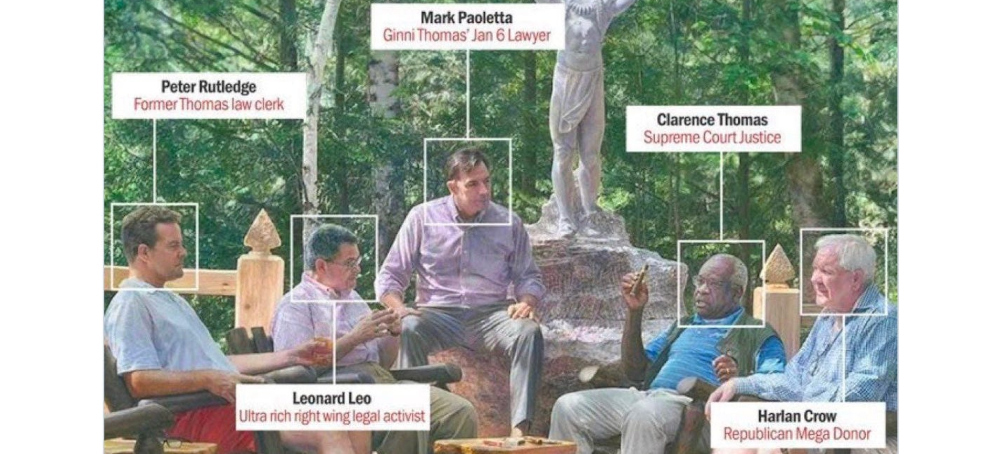 A painting by Sharif Tarabay that hangs at Camp Topridge shows Crow, Thomas, and associates. (photo: Senate Judiciary Democrats on X)
 The Supreme Court, Partner in Authoritarian Corruption
Ruth Ben-Ghiat LucidALSO SEE: Ruth Ben-Ghiat, Lucid (Substack)
Bringing things into the light that authoritarians want buried has been part of the mission of Lucid from the start. My very first essay was “Drain the Swamp” about how Benito Mussolini, Vladimir Putin, and Donald Trump cover up their corruption with myths of authoritarian efficiency.
I will be devoting more space going forward to corruption, examining how it works, why it is so central to the defeat of democracy and the consolidation of authoritarianism, and how it enables political, financial, sexual, environmental, and racial crimes.
The Trump administration and its enablers, including the Supreme Court, are providing Americans and the world with a lesson in how corruption can become systemic. That is the dream of all authoritarians, who seek to retool government and the culture to create the conditions to lie, steal, and repress people with impunity.
That means going after journalists, judges, investigators, opposition politicians, and others who expose official wrongdoing. It also means puffing up the leader’s personality cult and inventing narratives, backed by complicit religious institutions, about his selflessness and purity.
Over time, corruption can become the lubricant of how governance operates, from the national to the local level. Whether under Communism or Fascism, bribes have been essential to “get things done” in business and life. So is mastering the art of doing favors, such as granting public contracts to family members or friends. The no-bid contract Trump awarded to a company tied to a donor for his ill-fated reflecting pool is a recent U.S. example.
The role of family members in the leader’s corruption will be the subject of my next essay, to be published this weekend. Stay tuned for that.
Corruption is also what we don’t do. Dereliction of duty offenses include ignoring violations of compliance norms, or failing to report abuses of power, whether because of inner cowardice or external threats or pressures. Think of all the people who have kept Jeffrey Epstein’s trafficking and sex crimes secret to avoid incriminating themselves or face retaliation. Whether you think Epstein died of homicidal strangulation or suicide, his dead body sent a message about the virtues of staying silent.
The Case of Justice Clarence Thomas
The case of Justice Clarence Thomas illustrates how corruption requires a blend of action on behalf of interested parties and also strategic non-action.
How many people knew about Justice Clarence Thomas’s history (left out his financial disclosures) of accepting luxury gifts and travel from billionaire GOP donor Harlan Crow, but kept knowledge of those unethical practices to themselves? It took investigative journalism outlet ProPublic’s report to make it public.
In 2000, Justice Thomas had been carrying hundreds of thousands of dollars of personal debt, but by the time the Senate Judiciary Committee escalated the 2023 ProPublica investigation, Thomas and his family had received goods, experiences, and assistance worth millions of dollars, including Crow personally paying for the private boarding school tuition of Thomas's grandnephew.
Crow, who has a garden full of statues of dictators, and collects Adolf Hitler and Nazi memorabilia, is no fan of democratic transparency and believes in the power of dark money to influence politics. He personally helped to create the post-Citizens United dark money system to fund Republican politics.
This painting that hangs at Crow’s Camp Topridge retreat in the Adirondacks maps a world of far-right influence that includes Opus Dei (Leonardo Leo), Ginni Thomas’s lawyer in her quest to evade legal repercussions for her support of Trump’s attempts to subvert the 2020 election (Mark Paoletta), Thomas’s former law clerk (Peter Rutledge), Thomas, and his benefactor Crow.
As per the sacred laws of corruption, these “gifts” were likely supposed to be repaid whenever Thomas put on his robes. No matter that the Court, which has no ethical oversight mechanism, finally instituted a code of conduct in November 2023, which states that justices must “uphold the integrity and independence of the judiciary” and avoid actual and apparent impropriety.
Thomas showed how little he thought of this code of conduct when he promptly refused to recuse himself in Trump v. Anderson. This case asked the Court to overturn the Colorado state ruling that disqualified Trump from appearing on the ballot over his spreading of election lies and incitement of violence on Jan. 6. The other side argued that these actions violated the 14th Amendment’s insurrection clause. His wife Ginny Thomas’s involvement in election subversion and fake elector schemes led House Democrats and others to contend that Thomas could not be impartial in the matter.
(I contributed to an amicus brief, along with other democracy experts. You can view it here).
What good would Thomas be as a link in the chain of corruption if he took himself out of the game just when he was most needed? Recusal was not an option. He gained points for what he did not do.
The Supreme Court as a Partner in Corruption
And here we arrive at the Supreme Court as a partner in Trump administration corruption, first by giving the President immunity for official acts, and now by upholding his right to dismiss an official on political grounds.
A landmark ruling in July 2024 gave the President “the power of a king,” as the Brennan Center termed it, conferring upon him absolute immunity (for the exercise of core constitutional powers) and presumptive immunity (for all other official acts). This created the legal space for a lawless individual such as Trump to feel even more emboldened to use corruption and violence to destroy our democracy and make money doing it.
Now Slaughter v. Trump (on the legality of Trump firing Rebecca Slaughter, the last Democrat on the Federal Trade Commission) shows the power of those partners to create conditions for systemic corruption. Since 1935, the Supreme Court has said the president does not have the power to fire members of independent agencies created by Congress except for “inefficiency, neglect of duty, or malfeasance in office.”
We need to see this decision through autocratic eyes. Not obeying the Leader, refusing to participate in his corruption, and politicizing the practice of government are acts of negligence and malfeasance in office in the authoritarian world. Such people must be removed from public service, lest they influence others with their moral stances.
“Today’s decision in Slaughter will destroy the independence of the Merit Systems Protection Board, which will have a cascading effect on all federal employees, who have been free from political interference for 150 years,” commented Barb McQuade on Bluesky.
If you wanted practices of corruption and lawlessness to become ingrained within independent institutions, because ethical people who respect the law can be removed, this is the decision you would make.
Leave it to Solicitor General John Sauer, who represented the Trump administration, to summarize the authoritarian ideals of leadership behind both of these Court decisions and the key truth at the heart of this situation: a belief that the president has the right to do whatever he thinks is necessary to reach his goals.
Sauer told the court that the president must be able to remove officials in the agencies: “the President must have the power to control and…the one who has the power to remove is the one who…is the person that they have to fear and obey.”