
The Supreme Court Blew Up One of Biden’s Best Immigration Policies. How to Fix It.
Eric Lee Slate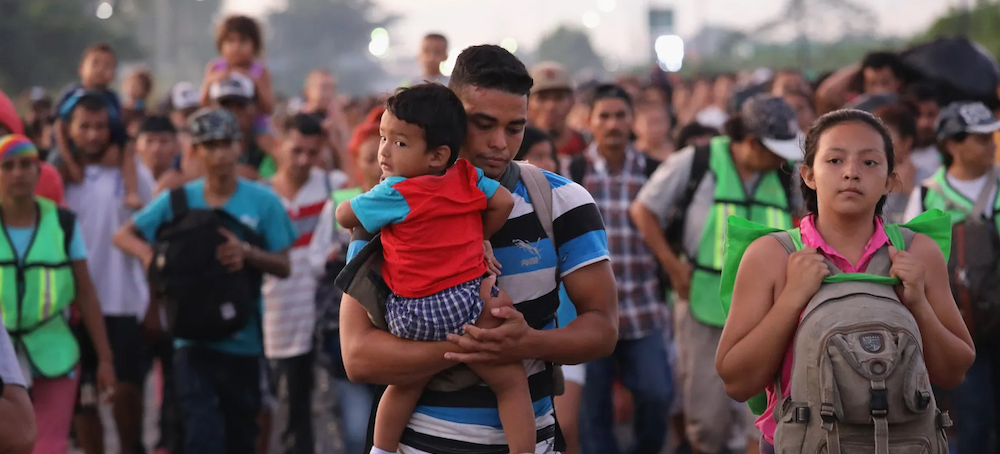 Members of a migrant caravan. (photo: John Moore/Getty Images)
 The Supreme Court Blew Up One of Biden’s Best Immigration Policies. How to Fix It.
Eric Lee SlateAt a White House event announcing the new policy on June 18, President Joe Biden said that requiring individuals leave the U.S. for a consular interview at the end of the green card process is the type of “problem that makes our immigration system unfair, unjust.” The president criticized the fact that “under the current process, undocumented spouses of U.S. citizens must go back to their home country to fill out paperwork and obtain long-term legal status. They have to leave their families in America with no assurance that they’ll be allowed back into the United States.” He said that eliminating the interview requirement “is a better way” because “it doesn’t tear families apart.”
All of this is true. Consider how the process currently works: Citizen spouses petition their noncitizen spouses for a “waiver” of unlawful presence by proving extreme hardship to the citizen. The noncitizen must pass a Department of Homeland Security background check. Then, as the last step, the noncitizen leaves the U.S. to attend an interview at the U.S. consulate in their country of origin. For most applicants, the visit is the first time they have returned to often war-torn countries they fled years before.
The “consular process” takes years and culminates in a brief interview at the consulate by officers with extremely heavy caseloads who must make a snap judgment as to whether the applicant is “admissible” to return to their home in the U.S. Unfortunately, time constraints and biases among some officers have turned the process into a gamble, even for applicants with no criminal records.
Hard as it is to believe, there are currently thousands of couples who have been permanently separated simply because the consular officer denied the applicant admission at the interview. In cities across the world, small networks of separated families do their best to provide support for one another. Some citizen spouses are forced to leave their jobs and homes behind to live with loved ones abroad.
While the new policy for families that will face this situation in the future is a good first step, the administration owes it to separated families to include them in that policy. The tragic outcomes that could be avoided are illustrated vividly in a recent Supreme Court decision for which I argued the losing side against the Biden administration.
In 2022, the U.S. Court of Appeals for the 9th Circuit ruled that U.S. citizens have a due process right to challenge the actions of consular officers denying visas at the interview stage. Late last year, the administration petitioned for certiorari with the U.S. Supreme Court, asking it to overturn the 9th Circuit’s ruling. On June 24, just days after Biden announced the parole-in-place policy, the Supreme Court ruled 6–3 in favor of the administration’s position that citizen spouses may not sue to correct wrongful visa denials. The ruling resulted in the permanent separation of Sandra Muñoz, a U.S. citizen and award-winning attorney, from her Salvadoran husband, Luis Asencio-Cordero.
Luis and Sandra are a case in point. At the time Luis left the U.S. for his consular interview, he had lived in the U.S. for 10 years and had passed a background check. He has no criminal record and resided peacefully at the couple’s Los Angeles home. Nevertheless, at the consular interview the officer denied Luis admission solely because of his tattoos, which an expert said were not gang-related.
Had Luis decided to remain in the shadows rather than follow the lawful process, he would have now qualified for a green card through the new parole-in-place program. Instead, he has been stranded in El Salvador and separated from his wife for nine years and counting.
The Supreme Court’s ruling shuts the courthouse doors on Sandra and Luis’ decade-long struggle to reunite. Writing in dissent, Justice Sonia Sotomayor cited an amicus curiae brief submitted by former consular officers explaining that the interview process is fundamentally flawed:
Former consular officers tell this Court that this lack of accountability, coupled with deficient information and inconsistent training, means decisions often ‘rely on stereotypes or tropes,’ even ‘bias or bad faith.’ Visa applicants may ‘experience disparate outcomes based on nothing more than the luck or misfortune of which diplomatic post and consular officer … they happen to be assigned.’ The State Department’s Office of the Inspector General has documented numerous deficiencies in consular processing across several continents.
The administration’s new policy acknowledges such problems, but so far does not provide any mechanism to unite the thousands of people like Sandra and Luis who have done nothing wrong but try to follow the law. It is urgent that the administration expand the policy so that such people are not left behind.
Given Trump’s threats of mass deportations at the Republican National Convention and his track record of family separation, it is imperative for the administration to act now, before it is too late.