
The Senate
Marc Ash Reader Supported News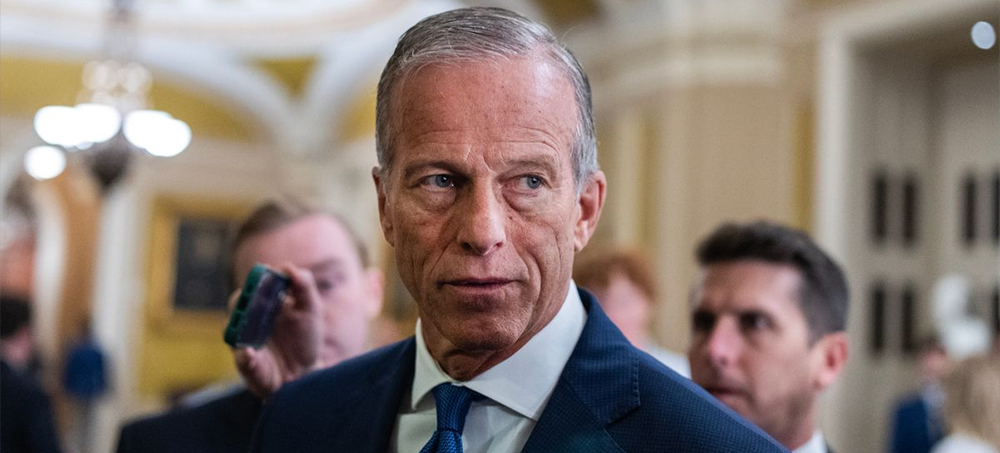 Senate Majority Leader John Thune is now in a battle for control of the upper chamber.(photo: Tom Williams/NY Magazine)
 The Senate
Marc Ash Reader Supported NewsALSO SEE: National Mood Is Against Republicans, but Redistricting Could Help Prop Them Up
For the record the justification the Virginia Supreme Court majority cited was that the Speaker of the Virginia House of Delegates (Don Scott) called a special session to consider the authorization of the public referendum rather than Governor Abigail Spanberger, who certainly would also have done so. That’s a distinction without a material difference and every member Virginia Supreme Court knows it.
The U.S. Supreme Court, the Roberts court has had ample opportunity to end gerrymandering motivated by politics or by race, it matters not. They could easily have ended it. The conservative members of the court chose instead to embolden the segregationists who wield gerrymandering like a cudgel. It is the bed they have made.
The combination of the U.S. and Virginia Supreme Court decisions have thrown the prospects for control of the House into uncertainty. Everyone is scrambling around trying to figure out what all this means. But it’s a difficult question to answer. The problem is that no one knows what the result of the Gerrymandering efforts in the former Confederate states will amount to. How many Democratic seats will actually be eliminated is an open question, it’s totally uncharted territory. Court challenges are sure to follow adding further layers of complexity.
Gerrymandering can be used to accomplish more than one thing, but it’s particularly well suited for managing control of seats in the U.S. House Representatives. It is the House districts that the race is on to control. It would seem unimaginable that the gerrymandering efforts now underway would not have a significant effect. The Senate however is a different matter entirely.
Many argue that the U.S. Senate is Gerrymandered by design. Sure there are no districts to redraw but population also does not matter. Each state gets 2 Senate seats regardless of comparative size. Maine with its population of 1.4 million stands as a full-peer beside New York with its population of nearly 20 million. Tiny Wyoming with its half million residents is on equal footing in Senate measure with California with its population of nearly 40 million. It is for larger States the mother of all handicaps and for smaller states a gift for the ages.
Nonetheless in that Trump and his supporters have nothing to artificially alter the battle for the Senate will play-out largely as it always has, albeit awash in money, much of it arguably illicit. If the Democratic Senate candidates, black, white or brown can win, then they win in the upper chamber.
There should be no illusions, winning enough Senate races this November to flip control of Senate will be an uphill battle for Democrats. That battlefield however will arguably be more level than the one on which the battle for control of House will take place and the stakes are even higher as the Senate generally enjoys greater power than the House.
One thing the Democrats will have this November is Donald Trump to run against. The policies of Trump and his entourage are as unpopular as those of any presidential administration in History. Senate control long considered safe for Republicans is now legitimately in play. The Democrats are thinking big and the opportunity is there.