
The Saudi Kingdon Braces Massive Assault
Bobby Ghosh Ghoshworld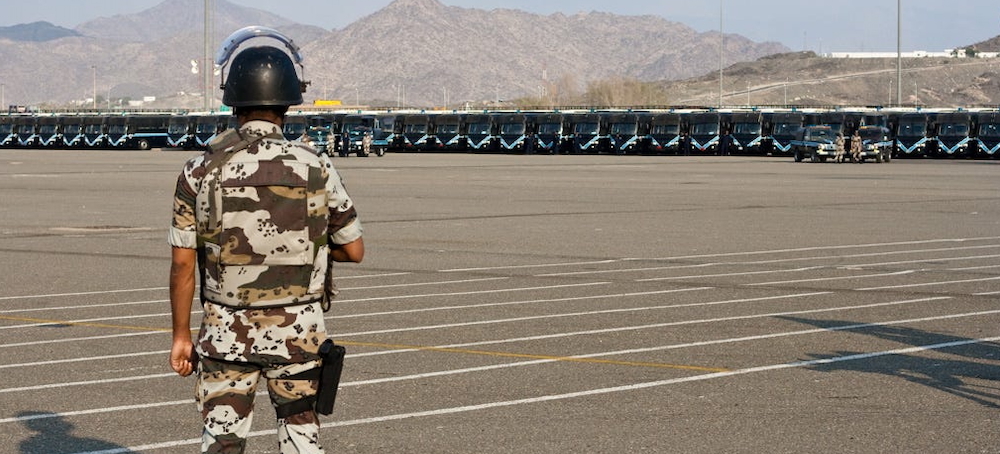 Where’s the cavalry? (photo: Al Jazeera/CC BY-SA 2.0/Wikimedia Commons)
 The Saudi Kingdon Braces Massive Assault
Bobby Ghosh Ghoshworld
SUBSCRIPTIONS ARE THE FUTURE OF RSN — The old donation system isn’t working. The financial consequences have been devastating. Everything RSN does is in immediate danger. The new fundraising-free subscription list gives RSN hope for the future and it’s a lot easier on the sanity of our donors. Need to get you signed up.
The clause is written to echo NATO’s Article 5, and it sounds the part. But Saudi Arabia is not girding against a hypothetical. It has been under attack since February 28, when the U.S. and Israel opened their war on Iran, and Tehran answered by raining missiles and drones across the Gulf. Iranian ordnance has targeted Prince Sultan Air Base and the Ras Tanura oil complex. Houthi missiles have struck Aramco facilities at Jizan and Yanbu; last week they claimed a Saudi tanker in the Gulf of Aden; Iranian-aligned militias have sent drones from Iraq. If the “an attack on one” clause was designed to summon the cavalry, the cavalry would already be in full gallop.
But there is less to this pact than meets the eye. The joint statement pinned no party to any specific obligation. A Turkish official was quick to call the agreement purely defensive, “not directed against any specific actor,” open to newcomers — and to stress that it overrides none of the parties’ existing arrangements. Deterrence does not usually come festooned with this many asterisks.
In any case, Pakistan is an improbable enforcer of an anti-Iran alliance. It shares a 900-kilometer border with Iran and is home to a large, restive Shia population; only weeks ago it brokered the U.S.-Iran ceasefire in Islamabad. Asim Munir did not fly to Mecca to volunteer his army for a confrontation with Tehran and its catspaws.
Turkey is a NATO member busy hedging on every front — courting the Gulf’s money and the BRICS’ attention while keeping Incirlik open and Iranian gas flowing. Ankara already keeps troops on the peninsula: a garrison outside Doha, at the Tariq bin Ziyad base, since 2016 — an installation Saudi Arabia itself once demanded be shut down. When Iranian missiles fell on Qatar this spring, those Turkish troops stayed in their barracks. Erdogan will trade a photograph in the holy city for goodwill in Riyadh. He will not trade F-16s for a war over the Bab el-Mandeb.
None of this is guesswork. Most of the machinery for mutual defense already exists, and it has been tested. Pakistan’s signed a pact with Saudi Arabia in September, its “aggression against one is aggression against both” language practically identical to Friday’s. But when Iran’s missiles landed on Saudi soil this spring, Islamabad — bound by that very clause — offered Riyadh statements of solidarity and no soldiers. As analyst Nour Eid pointed out then, that pact proved largely symbolic. Friday’s ceremony added a third signature to a guarantee that had already failed its one test.
Nor does the “new” pact move the needle on nuclear deterrence. Pakistan is the Muslim world’s only nuclear power, and it was suggested at the signing of the previous pact that the ambiguity over whether its umbrella now shelters the kingdom could complicate Tehran’s arithmetic. If the Iranians cannot be sure where the nuclear threshold lies, perhaps they will hesitate to prod the Saudis beyond a point. But Pakistan’s own defense minister has already walked the nuclear talk back to “not on the radar,” and Islamabad’s declared doctrine points its warheads at India, not Iran.
If the Mecca agreement isn’t directed at Tehran, then what even is the point? Perhaps the real audience is in Washington. For three years the Gulf has watched the American guarantee fray — from the shrug that met the 2019 strikes on Abqaiq, to the Israeli bombs that fell on Doha last September, to a war that has left Saudi cities exposed. The new pact may be Riyadh’s way of announcing that it is shopping for other partners — and doing the announcing in Islam’s holiest city, where the symbolism runs richest.
It is unlikely the message will change American policy, however. Even the Trump administration can see that the pact, in practice, amounts to very little. More likely than not, the three will share some intelligence, conduct some joint drills, trade some military hardware, and arrange the occasional photo-op for their generals. That is about the size of it. That isn’t entirely worthless — militaries that drill together grow used to one another — but it is a long way from the collective-defense guarantee sold in the headlines.