
The Rise of the Epstein Democrat
Jon Allsop New Yorker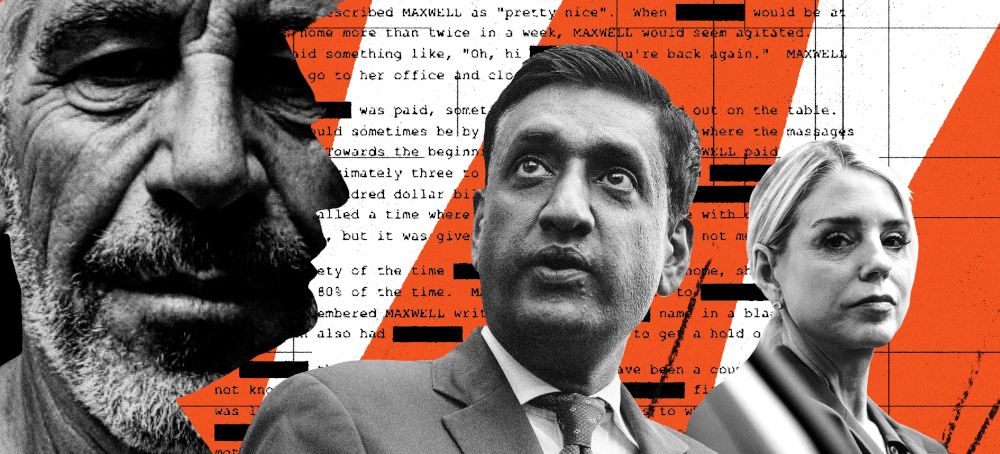 Pedophile Jeffrey Epstein, Rep. Ro Khanna, and Former Attorney General Pam Bondi.(photo: Jared Bartman)
 The Rise of the Epstein Democrat
Jon Allsop New Yorker
In demanding the release of the Epstein files, the Party has embraced a radically new way of fighting Donald Trump. Is it a good idea?
At the hearing, Khanna was seated next to Stacey Plaskett, a non-voting Democratic delegate from the U.S. Virgin Islands; when it was her turn to question Cohen, she asked which other former Trump staffers the committee should haul in. Plaskett took input on that line of inquiry from Jeffrey Epstein—the financier who had been convicted of soliciting sex from a minor a decade before—with whom she was texting during the hearing. “Hes opened the door to questions re who are the other henchmen at trump org,” Epstein wrote, of Cohen. He also told Plaskett, “You look great.” Within months, Epstein would be dead in jail, following his arrest on charges of prolific child sex trafficking. That we now know about his exchanges with Plaskett is thanks to the Oversight Committee, which, last year, released tranches of files that it procured from Epstein’s estate. Meanwhile, Khanna worked with the gadfly Republican congressman Thomas Massie on a bill that would force Trump’s second-term Justice Department to make public all the Epstein documents in its possession, with minimal redactions. Trump—who had a long, if not provably criminal, relationship with Epstein and spent last summer railing against Democrats for perpetuating an Epstein “hoax”—finally caved, signing the measure into law. (The D.O.J. was later accused of withholding, before eventually posting, pages detailing allegations that Trump himself sexually abused a minor in the eighties, a claim that he has vehemently denied. Plaskett, for her part, has acknowledged that texting with Epstein was a “bad idea” but argued that, as a former prosecutor, she has “learned to receive information from sources I do not like to obtain information that helps me get to the truth.”)
The contents of the files have embarrassed Democrats as much as Republicans; in addition to Plaskett, they have cast a deeply unflattering (if, again, not necessarily criminal) light on the behavior of Bill Clinton, in addition to other former officials, aides, and donors. Khanna’s centrality to such a crusade isn’t a surprise, if only because of his career-long commitment to idiosyncrasy: he is a Bernie Sanders acolyte who represents Silicon Valley in Congress and has been described as an “ambassador” for the tech industry; J. D. Vance and Steve Bannon have praised him (even if Vance sometimes finds him “very annoying”); he preaches bipartisanship, then practices it—not by building consensus around managerial centrism, per the stultifying Beltway credo, but by allying with hard-core right-wing ideologues, including, on the Epstein files, the likes of Massie and Marjorie Taylor Greene. Khanna would perhaps be the candidate most likely to win the 2028 Democratic Presidential primary, for which he definitely seems to be preparing himself, if only maga Republicans could vote in it. (Recently, he called for the assembly of a populist coalition of left and right, and Greene tentatively endorsed the idea.) He has said that there are “two different frames for me”—progressive coalition-builder or rank opportunist—proving that he is both politically unusual and unusually savvy about how he is portrayed in the media, where he is, as the old saw goes, unavoidable for comment.
What I do find surprising is how unifying a rallying cry “Release the Epstein files!” has become across Khanna’s party. Epstein’s crimes have long provoked bipartisan disgust, but their revival as a political concern in the second Trump Administration was initiated by right-wing conspiracy theorists adjacent to, if not soaked in, the broader QAnon belief that a cabal of liberal pedophiles controls the world. By the time Khanna and Massie’s bill came up for a vote, in November, only a single member of Congress voted against it, citing concerns about due process—and that was Representative Clay Higgins, a hard-right Republican. Earlier this year, nine Democrats on the Oversight Committee voted to recommend holding Clinton in criminal contempt of Congress as part of a push to question him about Epstein, and three likewise voted to do so for Hillary Clinton, even though she has no direct link to Epstein. (Khanna was not among the nine or the three; both Clintons avoided contempt proceedings by agreeing to be deposed in late February.) When Pam Bondi was ousted as Attorney General, top Democrats cited her mishandling of the files as among their primary grievances with her tenure, giving it comparable prominence to her (much more pressing) vengeance campaign against Trump’s perceived enemies. If the President’s Epstein stonewalling initially enraged his base, the issue is arguably now more animating for Democrats than for Republicans.
Khanna told me that Democratic voters are indeed animated by the plight of Epstein’s survivors, but, more than anything, he characterized his focus on the files as a matter of reaching across the aisle, calling it “the first time since Donald Trump came down the escalator that we actually engaged with the maga base about their frustrations and anger at the system, and said, ‘We want to partner with you instead of shaming you.’ ” Whatever the issue’s current valence among the electorate, that so many high-ranking Democrats have taken it up hints at a profound, if not yet fully realized, break with the Party’s politics dating back to that escalator ride, and perhaps further still. “For the past fifteen, twenty years, Democrats have become the party of protecting institutions, and standing up for the rule of law, and arguing for everyone to get a fair trial, for the legal system to work its process,” Caitlin Legacki, a Democratic strategist who served as a senior adviser to Gina Raimondo, Joe Biden’s Commerce Secretary, told me. Legacki has been struck by “the extent to which Democrats have been willing to embrace the idea that, if the American people wanna see the files, show ’em the files.”
For Legacki, this approach carries a “huge risk”—of spewing out uncorroborated information, or tarring people with guilt by association—that is “a major departure from how politics in the U.S. has often operated” and also reflects “a breakdown of trust in institutions, on both sides.” I agree entirely. Given the scale of Epstein’s crimes, highlighting due-process concerns can feel small-bore, or even like apologism. Yet they are important not only to the Epstein saga itself but to a much bigger, and still unresolved, debate over the direction of the Democratic Party, which has traditionally been seen as defending the institutions that Trump has trashed. “I flipped the script,” Khanna told me. But what does the new script say? And what if portions of the old one are worth keeping?
When the Epstein story flared last summer, there was nothing inevitable about the script flipping. Khanna told me that colleagues had warned him he would undermine his “serious brand” as an economic wonk by tying himself to a “crackpot” conspiracy theory; one anonymous lawmaker complained to Axios that “this whole thing is just such bulls**t.” The Democratic National Committee and Hakeem Jeffries, the House Minority Leader, marshalled Epstein as a talking point, but in terms that left open the possibility that there was no grand conspiracy afoot and that Trump and his allies were merely reaping baseless nonsense they long ago sowed. Many Democrats initially dismissed what they saw as “QAnon nutty theories,” even as they recognized that they “really tripped up Republicans on their own stuff,” Paul Mitchell, a Democratic data consultant, told me. At the time, he likened Democrats harping on Epstein to the N.B.A. tactic of fouling Shaquille O’Neal because he struggled to score free throws—effective, perhaps, but a little unsavory.
For years, Democratic leaders had seemed wedded to procedural responses to Trump, and to the ideal that nobody is above the law, embodied most visibly by the Mueller probe, then Trump’s impeachments, then the criminal cases he faced after leaving office. During the first Trump term, the Democratic base thought of Mueller almost as a matinée idol—the ramrod-straight lawman come to restore order—and fans of Justice Ruth Bader Ginsburg put her face on tote bags. Does the fact that none of this was effective—at least in the sense that Trump hasn’t been driven from the political scene for good—suggest that Democrats should now fight dirtier? With the midterms approaching, certain primaries have reflected broader debates about whether the Party might consider cursing more, capitalizing tweets, going Dark Woke. In Texas, James Talarico, an almost cartoonishly pious seminarian, defeated Jasmine Crockett, a Congresswoman whose many controversies have included calling Greene “butch” and ejecting a reporter from a rally for, per a member of her staff, being “a top-notch hater.” In Maine, Graham Platner, a rough-hewn populist who had to cover up a Nazi tattoo, looks set to handily beat Janet Mills, the polished seventy-eight-year-old incumbent governor. (Platner has said that he did not know about the tattoo’s Nazi associations when he got it.)
Epstein is hardly the only issue that these and other Democrats are talking about. But the story line has become unusually sticky—a noteworthy feat under a President who floods the zone with so many outrages that it can sometimes be hard to remember last week’s scandals. (Even Trump’s genocidal threats against Iran didn’t wipe Epstein from the news cycle for long—and not just thanks to Melania Trump’s apropos of nothing-to-hide-with-regard-to-Jeffrey-Epstein press conference.) More notable still, perhaps, is the fact that calling for the release of the Epstein files has seemed to cut across the myriad divisions rending the Democratic Party. Crockett, who serves on the Oversight Committee, has been a vigorous inquisitor regarding Trump’s ties to Epstein, sparring memorably with Bondi on the matter, and warning the President that “we are going to be on his ass.” Even the mild-mannered Talarico has said that QAnon got “one big thing” wrong—the belief that Trump would dismantle “this secret pedophile ring when he’s right in the middle of it.” When the Oversight Committee deposed Hillary Clinton, she cast her subpoena as part of a D.O.J. coverup, saying, “I would like to know, like every other American deserves to know, what is in those files.” Asked whether she thought Epstein might have been a spy, she said that she didn’t know, but that it’s “absolutely essential” the committee find out.
It is possible to see the Party’s Epstein energy as less of a script-flipping than a natural evolution. Some Democrats I interviewed, including Pat Dennis, the president of the Democratic super pac American Bridge 21st Century, insisted that they’ve been concerned about Epstein for years; Chuck Schumer, the Senate Minority Leader, has claimed that he pushed for the release of the files in 2019, following Epstein’s arrest. (Though the “Epstein files” didn’t really exist as a unified political concept back then, Schumer did call for clarity with respect to Epstein’s lenient 2008 prosecution—and gave away sums that Epstein had donated to his past campaigns.) More broadly, Democrats’ current Epstein rhetoric could be said to echo the righteous fury that they expressed at the height of the #MeToo movement, during Trump’s first term. Less charitable observers, especially on the right, might cast it as the latest iteration of a years-long effort to smear Trump. (Schumer and others have certainly used the story to troll the President, calling him “Epstein Don” and asking, for instance, whether Epstein was “THE REAL REASON TRUMP HAD KIMMEL CANCELED?!,” exemplifying the extraordinarily annoying Democratic tic of interpreting everything Trump does as an attempt to distract from the files.) Dennis pointed out to me that the “cliché Resistance libs” who seized on the Mueller story are now seizing on the Epstein story, because they tend to “glom on” to whatever is prominently in the news.