
The Omicron Variant Is Redefining the Pandemic. What You Need to Know.
Jesus Perez VICE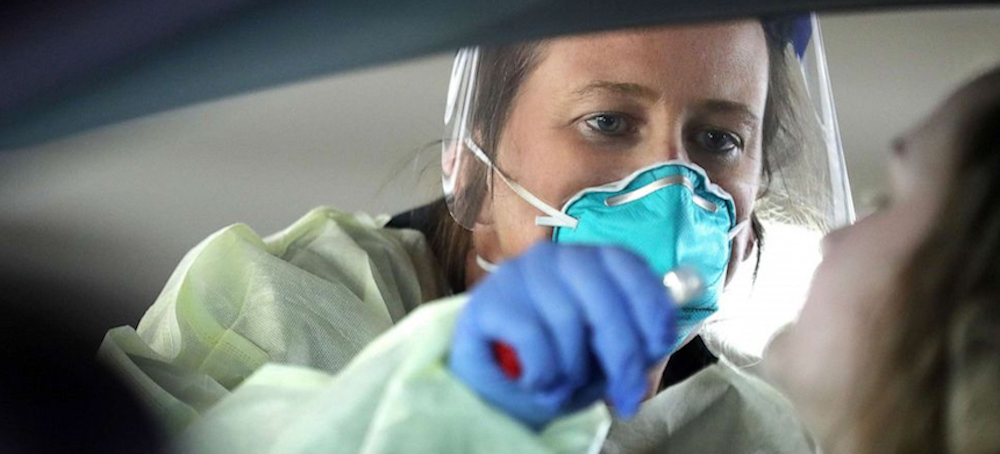 A healthcare worker and a patient. (photo: ABC News)
The Omicron Variant Is Redefining the Pandemic. What You Need to Know.
Jesus Perez VICE
The Omicron variant is quickly spreading across the world. Here's what we know about its incubation period, symptoms and severity.
After first devastating New York City, the Omicron variant has spread nationwide, forming new hotspots all across the country. New York’s neighboring states have been reporting a record number of cases, with New Jersey being hit especially hard.
A consistent hotspot for the virus, Florida reported 46,000 new cases on Tuesday, breaking all previous single-day records. Washington, D.C. is also dealing with a major surge as the nation’s capital is currently recording 1,192 new cases per day. And the increase isn’t limited to the U.S. mainland, as Hawaii and Puerto Rico are seeing abrupt surges.
Omicron accounts for more than half of the cases genomically sequenced as of Dec. 19. But Delta is also part of this surge, as both variants ravage a country that has shown itself to be consistently ill-equipped for the worst.
Via #SKy25
— Peter Wilson (@PetesWire) December 29, 2021
The line of cars and people waiting for COVID testing at the Square One Mall in #Saugus at this hour.@boston25 pic.twitter.com/qSVnZ7tcO6
How fast does the Omicron variant spread?
There seems to be little doubt that Omicron spreads faster than any previous variants. Since its discovery in South Africa, the Omicron wave has dominated COVID-19 cases in the U.S.
All signs point to a variant that is far faster at spreading than the already rapid Delta variant. Studies have found Omicron to be three times more likely to spread in a household than the Delta variant.
Preliminary data point to the specific mutations that the Omicron variant exhibits, making it infect and multiply 70 times faster in the human bronchus than the previous variants. The same study concludes that Omicron is ineffective at replicating in deeper lung tissue than the original virus, possibly making it less severe.
How long does Omicron incubate?
One of the prominent issues with past COVID variants was not just their easy transmissibility (which pales in comparison to Omicron) but their long incubation periods. The original and the Delta variant have incubation periods as long as 14 days. The Omicron variant, according to a CDC study, has an incubation period between 3 to 5 days.
The initial issue was the uncertainty that the long incubation periods created, but the rapidness of the Omicron variant does present a unique set of problems.
The Omicron variant’s easy spreadability coupled with its short incubation period makes it seem as if everyone is getting COVID, and though that is hyperbole, Omicron spreads like wildfire in densely populated areas. That’s resulted in shutdowns of services and businesses as many workers fall ill.
The unvaccinated and kids are overloading hospitals
By all accounts, the symptoms for Omicron are milder than for Delta or the original variant. Even so, COVID patients are putting a major strain on the nation’s already fragile healthcare system. As of December, a little over 60% of the U.S. population is vaccinated, which leaves about 132 million people still unvaccinated.
The line to get into Miami-Dade’s 24 hour COVID testing site is miles long right now. This is the wait before you even get into Tropical Park where you then have to zig zag around cones before the testing area. pic.twitter.com/4VpPzR7glf
— Brian Entin (@BrianEntin) December 30, 2021
The initial issue was the uncertainty that the long incubation periods created, but the rapidness of the Omicron variant does present a unique set of problems.
The Omicron variant’s easy spreadability coupled with its short incubation period makes it seem as if everyone is getting COVID, and though that is hyperbole, Omicron spreads like wildfire in densely populated areas. That’s resulted in shutdowns of services and businesses as many workers fall ill.
The unvaccinated and kids are overloading hospitals
By all accounts, the symptoms for Omicron are milder than for Delta or the original variant. Even so, COVID patients are putting a major strain on the nation’s already fragile healthcare system. As of December, a little over 60% of the U.S. population is vaccinated, which leaves about 132 million people still unvaccinated.
At the pharmacy - line wrapped around the building for Covid testing. Unfortunately no social distancing and most people in subpar masking- so there’s a good chance with Omicron that many of these people in line who are negative will actually be Covid positive in a few days…🤦🏽♂️ pic.twitter.com/dRtMYUc6GF
— Jerome Adams (@JeromeAdamsMD) December 24, 2021
Walensky said that the CDC’s concerns over rapid tests stem from growing evidence that the tests might not be sensitive enough to detect the Omicron variant.
Currently, the US is suffering from a supply shortage for COVID tests, though Walensky denies that the shortage has anything to do with the CDC’s decision to exclude a negative test requirement.
The state of COVID testing
The US is currently suffering from a shortage of COVID-19 test kits, leaving many Americans in the worst hotspots scrambling to get tested. Hospitals are hit especially hard as Americans resort to going to the ER just to get tested, stretching their resources thin.
Beyond the testing shortages, the Omicron variant presents a new set of issues for the two types of tests that have been reliably used in the pandemic so far.
Rapid Test: The COVID-19 antigen test, also known as the rapid test, may not be as sensitive to Omicron as it was to the original virus and the Delta variant. With the popularity of at-home rapid tests, this presents a problem of accuracy for many Americans.
PCR Test: Polymerase chain reaction tests, or PCR tests, are far more accurate at detecting the Omicron variant. But are not reliable at determining whether or not a person is still transmitting the virus since the test can show positive results for up to 12 weeks after infection.
How severe is Omicron?
Omicron symptoms, from the outset, look no different from the original virus and the Delta variant:
- Coughing
- Fatigue
- Congestion
- Fever
- Sore throat
- Headache
- Sneezing
The distinct loss of taste or smell that was the calling card of past variants doesn’t seem as widespread with the Omicron variant. The actual severity of these symptoms varies from person to person, and could be dependent on vaccination status and an individuals own immune response.
It will be weeks before we know how deadly the Omicron variant really is, since deaths are a lagging indicator. An unvaccinated Texas man in his 50s became the first recorded death from Omicron in the U.S. While many of the cases reported have been mild, the Omicron variant’s ability to spread at lightning speed makes it a cause for concern.