
The Mentor
Kai Bird and Susan Goldmark New Yorker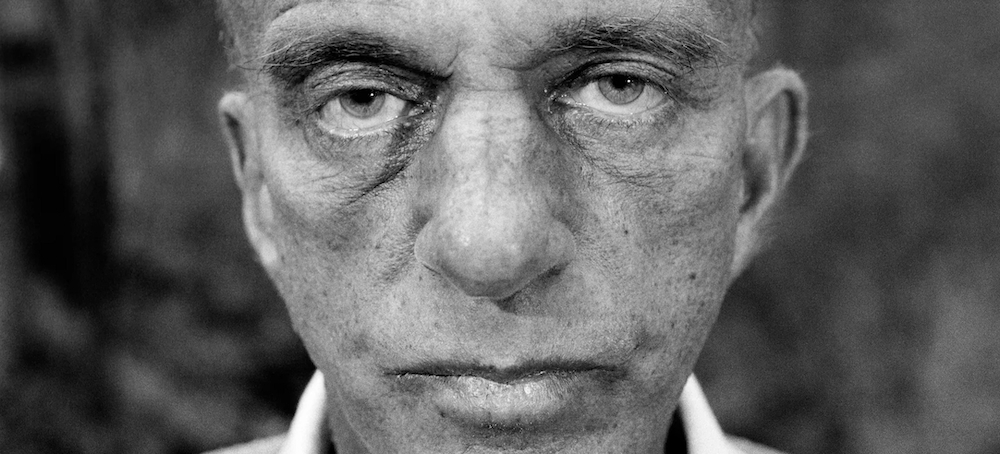 “Ignore the rules, do what you want to do, don’t leave a paper trail,” the reporter David Cay Johnston said, listing the lessons Cohn taught Trump. “And if somebody gets onto you, rat out other people to save yourself.” (photo: Mary Ellen Mark/New Yorker)
 The Mentor
Kai Bird and Susan Goldmark New YorkerTrump and Cohn had met forty-four years earlier, in 1973. The New York Post gossip columnist Cindy Adams later reported that her old friend Cohn had introduced her to his new protégé at a dinner party soon after. Trump was not yet thirty, and an ambitious outer-borough real-estate developer. In her column, Adams wrote that Cohn told her, “One day this kid is going to own New York.” Cohn, who was a closeted gay man, was invariably attracted to what could be called über-Gentiles—tall, fair-haired, blue-eyed. “Roy loved to surround himself with attractive straight men,” Robert S. Cohen, a divorce lawyer who’d worked for him in the sixties, observed. Trump—blond, six feet three—fit the bill.
The scene of their first encounter was Le Club, a private dining venue at 416 East Fifty-fifth Street, half a block from the East River. Cohn was a member. Opened on New Year’s Eve, in 1960, Le Club occupied a small white stucco house; a brass plaque reading “Members Only” was its only signage. The place had an international, jet-set atmosphere. Igor Cassini, a former society columnist for the Hearst papers and the brother of Oleg Cassini, Jacqueline Kennedy’s favorite couturier, was the chairman of Le Club’s board.
“It was the sort of place where you were likely to see a wealthy seventy-five-year-old guy walk in with three blondes from Sweden,” Trump wrote in his 1987 book, “The Art of the Deal.” In a few years, Trump would boast about being “a director” of Le Club, but in 1973 he was living in a rent-controlled studio at 196 East Seventy-fifth Street. The “dark, dingy little apartment,” as Trump described it, had a view of a water tank. His father, Fred Trump, had named him president of the Trump Management Corporation in 1971. The company owned thousands of rental units in Queens and Brooklyn, but the younger Trump was eager to expand the family empire into Manhattan. He wanted, he wrote, to be “a city guy instead of a kid from the boroughs.” He had joined Le Club because he thought it could help him make inroads into Manhattan society. Trump was having dinner there one evening when he spotted Cohn at a nearby table.
In “The Art of the Deal,” Trump recalls their meeting, a description that is likely embellished. He claims that, after he got introduced to Cohn, Trump told him, “I don’t like lawyers. I think all they do is delay deals, instead of making deals, and every answer they give you is no, and they are always looking to settle instead of fight.” He continues, “I’m just not built that way. I’d rather fight than fold, because as soon as you fold once, you get the reputation of being a folder.”
In an interview with us last year, Trump relayed a different version of the meeting, claiming that it had been Cohn who’d initiated the conversation. “I was doing very well, I guess people were reading a lot about me,” he said. “I remember it very vividly—he was with a whole group of guys, and he came over, he wanted to introduce himself.” Trump went on, “He said, ‘Maybe we’ll do some business—if you ever have a case. I’d love to work with you.’ I remember that he didn’t have cards. He wasn’t a card person. But I called him up.”
It’s more plausible that Trump, then a virtual unknown, introduced himself to Cohn and nervously explained that he needed some legal advice. In “The Art of the Deal,” he describes their conversation: “The government has just filed suit against our company . . . saying that we discriminated against blacks,” Trump told Cohn, and asked,“What do you think I should do?”
“Tell them to go to hell and fight the thing in court and let them prove that you discriminated,” Cohn snapped. Trump thought that this was splendid advice.
It wasn’t long before Cohn began introducing Trump around town. “I got to know everybody,” Trump said. In November, 1973, Cohn invited his new protégé to a black-tie dinner at the Biltmore Hotel to celebrate his twenty-fifth anniversary as a practicing attorney. (The event doubled as a fund-raiser for the Cardinal Spellman foundation and the American Jewish League Against Communism.) Cohn’s friend William F. Buckley, Jr., paid tribute to him in a speech: “Roy Cohn is a man who has triumphed over his tormentors, and he deserves the credit we are here to give him so enthusiastically.” A congratulatory letter from President Richard Nixon was read to the guests, who included the State Supreme Court justice John M. Murtagh and the mayor-elect Abraham Beame. Trump was enthralled. He craved these connections, and he knew that, in Cohn, he had found the kind of tough lawyer he needed to fight the government’s discrimination charges.
Trump’s father, Fred, appears to have had a long history of racism. On Memorial Day, 1927, when Fred was twenty-one, he was arrested for refusing to disperse during a violent confrontation between police and a band of white-hooded Klansmen in Queens; he was released shortly after. (It’s unclear what role he played in the riot.) Almost thirty years later, a tenant living in one of Fred’s first major developments, the Beach Haven apartment complex, in Brooklyn, was so disturbed by the racial discrimination he observed from the management that he wrote a song about it. The song was called “Old Man Trump.” The tenant was Woody Guthrie.
I suppose that Old Man Trump knows just how much racial hate
He stirred up in that bloodpot of human hearts . . .
Beach Haven is Trump’s Tower
Where no Black folks come to roam
By 1973, when Trump met Cohn, the evidence that Fred’s company had discriminated against Black people seemed undeniable. According to the Justice Department filing, thirty-nine Trump-owned apartment buildings had systematically barred Black people from renting. The Feds had found four Trump superintendents or rental agents willing to confirm that applications were coded by race; the forms would be marked by a large capital “C” to indicate that the applicants were “colored.” One Trump employee described the policy to an F.B.I. agent: “Fred Trump told me not to rent to Blacks. He also wanted me to get rid of the Blacks that were in the building by telling them cheap housing was available to them at only five hundred dollars down payment, which Trump would offer to pay himself.” These activities would have been a clear violation of the 1968 Fair Housing Act.
The Feds would have been satisfied had the Trumps merely signed a consent decree, agreeing to integrate their approximately fifteen thousand units; there would have been no fine and no admission of guilt. But Cohn encouraged Trump to reject the decree, and to assert that the Feds were pressuring the company to rent to “welfare recipients.” Exasperated, the Justice Department filed a formal discrimination suit, whereupon Cohn countersued the government for defamation, seeking a hundred million dollars in damages. Cohn and Trump held a press conference at the New York Hilton to announce their suit. Steven Brill, the founder of The American Lawyer, later said that he had been stunned that any reporters had shown up: “You couldn’t get through your second day of law school without knowing it was a totally bogus lawsuit.”
The stunt, a show of bravado, dominated local headlines, but, a month later, a federal judge dismissed the Trumps’ suit as frivolous, scolding Cohn that he was “wasting time and paper.” Trump and Cohn refused to back down, and they refused to engage with the accusations of racism. A friend of Cohn’s told us that, in private, Cohn routinely referred to Black people as “the Schvartze,” a slur he’d picked up from his mother, Dora, and that on at least one occasion he was heard using the N-word. Trump always said that he was color-blind and that his only criterion for tenants was the income of the male head of household: “We don’t generally include the wife’s income. We like to see it for the male in the family.”
Cohn dragged out the litigation for twenty months. He attacked the credibility of the government’s key witness, a former Trump employee, claiming that he had been coerced by a “Gestapo-like interrogation.” He also filed an affidavit charging that F.B.I. agents had been acting like “stormtroopers.” The judge reprimanded Cohn for his statements, which he described as “utterly without foundation.” Cohn quickly retracted his remark about stormtroopers. “I have never brought a charge against the F.B.I. in my life. I have personal reasons why I haven’t, and I never would,” he said, alluding to his close friendship with the former F.B.I. director J. Edgar Hoover. “My relationship [to the F.B.I.] is much too close.” But these digressions were great theatre, with Cohn as the ringmaster. The circus antics served to delay the proceedings further.
One day, in court, Cohn filed a contempt motion against a junior member of the prosecution’s team, Donna F. Goldstein. He claimed that Goldstein had been calling up prospective witnesses at 4 A.M. and threatening to have them jailed if they didn’t testify against Trump. Had this been true, Goldstein could have been disbarred. The accusation was serious enough that the judge halted the main case to hold a hearing to rule on the contempt motion. On the day of the hearing, according to a young trial attorney who was present, Cohn stood up in court and said, “Your Honor, the girl”—Goldstein—“made a mistake, and, if she promises not to do this again, I will withdraw the motion.”
The trial attorney was struck by how deferential the judge was to Cohn. On another occasion, this attorney watched as Trump’s deposition was being taken. Cohn took the lawyer aside and told him, “Leave Donald alone. He’s going to be big one day.”
Reflecting on the suit later, in “The Art of the Deal,” Trump writes, “The idea of settling drove me crazy.” But that’s exactly what he did, finally signing, in June, 1975, virtually the same consent decree that he could have signed in 1973. He agreed to initiate a program that required him to advertise his rentals in Black-owned newspapers and to list vacancies with the New York Urban League, a civil-rights organization. He paid no fines and made no admission of guilt. The Justice Department, however, described the decree as “one of the most far-reaching ever negotiated.” A headline in the Black-owned New York Amsterdam News proclaimed, “Minorities win housing suit,” and the accompanying story alerted readers that “qualified Blacks and Puerto Ricans now have the opportunity to rent apartments owned by Trump Management.”
Trump and Cohn nevertheless declared victory. Winning, Cohn was fond of saying, was not enough—people needed to know about it. And in the coming years Trump repeatedly claimed that he had won the case.
Three years later, the Feds declared the Trumps to be in contempt of the consent decree, alleging continuing discrimination. Cohn told reporters that the new charges were a “rehash,” without “the slightest merit.” (He had previously called the government’s case “a spit in the ocean.”) But the matter fizzled, and the Trumps never admitted wrongdoing. The lesson Trump took from Cohn was that the facts could always be drowned out by strident counterclaims. Trump never incurred any financial consequences for his alleged discriminatory practices.
By then, Trump had moved on to the bigger playing field of Manhattan real estate. He had already learned a lot from Cohn. “I was very young, and Roy was a very political guy,” Trump later told the Times’ Maggie Haberman. “A different kind of guy.” Trump was astonished to see Cohn’s name in the tabloids several times a week. Cohn taught him that the pyrotechnics of publicity were more important than the law. What counted was controlling the narrative.
“Roy was a master of situational immorality,” Sam Roberts, who covered city politics for the Daily News in the seventies, told Matt Tyrnauer, the director of the documentary “Where’s My Roy Cohn?” “He had rules about how to exercise power. . . . You would always try to goad your enemies into being the worst they possibly could be and then turn that against them, so that Roy Cohn would actually look like the good guy, which he virtually never was.”
Cohn taught Trump not to worry about what other people thought of him. “He would just make light of the fact that people in the family just didn’t care about him,” David Marcus, whose father was Cohn’s cousin, told Tyrnauer. Trump, Marcus said, manifested a different kind of narcissism, “a narcissism combined with insecurity. But in Roy it was a total security in who he was, except for the fact that he didn’t want people knowing in public he was gay.”
Trump viewed Cohn as a means to meeting influential people. One of the worlds that Cohn initiated him into was Studio 54, whose owners were clients. Trump attended Cohn’s fifty-second birthday party at the night club. The comedian Joey Adams (Cindy Adams’s husband) served as m.c.; one of his regular gag lines was “If you’re indicted, you’re invited.” Marcus recalled being at Studio 54 with both Trump and Cohn. “Roy’s eyes were glued to Trump. . . . He watched everything Trump did.” Trump sometimes wandered downstairs to check out the semiprivate V.I.P. rooms. “I saw things happening there that to this day I have never seen again,” he told the writer Timothy L. O’Brien. “I would watch supermodels getting screwed, well-known supermodels getting screwed on a bench in the middle of the room.”
Until the early seventies, Trump had been basically an errand boy, collecting rents for his demanding, imperious father. It was not a glamorous job. But Trump was deeply ambitious, and he understood that, in the world of commercial real estate, he needed government tax abatements, zoning exceptions, and friendly city regulators in order to make profitable deals. Cohn was a fixer who could pave the way.
That same year, Cohn had played a key role in the election of the city’s new mayor, Abraham Beame, whom Cohn had known since he was a young man. By 1973, as the city comptroller, he was running for the Party’s mayoral nomination. His leading opponent was the Bronx congressman Mario Biaggi. Cohn leaked a story to the Times that Biaggi had pleaded the Fifth the year before when questioned by a federal grand jury, and the controversy helped sink Biaggi’s candidacy. Beame was sworn in as New York’s first Jewish mayor in early 1974, and Cohn became a trusted adviser. Although Cohn had earned a reputation as a right-wing attack dog for his work with McCarthy, he was now a powerful figure in the Democratic Party clubhouse.
Three weeks after Beame’s inauguration, according to the Village Voice journalist Wayne Barrett, Trump was trying to persuade Ned Eichler, a businessman who managed some of Penn Central railroad’s properties in Manhattan, to partner with him on a real-estate deal in midtown. Eichler asked Trump for proof that he had the political connections to obtain the necessary zoning permits.
“What kind of proof?” Trump asked. Eichler replied that he’d want to talk to the Mayor, to make sure he was on board.
“When do you want to see him?” Trump asked.
“Tomorrow at 2 P.M.,” Eichler said.
Trump told Eichler that his limousine would pick him up at one-thirty. The next afternoon, Trump met his new business partner in the Mayor’s office. He’d brought along his father, who had contributed to Beame’s campaign. The Trumps quickly briefed the Mayor on the deal and why it would benefit the city, and then the five-foot-two Beame stood, reached his arms up to pat the shoulders of the two Trumps, and said, “Whatever Donald and Fred want, they have my complete backing.”
Fred may have made a phone call to City Hall, but it’s far more likely that Cohn orchestrated the meeting. He would be Trump’s legal counsel and fixer on all his Manhattan deals for the remainder of the seventies. In 1975, Trump and Cohn were focussing on a property owned by Penn Central, which was going bankrupt: the dilapidated Commodore Hotel, at East Forty-second Street, adjacent to Grand Central Terminal.
When it was built, in 1919, the hotel was one of the most colossal structures of its kind in New York. The Commodore had been named after Cornelius (the Commodore) Vanderbilt, the railway tycoon who had built Grand Central, in 1871. But by the nineteen-seventies the establishment had become a symbol of the city’s financial squalor. The decrepit hotel was barely operating. Half its rooms were empty. Homeless people squatted on the ground floor. A massage parlor occupied one of its storefronts. It was an embarrassing eyesore.
Mayor Beame was eager to sell the hotel to a suitable developer, but there were few prospects. New York was on the brink of bankruptcy, and the Republican-controlled federal government was not sympathetic. After one of the Mayor’s visits to Washington, D.C., President Gerald Ford made it clear that no federal money would be forthcoming for a bailout. The Daily News reported the President’s rebuff with a front-page headline: “FORD TO CITY: DROP DEAD.”
Trump was the only developer who showed serious interest in taking on the Commodore. But many in the real-estate business were dubious; they regarded Trump as a blowhard. One banker told the Times that Trump was “overrated” and “totally obnoxious.”
Trump could be disarmingly frank about his ambitions. Michael Bailkin, who ran Beame’s Office of Lower Manhattan Development, began meeting with Trump to discuss the possible deal. After several sessions in a Third Avenue bar, Bailkin blurted out, “You’re a very shallow person.” Trump replied, “Of course. That’s one of my strengths. I never pretend to be anything else.”
During the negotiations, it became clear that Trump was having trouble persuading a bank to lend him the seventy million dollars he needed to renovate the hotel. The banks would make the loan only if the city awarded the developer a tax abatement.
Bailkin came up with a novel solution: the Commodore would be given to a municipal agency, making it tax exempt, and Trump would lease it from the agency and develop it. Trump paid a rock-bottom ten million dollars to acquire the rights to lease the property, and he was given an extraordinary forty-year tax abatement, saving him approximately four million dollars a year in property taxes. He would pay a nominal annual “rent,” starting at two hundred and fifty thousand dollars.
Completing the deal took two years, and it was Cohn who finalized the details. He’d approached his good friend Deputy Mayor Stanley M. (Bugsy) Friedman with a proposition. Friedman was already a silent business partner of Cohn’s, having arranged for him to lease a half-dozen city-owned parking lots that generated thousands of dollars a week. The parking operation was funnelled through shell companies Cohn operated from his home, and he reported far less revenue than he was earning. In effect, he was regularly stealing hundreds of thousands of dollars from New York.
Friedman played a pivotal role in Trump’s Commodore deal, casting the deciding vote in its favor at a 1976 Board of Estimate meeting. He was thus in a position to get the tax abatement approved, days before the Beame administration gave way to Mayor Ed Koch’s regime. In turn, Friedman secured for himself a major perk in return for securing the tax break: a lifetime appointment as chairman of the city’s Water Board, a position that paid twenty-five thousand dollars a year and included the use of a chauffeured limousine. In addition, Cohn invited Friedman to become a partner at his law firm, Saxe, Bacon … Bolan, and gave Friedman his own spacious office. The Wall Street Journal, in its coverage of the Commodore story, called Trump’s unprecedented abatement “the tax deal of the century.”
In September, 1980, the hotel reopened as the Grand Hyatt. Trump had gutted the Commodore, replacing its brick exterior with bronze-tinted glass and steel. The new hotel had fourteen hundred rooms, a shiny ballroom, and convention facilities.
The Commodore deal was always controversial. Some wondered how a young and inexperienced developer had managed to get such good terms. “Donald Trump runs with the same clique that continues to manipulate things behind the scenes in this city,” the city councilman Henry J. Stern told the Times, calling the deal “a sweetheart contract.” Stern went on, “Roy Cohn is his lawyer. He throws around a lot of money in political campaigns.” In response, Cohn told the paper, “Donald wishes he didn’t have to give money to politicians, but he knows it’s part of the game.”
Cohn also encouraged Trump’s flair for finding the spotlight. “He is tall, lean and blond, with dazzling white teeth, and he looks ever so much like Robert Redford” read the opening lines of a fawning Times profile of Trump, written by Judy Klemesrud and published in November, 1976. “He rides around town in a chauffeured silver Cadillac with his initials, DJT, on the plates. He dates slinky fashion models, belongs to the most elegant clubs and, at only 30 years of age, estimates that he is worth ‘more than $200 million.’ ”
Trump had made a close study of Cohn, from the vanity license plates to the chunky car phone he had installed in his limo. But it was all gloss. Trump was not worth two hundred million dollars. In 1977, he paid $42,386 in taxes on an income of $118,530. In 1978, his salary, less than a hundred thousand a year, was paid by his father.
Another thing Cohn taught Trump was that he should always avoid a paper trail. Cohn, Trump said, “did not take notes.” And he didn’t want other people taking notes about what he said, either. Trump learned from Cohn to conduct business over the phone.
Wayne Barrett saw Cohn’s stamp all over Trump. “Both of them are attack dogs,” he said. Trump responded to that characterization in a 2016 interview with the Washington Post: “Well, I don’t see myself as an attack dog. I see myself as somebody that’s made a lot of money and done a great job and put a lot of people to work, but I don’t see myself as an attack dog unless I’m attacked.”
Trump and Cohn talked on the phone constantly. “Donald calls me fifteen to twenty times a day,” Cohn told Marie Brenner, the journalist. “He is always asking, ‘What is the status of this . . . and that?’ ”
Another trait Trump picked up from Cohn was being cavalier about paying bills. Cohn never had a credit card, and he once said that he’d regularly leave his house “without two cents in my pocket.” He ignored the small invoices that piled up on his desk. The trial attorney who worked with Cohn recalled seeing a letter from one of his venders. “Dear Roy,” the vender wrote. “I’m still waiting for a payment of $10,000.” Cohn scribbled in reply, “Dear Louie—Fuck you, Roy.” In 1976, Cohn’s law firm was in arrears on bills for office furniture, stationery, travel agents, and locksmith and telegraphic services. It owed $10,121.92 on expenses related to a company plane.
“He would go to restaurants,” Pamela Newhouse Mensch, Cohn’s friend, said, “and he just ran a tab. I never saw him actually pay. He just didn’t care.” By the seventies, Cohn had a reputation, as the Voice put it, “as a celebrity cheapskate and flimflammer.” One creditor told a reporter, “He lives like a millionaire, buys like a millionaire, and pays like a pauper.”
In 1976, the I.R.S. insisted that Cohn owed three hundred and seventy thousand dollars in back taxes. He had been under audit for seventeen years. In 1978, he accused the I.R.S. of engaging in a “vendetta.” By 1985, the I.R.S. claimed that Cohn owed more than three million dollars. Cohn flaunted his insolence about taxes, once writing an article in Parade titled “You Can Beat the IRS.” “I am an expert on the subject,” he wrote, and even offered tips on how to hide income from the Feds. “Keep one step ahead of them. If there is a problem, change bank accounts so they can’t grab your funds by knowing from your records where you bank.” He tried to put the I.R.S. off the scent by opening accounts with tiny deposits in rural Connecticut.
Lawsuits from creditors left Cohn’s assets untouched because his houses, Rolls-Royce, plane, and yacht were leased or held in the name of shell companies. For a time, in the late seventies, the deed to his town house on East Sixty-eighth Street was mysteriously put in the name of his firm’s office manager, Jerry Howard.
“All I own are the clothes on my back and some personal possessions,” Cohn said. “I have no assets. I want no assets, and I need no assets. My parents are dead. I am not married, I have no kids. I don’t need an estate. If anything happens to me, the law firm has a one-million-dollar policy on my life.”
Steven Brill noticed that, during the 2016 Presidential campaign, Trump sounded just like Cohn, using the same idioms and tough-guy language—“If you wanna know the truth” or “That I can tell you.” Whenever Cohn was about to tell a big lie, Brill recalled, he’d preface it with the phrase “to be absolutely frank.” Cohn also taught Trump to talk off the cuff, according to Roger Stone, a friend of Cohn’s who met Trump in 1979. “Trump’s greatest art form would have to be his ability to improvise,” Stone said to Tyrnauer. “This is a man who is working without a net. . . . And he uses the tactics and the strategy of Roy Cohn to be in your face, to attack, to drive the argument.” He continued, “Politics is about who dominates the dialogue.”
Trump admired Cohn’s snarling deportment. Not long after they met, he put a signed photograph of Cohn in his office, and, whenever in-person negotiations with adversaries became tense, he would point to the photo and say, “Would you rather deal with him?” Cohn inspired fear. “The mere sending of a letter from Roy Cohn has saved us a lot of money,” Trump told the writer Ken Auletta, who profiled Cohn for Esquire in 1978. “When people know that Roy is involved, they’d rather not get involved in the lawsuits.” On the other hand, Trump learned that, in an actual courtroom, Cohn had a tendency to wing it. “He could go into a case without any notes,” Trump wrote in “The Art of the Deal.” “When he was prepared, he was brilliant and almost unbeatable. However, he wasn’t always prepared.” Trump claimed that he would interrogate Cohn before every court date. “If he wasn’t prepared, I’d push for a postponement,” Trump said.
He didn’t mind that Cohn was controversial. In an interview last year, Trump told us, “He was a wonderful lawyer. He did a very good job.” The President went on, “Other people probably would say that they weren’t happy with him. But that’s the way life goes, right?”
In 1976, Trump started dating Ivana Zelníčková Winklmayr, a twenty-seven-year-old model from Czechoslovakia. They had met at Maxwell’s Plum, a stained-glass-encrusted Upper East Side singles bar. In a 2016 interview with the New York Post, Ivana described meeting “this tall blond guy with blue eyes. He said, ‘I’m Donald Trump, and I see you’re looking for a table. I can help you.’ I look at my friends and said, ‘The good news is, we’re going to get a table real fast. The bad news is, this guy is going to be sitting with us.’ ” The next morning, Trump sent a hundred roses to Ivana’s hotel. A fast-tracked courtship followed, with dinners at Le Club, “21,” and Tavern on the Green. After five months of dating, Trump broached marriage, on a ski trip in Aspen. (For years, he would brag, falsely, that Ivana had been an alternate for the Czech Olympic ski team.) Back in New York, Trump bought a three-carat diamond engagement ring from Tiffany’s. But, when he called Cohn to tell him the news, his friend discouraged him. “You’re better off not married,” Cohn insisted. “I don’t know why you want to do this.”
Trump pushed ahead with his engagement, but he did allow Cohn to sell him on getting a prenuptial agreement. An early version of the contract, drafted by Cohn, included a clause providing Ivana with a cash bonus for each child she bore, and another required her to return any gifts from her husband if they divorced. When Ivana saw the draft, she was shocked, and threatened to walk. Trump struck the offending clauses and blamed Cohn for having crafted them. New language was inserted to explicitly provide that, in the event of a divorce, Ivana could retain her clothing and any personal gifts from Trump and others. She got a hundred-thousand-dollar “rainy day” fund deposited in her personal savings account. But Cohn prevailed when it came to potential alimony; the final agreement stipulated that, if the couple divorced before nine years of marriage, Ivana would receive only thirty thousand dollars a year. The agreement read: “Under no circumstances will Ivana ever be possessed of or attempt to lay claim to any of Donald’s holdings or interest in his family business interests.”
The prenup was shockingly one-sided. “Donald has explained to Ivana and Ivana warrants that she is aware that Donald’s standard of living and lifestyle are neither opulent nor extravagant in that neither he nor the companies in which he has an interest own yachts, planes or the usual appurtenances generally connected with large and substantial businesses,” one part of the document reads. “Ivana acknowledges that she is familiar with the fact that Donald’s standard of living is basically simple and will continue to be so after the marriage herein contemplated.”
Ivana signed the prenup, a decision she regretted in 1990, when the couple split. (The divorce was granted on the ground of “cruel and inhuman treatment.”) Her lawyer for the prenup, Lawrence H. Levner, was also Cohn’s lawyer, handpicked by him to represent his client’s future wife. According to Christine Seymour, the switchboard operator at Cohn’s firm, who listened in on conversations, “Larry was a bozo. Roy wouldn’t have hired him to referee a dog show. . . . Larry was just there because Roy could control him.” Cohn had served his client well. He knew, he acknowledged later, that, by definition, such agreements protect the wealthier spouse: “You are stripping a spouse of a marital right.”
The couple married in April, 1977, in a Manhattan church ceremony presided over by Norman Vincent Peale, the radio personality and best-selling author of “The Power of Positive Thinking.” The pews were filled with Fred Trump’s business and political associates, including Mayor Beame and Cohn. Afterward, Cohn attended the reception at the 21 Club, where he served as toastmaster. The next morning, the newlyweds flew to Acapulco for a quick honeymoon before returning so that Trump could continue his negotiations over the Commodore.
Even before the Grand Hyatt project was completed, Trump began to put together a deal to erect what would become his most emblematic building: Trump Tower. He had his eye on the old Bonwit Teller department store at Fifth Avenue and Fifty-sixth Street. After learning that the store was struggling financially, he acquired a lease on the space and then started negotiating to purchase the air rights above the neighboring building that housed Tiffany … Co.
Trump’s aspirations were large. He had in mind a mixed-use skyscraper that would house luxury apartments above and offices and shops on the lower floors. In 1980, he brought Cohn into the project to help him obtain the building permits and zoning exceptions. That spring, crews began demolishing the Bonwit Teller building, a beloved landmark designed by Whitney Warren and Charles Wetmore, the architects of Grand Central Terminal, and soon Trump found himself embroiled in a series of controversies. For one thing, after preservationists sounded an alarm about the demolition, Trump had promised to save a pair of Art Deco bas-relief friezes and a large nickel-plated grille, situated over the store’s entrance, and to donate them to the Metropolitan Museum of Art. Despite this pledge, the sculptures were jackhammered into rubble. A story about the fracas in New York magazine showed Trump utilizing several P.R. tactics learned from Cohn. He called the smashed friezes “worthless” and crowed that the bad publicity had been a windfall: “The morning after the story hit the front pages of the Times, I must have gotten two dozen calls from people who wanted apartments in Trump Tower. It was fantastic promotion.”
Trump also got into trouble for hiring more than two hundred undocumented Polish laborers to handle the demolition. (They were employed by a firm called Kaszycki and Sons, which mainly did window washing.) Trump paid them substandard wages, and their working conditions were appalling. When the workers threatened to halt the project, Trump called in Cohn, who arranged to hire a different crew from House Wreckers Union Local 95, which was under the control of one of his mobster clients. (Several of the Polish workers sued, and, fifteen years later, Trump paid $1.4 million to settle the case.)
When construction started on Trump Tower, Cohn directed Trump to the mafioso Anthony (Fat Tony) Salerno, an important player in what was known as the Concrete Club, a syndicate that controlled the pouring of cement in Manhattan. This was critical to Trump’s project because his architects had persuaded him to build the skyscraper with a concrete skeleton nearly devoid of steel bars. Trump hired S…A Concrete, which was jointly owned by Salerno, the underboss of the Genovese crime family, and Paul Castellano, the boss of the Gambino clan, who would be gunned down at Sparks Steak House, in 1985. When unionized cement workers went on strike in the summer of 1982, the workers at Trump Tower continued to pour cement. “They were unbelievably good contractors in terms of doing the work,” Trump later told the Wall Street Journal. “But a lot of them were supposedly associated with the mob.”
Not only did Cohn keep the cement flowing at Trump Tower; he also orchestrated the early sales of its unbuilt luxury apartments. His client Robert J. Hopkins, a Lucchese crime family associate, bought two apartments on the fifty-ninth and sixtieth floors for $1.6 million. Such sales helped to create the buzz that enabled Trump to sell the other two hundred and sixty units.
Additionally, when, in 1981, Mayor Koch denied Trump a critical tax abatement for the project, Trump brought in Cohn to get the decision reversed. Trump had expected to qualify for a 421-A tax exemption because his tower was improving the neighborhood and increasing the assessed value of the site. But the law in question, from 1971, had been designed to encourage developers to build low- and middle-income housing. The expected abatement was worth millions of dollars and would have been held for ten years. Koch believed that tax breaks of that magnitude should not be used to subsidize luxury apartments. When Trump learned that the tax break had been nixed, he phoned the Mayor’s housing commissioner, Anthony Gliedman, in a rage and warned him, “I want you to know that I am a very rich and powerful person in this town and there is a reason I got that way. I will never forget what you did.”
In April, 1981, Cohn filed an appeal before the New York State Supreme Court. More than a year later, the court ruled 7–0 that the Koch administration should reconsider Trump’s application. But Trump was turned down once more. Relentless, Cohn refiled the appeal and went through the whole process again. This time, they got a different result.
“My lawyer, Roy Cohn, did a brilliant job,” Trump writes in “The Art of the Deal,” “arguing before seven justices without so much as a note.” In December, 1982, the Appellate Division of the State Supreme Court ordered the city to give Trump the abatement. Cohn gleefully told the Times, “A lot of people have been sitting back, afraid to build until this thing was settled. It is a shot in the arm for their proposed buildings.” The appeals-court decision was written by Judge Sol M. Wachtler, a Rockefeller Republican. The Koch administration appealed the decision once more, but, in 1984, the state’s highest court ruled in Trump’s favor.
Koch was annoyed, and he later referred to Trump as “piggy, piggy, piggy.” In return, Trump called him a moron. The Mayor, he said, was “extremely nasty, mean-spirited, and very vicious, an extremely disloyal human being.”
But Trump had got what he needed. He sent Cohn an effusive thank-you note. “Needless to say, your representation of me with regards to the Trump Tower case was brilliant,” he wrote. “Everyone scoffed at our pursuit of this difficult victory saying that ‘it could never be won.’ The skeptics . . . never saw Roy Cohn in action. . . . Great job! Thanks, See you soon, Donald.” Cohn framed the note and put it on his office wall.
Cohn treasured his relationship with Trump. “Dear Donald, Happy Birthday,” he wrote in a letter one June, in the late seventies. “As I look back over our close personal and professional relationship over so many years, the memories are among the high points of my life. With all the daily frustrations and unappreciative people we help, you have been a meaningful exception. You have never said no, never failed to be completely supportive, and [have been] the best morale builder I’ve ever known. Your encouragement and kindness mean more to me than any amount of money—and I will always be proud to be on your team.” The note was written on Cohn’s personal stationery, imprinted with a scowling caricature of himself.
Cohn claimed that he never asked Trump, whom he liked to call the “young genius, builder, and developer,” to pay him for the legal work he did. But Trump apparently paid him anyway. “I’ve never sent him a bill in my life,” Cohn told the journalist Peter Manso, in 1980. “But there is no check that he has ever sent me that isn’t higher than the amount for which I would have billed him.” Cohn’s relative, David Marcus, believed that Cohn had a genuine affection for Trump: “Roy, I think, really felt this sort of pride of ownership in Trump,” Marcus told Tyrnauer. “He’d created Trump. He had saved Trump from ruin after they met. And he felt this odd attraction to him until the end.”
Cohn recognized that Trump was vulgar and uncouth, but the younger man’s unembarrassed openness about his shallowness was disarming. “If the charge is that Donald is unsophisticated, they are in some ways right,” Cohn said. “If you go with Donald to see an art collection, he’s not that interested. He’d rather look out the windows at buildings.”
Trump regarded Cohn as a highly entertaining friend. “I got a kick out of Roy Cohn,” Trump later told the Washington Post. Just as Trump kept a photo of Cohn in his office, Cohn treasured a shot of Trump that hung on his office wall. It was signed “To Roy, My greatest friend. Donald.”
Trump liked to draw a contrast between Cohn and all the “respectable” guys who made their careers “boasting about their uncompromising integrity . . . [but] don’t think twice about stabbing a friend in the back if the friend has become a problem.” He occasionally dropped by Cohn’s town house, where Saxe, Bacon … Bolan was based, so he witnessed firsthand some of the chaos in the firm’s operations. “He was a man who did a lot of socializing with judges. He liked a lot of judges,” Trump told us, speaking about Cohn. “He was a very complex person. He was a very brilliant guy in so many different ways. He was also somebody that got himself into a lot of trouble.”
Cohn lived a secret life, hooking up regularly with gay hustlers. Trump was almost certainly aware of this. “Roy had a whole crazy deal going,” he told the Washington Post. In an interview with us, Trump said, “He enjoyed life. He’s a different kind of a guy, but he enjoyed life.” Trump went on, “A lot of people didn’t know he was gay until toward the end.” (When Cohn was dying of AIDS, Trump fell out of daily touch with him. But just before Cohn’s death, in 1986, Trump invited him to a dinner party at Mar-a-Lago. Afterward, Trump reportedly ordered his staff to “fumigate” the dishware and cutlery.)
Cohn always understood that, in dealing with Trump, a degree of obsequiousness was required. Trump could be demanding. As the years went by, Cohn functioned less as a mentor than as a fixer, having to dip into his favor bank to take care of Trump’s needs. In 1983, Cohn used his many connections in Ronald Reagan’s White House to engineer the elevation of Maryanne Trump Barry, Trump’s sister, to a federal judgeship. But the Cohn favor bank was nonideological. He didn’t care about Maryanne’s qualifications. He knew nothing about her politics or legal experience. He just knew that she was Trump’s sister.
Trump’s father had reared him to have cutthroat ambition. But Cohn taught him tactics. The Times reporter David Cay Johnston told Tyrnauer that Cohn had instructed Trump to “ignore the rules, do what you want to do, don’t leave a paper trail, don’t keep a calendar, never do things in writing, and, if somebody gets onto you, rat out other people to save yourself. Delay, delay, delay, ’cause grand juries have a limited time, and you can run out the clock. And call in the news media. Make up a fantastic story. We’re just honest businessmen who are being attacked by these corrupt New York City police, or F.B.I. agents, or especially the corrupt and heartless I.R.S. agents. And that’ll be the news story. It’ll put the government on the defensive.” Cohn’s rules became Trump’s rules.
In the spring of 1984, GQ put the thirty-eight-year-old real-estate developer on its cover and ran a story by Graydon Carter, with the cover line “Success: How Sweet It Is.” The profile opened with Cohn calling Trump one morning with a problem. He needed a hotel room for a client that night: “What’s up? Who? Sorry, Roy, I think the Grand Hyatt is full,” Trump says. “But how about the Barbizon? Hold on. Let me find out.” A moment later: “Okay, I think we can book him into the Barbizon. Only for you, Roy.”
Carter captures the young Trump’s greed and bravado. “About the only thing that gives away this striver from an outer borough are his cuff links: huge mollusks of gold and stone the size of half-dollars,” Carter wrote. The piece makes Trump seem vacuous. “Did you ever pass Trump Tower at night and see the way it glows?” Trump asks. “It almost glows in the dark. That’s because I used real bronze. If you get imitations, it doesn’t look the same. It looks like nothing.” In the profile, Carter notes that Trump has hands that are “small and neatly groomed,” an observation that would nettle Trump for decades, even into his Presidency.
Cohn was of New York, but he deeply resented New York’s intellectuals, its universities, and its élite law firms. Trump has always felt the same resentment. “I’ll never have the good will of the establishment, the tastemakers of New York,” Trump said, in 1990. Another time, he remarked, “I love the poorly educated.” As Cohn did before him, Trump likes to frame his anti-establishment politics of resentment as empathy for the working class. For both men, that was a charade, yet Trump learned how to effectively deploy the sentiment at campaign rallies.
“He had a lot of respect for me,” Trump told us, of Cohn. “He said, ‘You’re going to be President someday. If you want to.’ ” He added, “He said that many times.” According to Vanity Fair, the day after Trump was elected to the Presidency in November, 2016, Roger Stone reached him by telephone to congratulate him. “Mr. President,” Stone said. “Oh, please, call me Donald,” Trump replied. And then Trump remarked, in a pensive tone, “Wouldn’t Roy love to see this moment? Boy, do we miss him.”