
The Massive Federal Abortion Ban You Didn’t Know Existed
Laura O'Connor Rolling Stone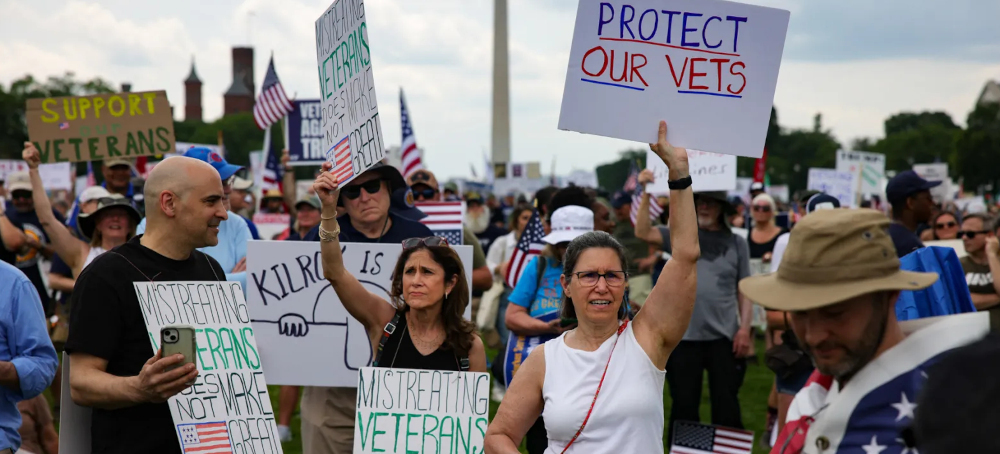 The 'Unite for Veterans, Unite for America Rally' to support veteran's rights and oppose policies of Donald Trump, in Washington, D.C., on June 6, 2025. (photo: AFP)
 The Massive Federal Abortion Ban You Didn’t Know Existed
Laura O'Connor Rolling Stone
Veterans Affairs prohibiting reproductive care in a post-Dobbs America will have devastating consequences. Advocates are suing
The VA banned abortion until 2022, when Joe Biden allowed it to provide abortions in certain cases, as well as comprehensive abortion counseling, while providing referrals to non-VA clinics where necessary. The administration’s lift of the ban came in response to the Supreme Court overturning Roe v. Wade, and the Trump administration reinstating it in a post-Dobbs America will have devastating consequences.
In May, the National Women’s Law Centre and Democracy Forward, on behalf of Minority Veterans of America, brought a lawsuit against the Trump administration challenging the legality of the ban, which also prohibits access to abortion counseling. For advocates, the ban is part of the MAGA movement’s wider attempt to covertly undermine reproductive freedoms. For the half a million (or more) veterans who have lost access to comprehensive health care, the ban represents a threat to their medical freedoms, and is part of a wider erasure of the countless sacrifices by women and non-binary veterans who served their country.
Ash, 41, served in the U.S. Army, including time overseas. For them, the ban is potentially life-threatening. Ash lives with a genetic blood clotting disorder and is on lifelong anticoagulant therapy. After a miscarriage and a pulmonary embolism, their hematologist told them to not get pregnant again, as it could cause another miscarriage, a heart attack, stroke, or another pulmonary embolism. “I am terrified of pregnancy,” Ash says. “I use VA for my health care, I can’t afford anything else.”
While Ash’s condition is genetic, veterans of all genders are far more likely to develop illnesses and disabilities, often a result of their service. Recent figures suggest that roughly half of veteran women who become pregnant have some kind of medical or mental condition that will negatively impact their pregnancy. “It’s well known in the veteran community now that there are higher risks towards veteran pregnancies, whether there’s exposure — toxic exposure issue — or just age,” says Dr. Kyleanne Hunter. “Most women spend their 20s in the military.”
Hunter is a Marine Corps combat veteran and CEO of the Iraq and Afghanistan Veteran Association (IAVA). After leaving the military, she completed a PhD on America’s women veterans at the University of Denver. “We are very opposed, as an organization,” she says, noting that the vast majority of members of the IAVA believe the VA should be providing full health care to veterans, including abortion. She and her network are also concerned about the future of reproductive health care: around 70 percent of health care professionals are trained in VA facilities, and are now unable to receive any kind of training around abortion. Even for young health care professionals who pursue gynecology and obstetrics, “now they’re unable to learn an essential piece of medical care,” Hunter says. “Even if things are reversed, we’ve still lost that many years of people actually being competent to do it,” meaning providing safe abortion and counseling.
Ash lives in Colorado, where abortion is accessible in civilian facilities. “As it stands in Colorado, I have less access to care than my neighbors,” they say, adding that it’s even worse for those living in more conservative states. “Veterans in red states are left with harrowing decisions to make.” Texas, for example — the state with the highest number of veterans in the country — has a near-total abortion ban, which has so far resulted in the deaths of at least two women who sought (and were denied) care following miscarriages of wanted pregnancies. More broadly, Rolling Stone found that all 13 states that have enacted near-total abortion bans have veteran populations at or exceeding the median of six percent.
The National Women’s Law Center and Minority Veterans of America are doing what they can to block the ban. “We brought this lawsuit because we really want to hold the Trump administration accountable for this attack on veterans and their health care,” says Lucy Zhou, senior council at the NWLC. The lawsuit argues that the administration “did not provide a reasoned explanation for changing the VA’s abortion care policy and relied on a flawed interpretation of governing law,” and, in doing so, violated the Administrative Procedure Act.
The Administrative Procedure Act dictates that a federal agency must publish a proposed rule change and give the public time to comment on the proposal and provide feedback. The agency is supposed to consider the feedback before implementing any rule, and explain their decision-making process when they do. In August 2025, the VA published the proposed ban and allowed a 30-day comment period (which Zhou says is considered very short), and received over 20,000 comments — the vast majority of which were opposed. Still, on December 22, the ban was quietly implemented without comment from Trump. “The Trump administration likely did not want people or veterans to know what they were doing,” says Jackii Wang, a senior legislative analyst at the NWLC. “From our knowledge and the veterans we talk with, nobody knew about this.”
The lack of transparency is also apparent in the ban itself. Zhou and Wang expressed deep concern over the lack of clarity around what constitutes life-threatening and counseling. “It could be the case that a provider has to wait until a veteran is on the brink of death before they can provide abortion care. And that’s not a place where we want anybody to be,” says Wang.
Many of the women who have died in the United States because of abortion-related issues, including sepsis and extreme blood loss, didn’t make it because physicians weren’t legally able to provide care until it was too late. Hunter describes a sense of “fear and confusion” among the physicians she’s spoken to, with Zhou adding that VA health care professionals “want to follow their ethical obligations but at the same time are concerned about their own liability if they were to provide care that they could then be prosecuted for.”
“The lawsuit asserts that the VA violated the administrative procedure act by wrongly concluding that VA does not have authority to provide abortion care, and by failing to substantively address public comments or provide a reasoned explanation for this decision making,” explains Zhou.
It is expected to take at least a year until oral arguments are heard, with the VA being expected to provide their initial response in the fall. While the ban is litigated, it will continue to remain in effect. In response to a list of questions from Rolling Stone, the VA said it does not comment on pending litigation.
Lindsay Church is a co-founder and executive director of the Minority Veterans Association, the organization represented in the lawsuit. They served in the U.S. Navy from 2008-2012. “I don’t think [the Trump administration] cares about us,” says Church. “I’m heartbroken, but I’m also really scared. I am genuinely scared for the veteran community.” Still, Church is resolved: “We’re never going to stop fighting. I have hope that we will see the end of this ban.”
One in three women veterans is also a survivor of sexual violence — including both Ash and Church’s mother, who served in the U.S. Army from 1978-1988. Sexual violence is pervasive in the military, and so is underreporting, with some estimating actual rates of sexual violence are two to four times of those reported. Hundreds of these sexual assaults occur in VA facilities. As Church puts it, a person could be raped within a VA facility, become pregnant, and be denied abortion care or counseling in that very same facility.
“This is all part of the Trump administration’s anti-abortion agenda,” says Wang. “They said they wanted to leave abortion to the states, they said they were not going to pass a national abortion ban — but here we are.” In the view of experts like Wang, the lack of clarity of the bill not only presents confusion, it also discourages veterans from seeking reproductive care, as they may assume or fear being denied. In essence, the ban is part of a wider movement to not only legally prohibit abortion access, but to cultivate fear and uncertainty around accessing and discussing abortion.
Veterans are able to seek an abortion privately, outside of a VA facility, if they pay out of pocket or can access insurance through a spouse, for example. However, not only do several veterans not have the financial means to seek this care, it also downgrades the level of care they may receive: civilian physicians aren’t typically used to working with pregnant people who have been exposed to toxic chemicals, war-related injuries, or military-related trauma. Moreover, for advocates and veterans, the very principle of veterans being denied health care in their own facilities is a fundamental erasure of the sacrifice they’ve made.
To Ash, the VA ban is the canary in the coal mine. “This administration is using service members, military families, and veterans as a test run for everyone else in the country,” they say. “They want to see what they can get away with and what they can push, through policy, that will affect people directly and how many people will speak up.” Beyond the abortion ban, the Trump administration has covertly proposed hundreds of billions of dollars of cuts to veterans’ benefits.
Hunter served for over a decade in the Marine Corp. After joining IAVA, she felt a sense of progress. She and others lament how this progress is now being undercut by the Trump administration. “It does feel like a regression. It does feel like there’s a very deliberate attempt to practically and normatively erase the contributions of women,” Hunter says with a sigh. “When you have things like health care access being restricted, it makes it very hard to believe that women are seen as actual equals.”
“The Constitution that I served included the right to an abortion,” says Church. “We are fighting the same battles that my mom’s generation fought.”