
The Huang Honey-Trap Scandal Sends a Message About Chip-Export Controls
Craig Singleton The Washington Post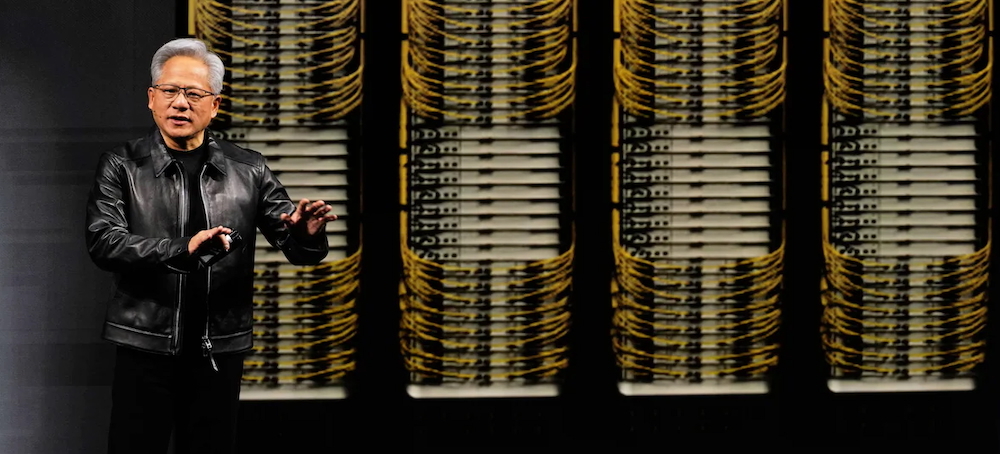 Nvidia CEO Jensen Huang in Berlin last month. (photo: Markus Schreiber/AP)
The Huang Honey-Trap Scandal Sends a Message About Chip-Export Controls
Craig Singleton The Washington Post
Democrats and Republicans disagree on nearly everything. They should work together to prevent China from winning the AI race.
The incident has spurred bipartisan scrutiny. The Republican chairs of three House committees have asked Huang to appear for a closed-door briefing. House Democratic leader Hakeem Jeffries (New York) said Trump administration officials would brief high-ranking members of the House and Senate from both parties, known as the Gang of Eight.
The Huang scandal underscores why Washington cannot leave chipmakers to police their own sales to China. Over the course of this Congress, lawmakers have examined how Chinese companies evade American chip controls. This year’s defense bill gives them a chance to close the gaps they uncovered.
Congressional investigations have found that Chinese companies smuggle advanced chips through middlemen, remotely access American chips in overseas data centers and buy chipmaking equipment from foreign suppliers operating under weaker rules. American AI developers have also reported that Chinese competitors use fraudulent accounts to access U.S. models. The competitors then use those models’ responses to train their own, a technique known as distillation.
Including a package of bipartisan measures in the 2027 National Defense Authorization Act would close many of those loopholes. One proposal would block sales of the most advanced AI chips to China and require the Commerce Department to certify that other chip exports would not come at the expense of existing orders from American companies. Others would block sales of key foreign tools China needs to make its own advanced chips and penalize foreign companies that use distillation to copy proprietary features of U.S. models without permission. Another measure would block Chinese companies’ remote access to restricted American chips abroad.
Failure to crack down on chip exports would jeopardize America’s AI leadership. U.S. private AI investment reached nearly $286 billion last year. Advanced chips let developers train better models, run more experiments and serve more customers. If these loopholes help Chinese AI providers overtake their American rivals, Beijing could gain influence over the platforms that businesses rely on and the rules governing their data. In doing so, Chinese firms would profit from breakthroughs American investment helped create.
China’s executives acknowledge that American chip-export controls are holding them back. Liang Wenfeng, founder of the Chinese AI start-up DeepSeek, called U.S. chip restrictions the primary obstacle to competing with American AI giants. Huawei founder Ren Zhengfei told the Chinese Communist Party’s flagship newspaper that the company’s individual chips trailed their American counterparts by a generation. U.S. export controls deny Huawei the key tools it needs to close that gap, which helps explain why Chinese diplomats keep pressing Washington to lift the restrictions. Tightening them would give the United States more leverage.
Washington needs that leverage because Beijing is using advanced computing to challenge American power abroad and tighten the CCP’s grip at home. China uses supercomputers to design weapons that can threaten U.S. warships. The CCP uses AI-powered facial recognition to surveil and detain Uyghur Muslims and other ethnic minorities. Beijing is also using AI to advance robotics and discover new drugs. Dependence on China for essential medicines would allow Beijing to squeeze Washington, just as it has by restricting exports of rare earths that U.S. manufacturers need.
Critics of chip-export controls argue that tighter restrictions spur China to develop work-arounds. But Beijing made semiconductor independence a national priority in 2014, years before today’s controls were announced. Billions in Chinese state subsidies cannot readily replace the advanced chips and manufacturing tools that Washington and its allies can keep out of China’s reach. Beijing is already pushing its companies to run AI models on Chinese chips, even as it seeks access to American ones. Selling more would give China the computing power it needs today while it builds the chip industry it wants to rely on tomorrow.
Democrats and Republicans disagree on plenty, but neither should want China to win the AI race. Congress does not have to choose between holding Trump accountable and helping him negotiate a trade deal with Beijing. Including these measures in the annual defense bill would give Democrats a standard for scrutinizing chip sales to China and strengthen Trump’s negotiating hand by taking America’s most advanced chips off the table. This Congress has roughly 50 days left to close the loopholes both parties spent two years exposing. Passing the buck buys Beijing time to catch up.