
The Grave Threat Posed by Donald Trump’s Attack on Jimmy Kimmel
Isaac Chotiner The New Yorker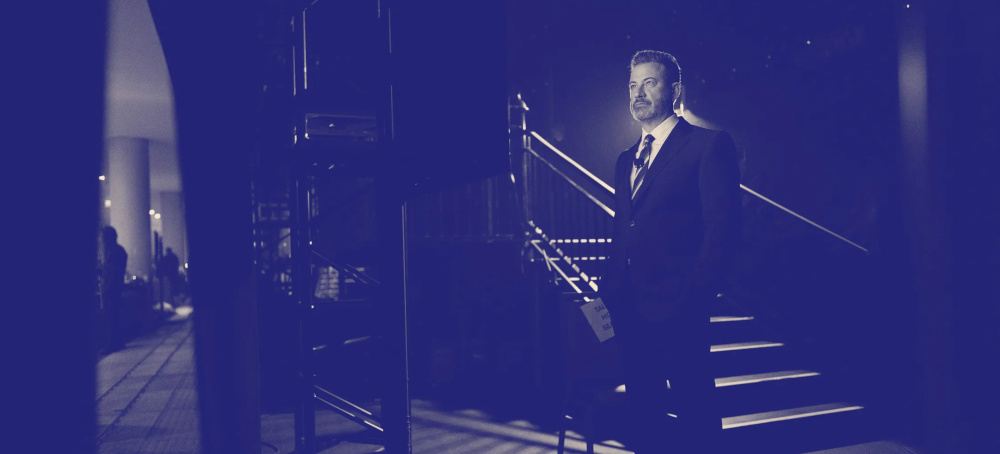 The President and his allies are using the power of the state to silence speech they dislike. (photo: Al Drago)
 The Grave Threat Posed by Donald Trump’s Attack on Jimmy Kimmel
Isaac Chotiner The New Yorker
The President and his allies are using the power of the state to silence speech they dislike.
To talk about Kimmel’s suspension, and more broadly about authoritarian leaders and their response to comedy, I called Michael Idov, a novelist and filmmaker who ran GQ Russia between 2012 and 2014, and wrote and directed the 2019 film “The Humorist,” about a fictional comedian in the late Soviet era. (Idov’s most recent novel is “The Collaborators.”) During our conversation, which has been edited for length and clarity, we discussed the similarities and differences between Trump’s and Putin’s approaches to cracking down on comedy and culture, the speed of Trump’s attack on institutions in his second term, and Russian comedy under Putin’s rule.
What did you think when you first heard this news about Jimmy Kimmel? What did it recall for you?
Slightly more than a decade ago, there was a spate of firings in the Russian media of more or less independent editors and producers who were one by one replaced by Putin loyalists. And an acquaintance of mine, in reference to several of these firings, coined a phrase that became a Russian meme at the time: “Links in a fucking chain.” Every time somebody would get fired and replaced, somebody would write “links in a fucking chain.” Honestly, that was my reaction. Last month, I saw that the Trump Administration declared that the National Endowment for the Arts’ creative-writing fellowships are going to be cancelled, and grants will now be contingent on writing on such topics as “Make America Healthy Again.” That to me was even more reminiscent of things I’d seen during my time in Russia.
It took more than a decade of Putin’s rule for the Russian Ministry of Culture to even start suggesting preferred themes to filmmakers and TV creators. And when they started suggesting themes, it was a scandal. Vladimir Medinsky, the Minister of Culture at the time, would say things like, “Oh, we want to see more films about heroic cosmonauts or the Olympics and the Second World War,” et cetera. People would say, “How dare he suggest topics like that?”
Can you step back and discuss the time line for the different changes in Russia? It seems like you are saying that they went after journalism before culture, to some degree.
Right. The first attacks on the news media came very early, within a year of Putin coming to power. In 2001, the network that was owned by an oligarch named Vladimir Gusinsky was taken over. And that was part of Putin’s first wave of consolidating power—in this case, getting out from under the oligarchs that helped put him in power. I would argue that the second wave came after 2004, in the wake of the so-called Orange Revolution in Ukraine. Putin and his people realized that they have to start paying attention to the internet and youth culture, and start creating these sort of AstroTurf movements, as well as generally keeping tabs on what’s going on in the online space. It had not occurred to them before.
But the overarching tendency here is that every time this happened, it was a reaction to an external event. Until the full-scale invasion of Ukraine, in 2022, repression of the media was always in response to something, and they took what they felt they needed and left the rest alone. Every time there was something that they wouldn’t touch. For example, glossy magazines were exempted for many years because the thinking went that, Well, the glossy-magazine culture is basically the urban élites talking to themselves, and we don’t really need to get into that space as long as we control TV news and daily newspapers. As time went on, the government felt it needed to control more aspects of the media and just the general informational space in order to stay in power.
Does the idea that these restrictions were often prompted by external factors fit with your answer that the early moves against the media were Putin trying to take power from the oligarchs who helped get him in power?
Well, I think that was the external factor. Putin saw firsthand, in 1996, under Boris Yeltsin, that a media strategy, which back then meant TV ads and skewed reporting, could swing an election. The first move was to close that loophole and to make sure that an independently held TV network with a robust news operation can never create a popular challenger to him. So that was the need. My long-held view on Putin is that he lacks anything resembling a master plan or a strategy. He is, however, a brilliant tactician with the sole purpose of surviving and keeping himself and his friends in power. And, basically, he will espouse any ideology or hold up or hoist any flag in order to make that happen. When, in the two-thousands, for example, it seemed more advantageous to present himself as a liberal reformer, he was a liberal reformer. When, in 2012, it was temporarily expedient to have Russia become almost like a religious state and really, really empower the Patriarch as one of the main decision-makers in the country, he did that.
This is the head of the Russian Orthodox Church?
Yes. And notice that we have not heard from him in a good while because he’s no longer necessary for the task at hand. The war with Ukraine is the unifying factor for the society, and all the attendant repression is basically to minimize antiwar sentiment, and, interestingly enough, to minimize unfettered pro-war sentiment, too. A lot of bloodthirsty nationalists are feeling the full weight of the repression because, in Putin’s eyes, the country requires the specific kind of war that he has been waging, which is popular, but not a total war that engages the entire population.
What do you think drove the later turn to cultural repression?
The first move was consolidating control while not particularly messing with the content. This is the era around 2012 or so—an era that saw the creation, for example, of the Gogol Center, Kirill Serebrennikov’s famous experimental theatre that became a hub for free expression, including very au-courant European plays and L.G.B.T. content, and so on. But all of that was financially tied to the Moscow Department of Culture, and to the regional government’s budget. And that was the thread they ultimately pulled to undo this entire enterprise—by accusing Serebrennikov of embezzling the state budget, which he absolutely did not do. [The Gogol Center was permanently closed in June of 2022.]
So, the first step was basically just to gain control that can be exercised when needed, but not necessarily immediately. The Russian Ministry of Culture, for example, functioned the way most European ministries of culture do. They would finance opposition-minded art. They would finance things critical of the government, including, partially, my film, which had about ten per cent of its budget come from the Russian Ministry of Culture, in 2017. They never questioned the content and never exercised any pressure to drive the content, which I found shocking, to be honest.
But by that time the Russian Ministry of Culture was putting an emphasis on more patriotic stories and censoring certain things, correct?
Correct. A lot of it was presented to the public as the personal quirks of Medinsky, who is this kind of quack revisionist historian. His decision to withdraw the distribution license for the film “The Death of Stalin” was a scandal at the time. The film was banned in 2018. And there were investigative pieces that trace that decision to Medinsky himself screening the film for his buddies and going off of their reaction to unilaterally ban the film. When that happened, it was still scandalous.
It’s true that the law banning “L.G.B.T. propaganda” was in place. So films would get cut—gay and lesbian content would be cut from films. I have to say that was also done with the full acquiescence of U.S. rights holders.
So you’re saying that Hollywood would make movies, they’d sell them to the Russian market, the Russian market would cut out parts that were objectionable, and the Americans would allow it?
Yeah, and that was that. At that point, the idea that you could actually weaponize the bureaucratic formality of a distribution license to keep a film you don’t like out of theatres was still novel. And now it is normal. All these processes have been honed since then. But it wasn’t that long ago that these things seemed out of the ordinary.
How would you define the role that the culture ministry plays now?
Well, the full-scale invasion of Ukraine was the absolute game changer in all of this. Many of the best and the brightest have left the country. The stuff that’s getting produced in Russia now is either historical and patriotic content, or a sort of great collectivist celebration of the glory of Russian society. There’s a new TV series that is basically a Western-style bio-pic of Peter the Great, which was, of course, shown on the main state channel. It is the No. 1 TV network in the country. It is what the BBC is to the U.K. And one of the lead consultants on this TV series is a man often described as Putin’s personal priest. That is where we’re at right now.
What was the comedy scene like in Moscow in the early years of Putin’s rule, and during your time there in the early twenty-tens?
Let’s not idealize the Russian comedy scene because there’s not much there that’s up to the world’s standards. I will say that, when I was in Russia in 2012 through 2014, it was a really interesting transitional period because there were really cool young comedians, like Idrak Mirzalizade, who were basically discovering the alternative or indie comedy of the current Western sort and trying to work within that paradigm. But the mainstream comedy scene was still a “take my wife, please,” safe, domestic kind of comedy that’s built on really basic patriarchal values and does not challenge them in any way, shape, or form. And that’s the stuff that still remains. After 2022, every promising or talented comic left the country. Idrak Mirzalizade was actually run out of Russia, in 2021, on the strength of a joke he made before the full-scale invasion even started. He’s a Belarusian citizen. He was barred from entering the country.
What was the joke?
Mirzalizade is Muslim, and he was riffing on how a lot of Russian apartment-rental ads openly say that the owners are only renting the place to Slavs. The joke was about how, in one apartment he moved into, whose previous tenants were Russian, the mattress on the bed had shit all over it.
Maybe not headed for a list of the greatest jokes, but that doesn’t matter.
Right, exactly.
How much was Putin the source of comedy in the year before the full-scale invasion of Ukraine?
He doesn’t give you a lot of material because he’s kind of a faceless, gray little man. And I think that a lot of jokes about him were actually fairly amiable in the first few years because people were so tired of Yeltsin and his alcoholic antics that somebody like Putin was a welcome reprieve. The main source of jokes in the beginning was the incongruity of his warlike rhetoric coming from such a small, unassuming K.G.B. guy. But every time he did something meme-worthy, that would stick around for years or decades. For example, in the two-thousands, at one of those tightly choreographed meetings with the electorate, he approached a little boy and lifted his shirt and kissed him on the stomach. That, for some reason, inflamed people’s imaginations for the next ten years. As Putin ages, there are more and more jokes about his body doubles, Saddam-style. Each double has a funny nickname, etc. Each supposed double, I should say.
A lot of Trump’s attacks on the media and on comedians seem driven by his personal annoyance with being made fun of or criticized. Was that ever the sense in Russia?
No, I think Trump has a clearer model in mind that he and his government apparatus are emulating, which is less Putin and more of a mix of Viktor Orbán and possibly Recep Tayyip Erdoğan, in Turkey. I think they have more of a strategic vision and accomplished it faster. On the other hand, a lot of it seems driven by Trump’s personal character.
Up until very recently, ninety-nine per cent of censorship that I’ve witnessed in Russia and in Russian culture was self-censorship. In a way, it was middle managers trying to divine which way the wind blows and preëmptively complying with rules that were never really written down. Now, even when repressive laws and laws curbing freedom of speech—such as the anti-L.G.B.T. propaganda law, or another law that makes it easy for any offended party to sue anyone in a criminal court—were passed, the application was very capricious and unpredictable. What you saw was a lot of anticipatory compliance with laws that weren’t even on the books. One can argue that that’s what we’re seeing in the U.S. right now, too. But of course, again, the full-scale invasion of Ukraine has been a huge factor because now it’s not up to the middle management to figure out where the red lines are. Everything is a red line.
In Putin, we have an enigma who does not do a lot of public speaking, and doesn’t always make it clear to everyone what he wants. But, in Trump, we have a President who posts, we have a President who constantly issues edicts—and they’re incredibly micromanaging edicts. It’s a completely different situation because his flunkies don’t need to guess and the media managers don’t need to guess what the wind in Washington is like. He goes online personally and says, “Get this guy or that guy off the air.” Which, again, Putin has never done.