
The Founders Warned Us About A Man Like Trump
John Avlon Rolling Stone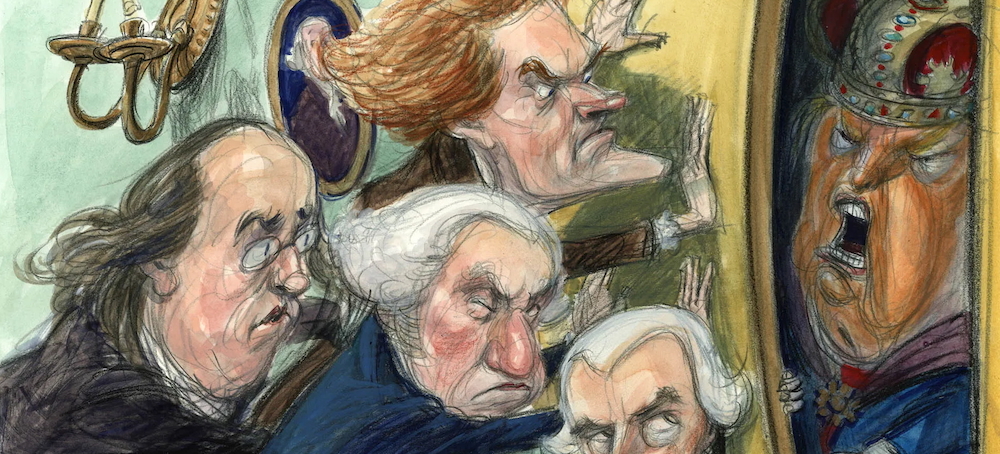 "The U.S. Constitution was designed to protect the rights of the people against the rise of a would-be tyrant." (image: Victor Juhasz/Rolling Stone)
 The Founders Warned Us About A Man Like Trump
John Avlon Rolling Stone
Trump allies call for deranged misogynistic crackdowns, while immigrants still fear for their families.
Sorry. Let me explain. For months, legal experts have been expecting the Supreme Court to rule against Trump’s executive order that attempted to end birthright citizenship; those expectations were met earlier this week. I knew that when the ruling was announced, the administration and its allies would fire back at the justices, which they did. But while I’m fairly familiar with MAGA world, I’m no Will Sommer, which is to say: I was simply not ready for the cuckoo-bananas direction MAGA went in response to the Trump v. Barbara ruling.
White House deputy chief of staff Stephen Miller went, predictably, nuts. After bizarrely comparing America to a plane and citizens to trained pilots, he got down to his real concern: namely, that people from ‘shithole’ countries aren’t fit to be Americans.
“We have people from all over the world—from third world nations, nations that on their own would have never invented the wheel, let alone modern technology, let alone medicine, let alone air travel—and they can just come into the country, have a baby in a hospital, paid for by you and me, and then that baby is automatically a citizen?” Miller fumed. “That baby can sit on a jury when he turns 18, and sit in judgment of . . . me?”
Alonso Gurmendi, a fellow in human rights at the London School of Economics, had Miller’s number when he responded, “This is straight out of Mein Kampf. . . . the idea that the Aryan race invented culture/technology and so a Pole or a Slav could never be truly German is the core foundational idea that gave birth to Nazism.”
The Daily Wire’s Matt Walsh suggested that because the Supreme Court had reaffirmed the law of the land, ICE should step up its enforcement activities. The reactionary influencer threw in an extra gibe for good measure that seemed to make light of the murder of Renée Good.
“Now that SCOTUS has opened the floodgates for foreign invaders to flock across our borders and spawn, the only choice we have is to triple down on immigration enforcement,” he ranted on X. “Militarize the border. Mass deportations. Round every illegal up. Don’t pull back when the lesbian activists start screeching about it. Use whatever force is necessary. There is no other option.”
Demonstrating that his bigotry isn’t limited to immigrants, Walsh added that Republicans should learn the obvious lesson from Amy Coney Barrett’s role in the ruling and stop nominating female justices.
“The worst Supreme Court Justices of all time have all been women,” he complained. “That’s just a fact. Republican presidents should take the hint.” I’m curious what Walsh would say if someone were to ask him if he thinks Barrett is a worse justice than the authors of Dred Scott or Plessy v. Ferguson. Actually, on second thought, I’m not curious about that.
Derrick Evans, a pardoned January 6th rioter and Republican former West Virginia state legislator, kept the xenophobia short and to the point.
“If you see a pregnant foreigner, contact ICE immediately,” Evans wrote. “The future of our country depends on it.”
But the most truly deranged response to the Court’s ruling came from Sean Davis, the CEO and cofounder of Trump fansite the Federalist. Davis claimed that because Barrett and Chief Justice John Roberts had chosen to “nullify” the Fourteenth Amendment, states should in turn effect the “nullification” of birthright citizenship by refusing to issue birth certificates to non-citizens. But that suggestion was just a warm-up, as was his recommendation for Republicans to pack the court. He really got rolling with recommendation #3: “Deny entry to all pregnant foreigners.” Too much of a hassle to ascertain who’s pregnant? Perhaps we should then “deny entry to all female foreigners” instead. Or simply require the “sterilization of all foreign visitors prior to entry.”
Forced sterilization. America is back, baby! It’s remarkable to think that “dissolution of the union” was not the craziest suggestion on Davis’s list.
But what should we expect? It’s clear that the MAGA coalition, at least at the elite and influencer levels, has become fully radicalized on race and immigration. It’s dark out there, and the darkness makes it even more important to continue the work of throwing light on the stories of immigrants as well as the Trump administration’s attempts to push immigrants out of the country. With the right’s self-appointed leaders joining the Sean Davis chorus, it’s not hard to see why this issue—and the extremes in play—aren’t going away soon.
Future—and Retroactive—Punishment of Babies
When I tried to interview some birthright citizens immediately after the Court’s decision, I repeatedly heard that they were afraid to speak out; they didn’t want to put a spotlight on themselves and their families. Some were open to talking at first but then backed out, worried for their parents who are either not citizens or are only green card holders. That was a clear theme in my conversations: a palpable fear not just for the citizenship status of future generations but also for residents and children with citizenship already.
Here’s what I mean:
Estrella Lopez, 19, is a U.S. citizen whose mother is active with We Are CASA, an immigrant-rights organization. When the birthright citizenship ruling came down, she was in Maryland with her aunt and her baby nephew. “We felt so happy, we cried. My mom got happy. She’s been part of CASA fighting for this,” Estrella said.
“I was there with my nephew and felt complete happiness. I feel like I felt his future in my eyes. I feel so emotional right now due to the fact that this was even a thought—something we even had to fight for . . . that there was something in the Constitution they wanted to destroy.”
While her nephew is a U.S. citizen and Trump’s executive order was written to apply to children of parents in the country illegally after February 19, 2025, Estrella was still afraid. If the ruling had upheld the executive order, “my nephew would be unsafe, his place in this world revoked, his citizenship could have been taken away. He was not in danger, but it felt like he was in danger and his citizenship could be taken.”
Estrella was not alone in worrying that retroactive revocations of citizenship could follow.
Rosa, 34, a food vendor in Las Vegas, has a pending asylum claim based on domestic violence she endured in El Salvador. Her 18-month-old baby is a U.S. citizen, but instead of feeling more confident after the ruling, Rosa too worried the administration might seek to revoke it had the ruling been different.
“I was afraid about that,” she told me. “It would cause a huge impact in our lives because children born here have benefits and opportunities when they become adults.”
Beyond the fact that our country was looking to create this group of second-class citizens, the logic behind this fear is all too understandable. If the Trump administration could change the plain-language meaning of the Constitution by fiat and then have that assertion affirmed by conservatives on the Supreme Court, then immigrants may well have been right to ask: Are my children safe?
“I heard it was possible—that this could affect our future kids, that they would suffer these consequences,” Rosa told me.
Another Salvadoran I spoke to, this time a Temporary Protected Status holder, felt a double blow after the last week of Supreme Court rulings. Not only did she fear losing her TPS and mass de-legalization, she worried about her immediate family.
The woman had immigrated to California with her parents and her sister in December 2000 and received Temporary Protected Status as a result of the devastating 7.7 earthquake off the coast of El Salvador in January 2001. The status allowed her to live and work in the United States. Her fear, she told me, was that the Trump administration might have targeted people, like her parents, who had recently become residents with green cards based on familial relationships with birthright citizens.
Murad Awawdeh, the executive director of the New York Immigration Coalition, told me such fears are totally comprehensible. The Court’s ruling on TPS last week gave Trump “a loaded gun” aimed at 1.3 million people, he said.
A birthright citizen himself, Awawdeh was “on pins and needles” until that decision was announced this week. But even after the ruling, the future of birthright citizenship remains uncertain to Awawdeh. “Legally, for now” it’s safe, he said. But “we all have to continue to fight for all of our rights, because when the government tries to convince us some people have rights and others don’t, none of us do.”
He summed up the challenge by quoting Ronald Reagan: “If we ever closed the door to new Americans, our leadership in the world would soon be lost.” That sensible sentiment, Awawdeh suggested, would seem radical to MAGA types.
“My fear was what it says about this country that we even entertained the idea that some babies born on American soil count less than others,” Awawdeh told me. “That’s not a legal debate. That’s a confession that America still questions whether some of its children are truly its own.”
Elon Musk is newly minted as humanity’s first trillionaire, but the world’s richest man seems grumpy. And he definitely is not a fan of mine.
“Kristof is lying through his teeth,” he announced on social media this week.
I got on his nerves for pushing back at his claims that his demolition of the United States Agency for International Development last year did not cost lives. The fracas began after Representative Ro Khanna, a California Democrat, said that Musk had “possibly sentenced to death” a large number of children, and Musk retorted that it was “time to sue this liar.”
“There is not even a single dead child!” Musk protested on social media. I noted that I had met many families of children who had died — and that’s when he concluded that I was lying.
Musk’s assertion that not a single child died is absurd, yet he doubled down: “They cannot cite a single name of someone who died out of the ‘millions’ they falsely claim have died. Not a single name!”
On X, I began to give Musk some names. Let me elaborate:
Jibia was a 10-year-old girl, ranking third out of 58 students in her fourth-grade class in Rwamwanja, Uganda. Aid cuts meant that the local clinic ran out of $2 bed nets to protect from mosquitoes, as well as anti-malaria medicines. Jibia died of malaria last July, her mother told me outside the family home. Medical records confirmed that, and health workers told me that she would have been fine without the aid cuts: Replacing her tattered bed net with a new one could have prevented malaria, and in any case drugs would have helped her to recover promptly.
Yamah Freeman hemorrhaged while pregnant with her third child in her village in Liberia. The United States had provided ambulances to the local hospital, but the aid cuts under Musk and President Trump meant that the ambulances had no fuel. The strongest young men in the village placed her on their shoulders and raced down the path toward town, shouting encouragement to her as they ran, but she bled to death along the way. Her parents and sister told me about this, and I visited her grave.
Achol Deng, 8, had been infected with H.I.V. at birth in South Sudan but had been kept alive by American-provided medicines costing just 12 cents a day. The dismantling of U.S.A.I.D. and the resulting chaos meant that she lost her caseworker and access to medicines, and soon died of an opportunistic infection, health workers told me.
I could keep going. A Boston University researcher estimated that the aid cuts have cost more than 750,000 lives worldwide. A study published in the Lancet, the British medical journal, forecast that at present rates, the aid defunding will cost 9.4 million lives by 2030.
These figures may not be accurate; we just don’t have solid mortality data, and the aid cuts have also reduced data collection. What I can say after visiting numerous impoverished villages is that aid cuts are unquestionably costing the lives of many children.
Some prominent conservatives leaped to the defense of Musk, saying in effect: Why is it our job to save the lives of children in South Sudan? Why don’t rich liberals write checks? Why don’t other countries do more?
Those are fair questions. But if any of us came across an ambulance that had run out of gas with a hemorrhaging woman inside, surely we would happily hand over a $10 bill to save her life.
Until Trump’s second term, American aid cost just 23 cents for every $100 of gross national income and saved a life approximately once every 10 seconds. Seems like a bargain to me. Certainly it appears wiser than spending billions of dollars on a war with Iran.
I say “wiser” because all this is not just about compassion but also about self-interest. Aid money serves national security and protects us from diseases. I’ve noted that the current Ebola outbreak in Africa may have gotten out of control precisely because we cut aid spending in the region.
Yes, other countries should do more, impoverished countries should be less corrupt, and our own aid can be allocated more wisely. But note that some countries in Europe are significantly more generous than America, spending up to 10 times as much on aid as a share of national income as we do.
Should liberals donate more to humanitarian causes? Sure. But compassion isn’t a liberal impulse — it’s a human one. It was evangelicals and Republicans who in 2003 started the single best aid program ever, the President’s Emergency Plan for AIDS Relief, or PEPFAR; it has saved more than 26 million lives so far. Some of the most heroic aid workers I’ve met in dangerous locations have been Christian missionaries, from nuns to doctors; they would dispute the idea that empathy is woke.
It’s reasonable to ask how much we should spend or how we should reform the system. But why would anyone begrudge $2 bed nets or $4 malaria vaccines to save children’s lives?
So let me offer a challenge to Musk: Come with me on a reporting trip to South Sudan or Somalia or Mozambique. Meet starving children whose lives can be easily saved. Hold them. Look into their eyes. Talk to their terrified moms.
You’ll understand that these kids are just like ours, except that they didn’t do as well in the lottery of birth — and that just because we can’t save every child’s life doesn’t mean we should save none of them.