
‘The Dirtiest, Worst Oil’ Is in Venezuela
Phil McKenna Inside Climate News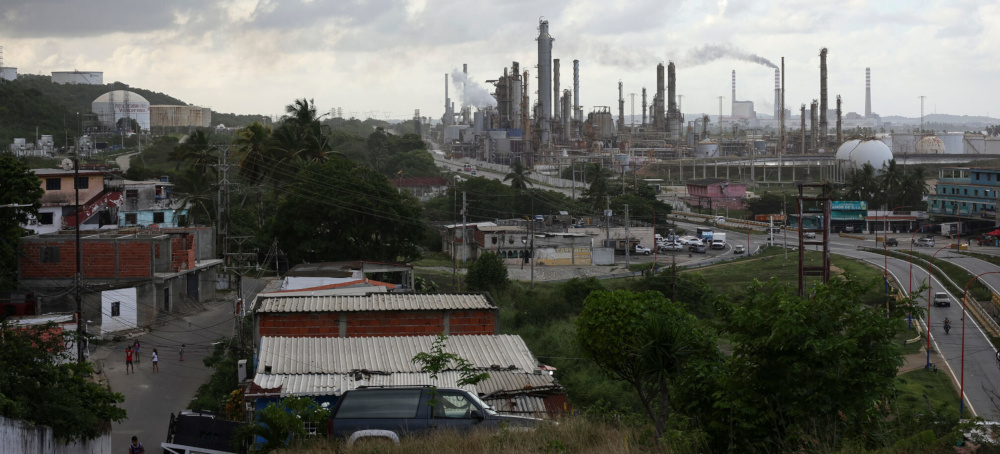 A view of the El Palito refinery operated by Venezuelan state oil company PDVSA. (photo: Jesus Vargas/Getty)
 ‘The Dirtiest, Worst Oil’ Is in Venezuela
Phil McKenna Inside Climate News
The country’s “extra heavy” oil packs some of the highest associated greenhouse gas emissions of any crude oil.
Following the capture of Venezuelan President Nicolás Maduro by U.S. forces, President Donald Trump said, in a social media post on Tuesday, that the country would turn over 30 to 50 million barrels of high quality crude oil to the U.S. However, Trump himself previously stated that Venezuela’s oil is “the dirtiest, worst oil probably anywhere in the world.”
Venezuela’s “extra-heavy” crude is a thick, tar-like substance that typically must be heated to bring it to the surface and diluted with other chemicals before it can move through pipelines.
“It takes a lot of energy to heat the stuff and get it out of the ground and then get it to move and flow, and then turn it into normal products,” said Deborah Gordon, senior principal in the Climate Intelligence Program and head of the Oil and Gas Solutions Initiative for RMI, a nonprofit focused on clean energy. “And every energy input means a lot of emissions.”
Greenhouse gas emissions from heavy crude oil production, refining and use are, on average, 1.5 times higher than those of light crude oil, according to a 2018 study published in the journal Environmental Research Letters. The study, co-authored by Gordon, assessed the climate impact of 75 different crude oils worldwide.
Heavy crudes are also low quality oils that require more refining, which further increases the energy used to bring the fuel to market and its associated emissions, said Adam Brandt, an energy science engineering professor at Stanford University and the lead author of the study.
Oil from Venezuela, the majority of which is extra-heavy crude, has the second-highest carbon intensity of oil from any country, a policy paper published in 2018 by Brandt, Gordon and others in the journal Science concluded.
An updated analysis by RMI’s oil and gas climate index, based on 2024 data, found that oil from Venezuela had the highest carbon intensity among 55 leading oil-producing countries.
“Just because this hydrocarbon exists doesn’t mean that it should be marketed or taken out of the ground,” said Gordon, who is the author of No Standard Oil, a book that looks at the varying climate impacts of different crude oils. “If there is demand, there are far better places to go than Venezuela.”
Leaks and intentional venting of methane gas associated with oil production in the country contribute to its outsized climate impact. Methane is a potent greenhouse gas. On a pound-for-pound basis, it is more than 80 times worse for the climate than CO2 over a 20-year period.
Venezuelan oil had the second-highest methane intensity among leading oil producing countries in 2023, according to the International Energy Agency. The country’s high leak rate is due in part to ongoing oil and gas sanctions, which have led to poor resource management, Gordon said.
A lack of proper maintenance has also led to frequent oil spills. Venezuela’s state-owned oil company Petróleos de Venezuela, S.A., reported more than 46,000 oil spills between 2010 and 2016. The company hasn’t reported any spills since then. However, in 2020, the head of Venezuela’s Unitary Federation of Petroleum and Gas Workers, a labor union, estimated that oil spills occur almost daily in some states.
Despite Trump’s pledge to open Venezuela’s oil reserves to U.S. companies, that may not result in increased production.
Simply maintaining current production levels in Venezuela would require $53 billion in new energy infrastructure investments according to an analysis released Tuesday by Rystad Energy, an independent energy research and business intelligence company headquartered in Oslo, Norway.
Kirk Edwards, president of Latigo Petroleum, an independent oil and gas producer based in Odessa, Texas, called the U.S. government’s recent actions in Venezuela a “nothing burger” for oil markets.
“This is not ‘drop a rig and up comes the bubbling crude,’” Edwards wrote on LinkedIn. “Any real turnaround would require $50–100 billion of sustained investment, modern infrastructure, and years of political stability.”
Edwards said companies are unlikely to make that investment given current low oil prices.
Gordon said Venezuela’s oil and gas sector will continue to have an outsized climate impact, whether production increases or remains in its current state of disrepair.
“They’re just basically throwing stuff into the air,” Gordon said of current methane emissions.