
‘The Day of Accountability Has Arrived’
Adrian Carrasquillo The Bulwark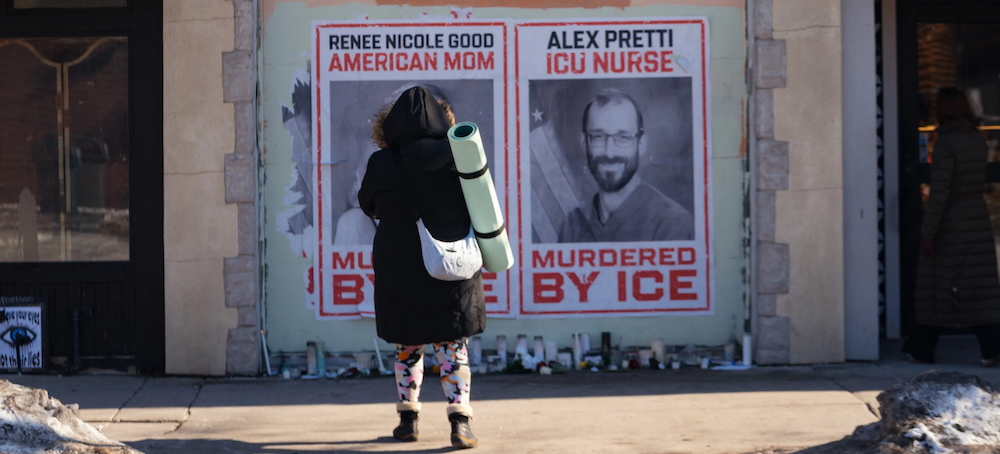 Posters displaying images of Renee Good and Alex Pretti in south Minneapolis on Jan. 29, 2026. (photo: Ben Brewer/Bloomberg/Getty Images)
‘The Day of Accountability Has Arrived’
Adrian Carrasquillo The Bulwark
The families of Alex Pretti and Renée Good are demanding answers. Plus: Remembering Dolores Huerta.
“This is not normal. This is not justice. This is morally wrong,” he continued.
Michael and Susan Pretti join the family of Renée Good in demanding action from a government that has killed and slandered their loved ones while refusing to hold its agents accountable for their actions. Neither family wanted to take on such a public role; the Prettis make clear they do not want to be seen as political activists. Yet it’s likely that the only way these families—and the many more victimized by ICE—will see real justice is through political action leading to political change, starting with the midterm elections.
But the Prettis didn’t foreground politics at their press conference on Tuesday. The main thing they conveyed was their grief. They talked about missing their son—his big heart, his warmth, his humor, his intolerance of bullies. Michael described their tight-knit Midwestern family. He wishes he could chat with his son about cars and hiking.
Minnesotans have maintained a memorial for Alex, a subject that brought Susan Pretti close to tears. “I save every post, I save everything that is ever written. It’s my only connection,” she said. “So for everyone that says anything about Alex, we read it, we keep it, we cherish it.”
Michael added that they have received over two thousand letters. “[We] read every single word, every single card.”
But memories of their son naturally point back to the manner in which he was taken away from them. And as parents and as citizens, they want justice. “Michael and I are not asking for any special treatment,” Susan said.
We do not want to be on TV. We are not political activists, nor do we want to become political activists. All we want is justice for Alex. We are here today to simply request that the federal government treat us with the dignity and respect that our son deserves.
Dignity and respect would signal a change in the government’s M.O. when it comes to the Prettis, who have received a combination of silence and lies from the Department of Justice about Alex’s death. The DOJ has also refused to cooperate with a state investigation into the killing.
“He was peaceful, he was observing, he was not protesting, this was not a protest that Alex was at. His hands were in the air when he was tackled to the ground, he was face down on the ground when he was executed,” Michael said. In the immediate aftermath of the killing, the Trump administration did not reach out to Pretti’s family. Instead, cabinet members went on TV and implied he was a domestic terrorist.
“Imagine that your child was killed by the actions of the federal government. Imagine learning that your child had been murdered by watching it on TV. No one from the government called us that day. They didn’t call us the next day nor the next, nor the next 275 days,” Michael said.
The Prettis called on Daniel N. Rosen, U.S. attorney for the District of Minnesota, and Attorney General Todd Blanche to “stop shielding Alex’s killers” and to resume sharing information with state-level investigators.
Renée Good’s family held a similar press conference earlier this month, announcing the filing of two related civil lawsuits against the U.S. government and against the individual Trump officials who oversaw the failed immigration enforcement operation in Minnesota last winter: White House deputy chief of staff Stephen Miller, disgraced former DHS chief Kristi Noem, former acting ICE director Todd Lyons, former Border Patrol commander Gregory Bovino, and even Corey Lewandowski. The agent who shot Good, Jonathan Ross, is also named in the latter suit, along with ten anonymized “John Doe Federal Agents.”
“The day of accountability has arrived for our own U.S. government and its governmental agencies ICE and CBP,” Antonio M. Romanucci, an attorney for Good’s family, said. “Our country cannot tolerate unjustified and excessive use of force, let alone deadly force on ordinary people who are exercising their rights under the Constitution of this country.”
ICE agents, like Jonathan Ross, who shot Good, and Border Patrol agents, like the ones who killed Pretti, are not above the Constitution, Romanucci added.
“There is no such thing as impunity when it comes to violating protected rights,” he said. “When government power crosses the line, there must be accountability.”
Once again, accountability requires political action leading to political change. But there’s reason to think that lesson is catching on. Hundreds of people, for example, have left “I Voted” stickers on the street memorial in Houston to Lorenzo Salgado Araujo, the homebuilder murdered by ICE this summer.
People want accountability for the dead, but not only for them. The administration dirties its hands every day. The same bureaucratic cruelty that provides cover for federal agents who have killed people in the street also causes processing slowdowns for people seeking to change their immigration status. That bureaucracy masks the reality of indefinite immigration detention, which is often brutal to detainees.
Yesenia Santiago, 28, is a U.S. citizen from Austin whose husband Lucas Santiago Martínez has been detained at T. Don Hutto Detention Center in Taylor, Texas since September 21. Santiago Martínez’s story might sound familiar for how it resembles the stories of so many others who have been taken by immigration enforcement: He has no criminal record and worked as a builder for six years before starting his own carpentry company. He was on the way to work when he was detained.
The family has been working to regularize Santiago Martínez’s legal status. Based on his wife’s citizenship, Santiago Martínez is eligible to adjust his status and receive permanent residency. But because he entered the country without inspection, he needs a waiver, which they have petitioned for. This process used to take one to two years. Yesenia says that the family is now working with a timeline of 53 months.
The situation is urgent. The couple’s 14-month-old son misses his father, unable to understand why he is gone. Yesenia is pregnant and has been warned by doctors that the stress may induce premature birth. And with her family’s financial anchor unable to provide, Yesenia has struggled to secure basic necessities. The family has started a GoFundMe to cover her husband’s legal bills. They are otherwise beyond her means.
With this situation weighing heavily on her, Yesenia voted early on Thursday. She wants people to know that their vote can change things for Americans like her. “Lucas has a registered company, his family is here, he’s not a flight risk,” she said. “He should be out fighting his case on bond but instead is being detained the whole time, which is directly linked to who we have voted for.”
We lost a giant on Wednesday, but the legacy of her relentless spirit lives on.
That was the message from organizers, advocates, and Democratic lawmakers following the death of Dolores Huerta at the age of 96. Huerta was an icon of the labor movement that brought often-exploited farmworkers into the public consciousness in the 1960s and kept them there after. A political force who long worked with Cesar Chavez to protect workers and immigrants while electing Democrats willing to advocate for those communities, Huerta remained active for decades. She coined the slogan “Sí se puede,” which means “Yes we can” in Spanish—an inspiration, years later, to Barack Obama. A truthteller, Huerta revealed publicly this year that Chavez had raped her.
A source close to Huerta and her family told me she was diagnosed with cancer this year, and although given months to live, she succumbed faster than expected. But despite her age and diagnosis, Huerta remained politically active, endorsing candidates and calling Donald Trump’s immigration crackdown “ethnic cleansing” at a No Kings rally last year. Shortly before the rally, she had filed a petition with the United Nations Human Rights Council urging an investigation into potential human rights violations by the administration.
She was remembered Wednesday by people who knew and worked with her as a hero in a time of cowards. But her colleagues and loved ones also spoke of someone as fun and personable in person as she was larger than life when leading a rally. One Democrat I spoke to recalled a spooky season “Twerk or Treat” house party on Capitol Hill in 2013 where they saw Huerta. At the spry age of 83, the activist drank shots with the partygoers and held court with them, talking at length about the immigrant rights movement. Still others I spoke to recalled her as a salsa dancer with enough endurance to outlast far younger people into the night: “It was a common story: ‘Why are you going to bed? We’re just getting started.’”
Democratic organizer Jess Morales Rocketto, who got to know Huerta over the past decade, noted that Huerta’s importance owes something to there being fewer well-known heroes in the Latino and labor space. Rocketto said young people know Huerta because “she did it for life.”
“It was so known that if you called Dolores, she would say yes, up until her death she was fighting for things she believed in,” Rocketto said.
Those who worked with Huerta remember one thing about her above all: She never gave up.
“Today we grieve Dolores Huerta and grieving her honestly means refusing to slow down,” Obama and Biden administration alumna Nathaly Arriola told me. “With days left before an election that will shape the lives of farmworkers, immigrant families, and working people across this country, the best tribute we can offer is to leave it all on the field. That is how we will honor her and the movement that raised us.”
That sentiment is why Rocketto has launched “Do It for Dolores,” a digital campaign to motivate people to vote in her name.
“If you don’t want to vote for any of these guys, vote for Dolores, cast your vote in her memory,” Rocketto said. “That’s what she would have wanted—that’s what she worked for her entire life.”