
The Antifa Trial
Rachel Monroe New Yorker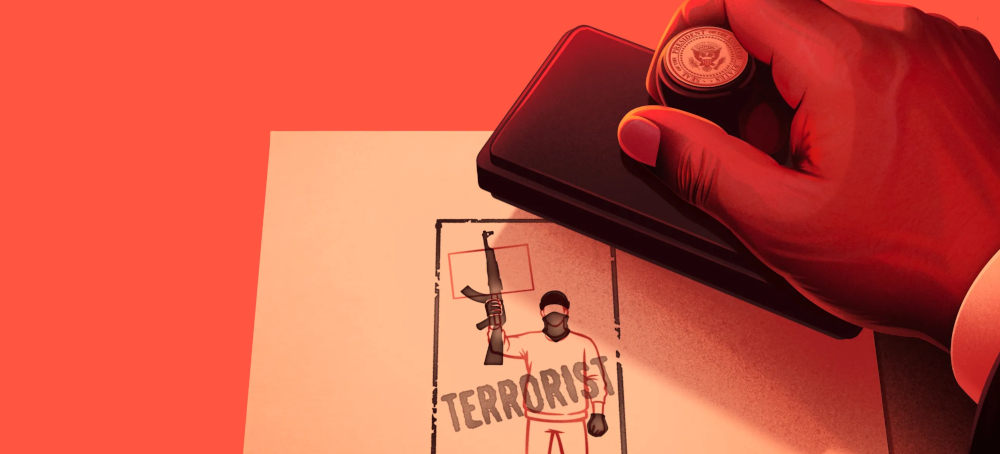 The trial of supposed Antifa members after a shooting at an ice facility is part of a disturbing strategy. (photo: The New Yorker)
 The Antifa Trial
Rachel Monroe New Yorker
The trial of supposed Antifa members after a shooting at an ICE facility is part of a disturbing strategy.
Initially, Song and others who were at Prairieland that night were charged with attempted murder. Then, on September 10th, the conservative activist Charlie Kirk was killed at an outdoor event at a college in Utah. President Donald Trump blamed the assassination on “the radical left” and vowed a crackdown. For years, Republicans had used the term “Antifa” as a catchall for left-wing activists; in the days after Kirk’s death, Trump issued an executive order, declaring Antifa a domestic terror organization, and a Presidential memorandum, directing federal resources to investigate and disrupt financial networks that fund left-wing domestic terrorism. During a roundtable on Antifa, which featured a mixture of conservative influencers and government officials, then Homeland Security Secretary Kristi Noem called Antifa “just as dangerous” as Hamas, Hezbollah, and ISIS. In November, prosecutors released a new indictment that referred to the Prairieland defendants as “operatives” in a “North Texas Antifa Cell” and added the charge of material support to terrorists.
The Prairieland case was billed as the federal government’s first indictment of a purported Antifa cell. Earlier this month, nine defendants were found guilty of various charges, eight of them for providing material support for terrorism. (Song was also convicted of attempted murder.) “Today’s verdict on terrorism charges will not be the last as the Trump Administration systematically dismantles Antifa and finally halts their violence on America’s streets,” Attorney General Pam Bondi said of the convictions.
The three-week federal trial of the nine Prairieland defendants took place in a Fort Worth courtroom that had the ambience of a mid-century steakhouse: warm wood-panelled walls, dim lighting, murals of Texas Rangers on the wall. The defendants’ family members jockeyed for spots in the cramped space. One morning, Amber Lowrey, the sister of a defendant named Savanna Batten, showed up early after dropping her kids off at school. Lowrey told me that her younger sister had been acutely aware of the suffering of others, human and nonhuman, from a young age: “When she was twelve, she became vegan, and she never wavered. It was just immediate.” As a teen-ager, Batten was the president of Animal Connection of Texas, an animal-rights nonprofit, and lobbied for restrictions on travelling circuses. After her arrest in July, she was kept in solitary confinement for months. “She’s very well read, and she had trouble stringing words together after that,” Lowrey said. Like many of the defendants’ family members, Lowrey found it hard to believe that her sister would have attended a protest that she knew would turn violent. “She has never hit anyone, she won’t even say a swear word,” she said.
Benjamin Song’s mother was a regular presence at the trial. She wore elegant pants suits and professed absolute confidence in her son’s innocence. At least publicly, the defendants’ loved ones seemed loath to blame Song, and instead floated various theories for what had happened that night. Maybe the police officer had shot first, and Song had fired in self-defense, or to protect another protester. Maybe he had aimed at the ground, but misfired. Only one parent quietly condemned the shooting to me. “I think it’s despicable,” they said. “It made what everyone else did terrorism.”
In the aftermath of the shooting, law-enforcement officers searched the defendants’ cars, apartments, and a brick home, affectionately nicknamed the Big Gay House, where some of them lived. They seized more guns, body armor, and a printing press. They took pictures of a hoodie that said “chinga la migra,” stickers that read “be gay do crime,” and a drawing of President Trump with a swastika. They looked into the Emma Goldman Book Club, an anarchist reading group that several of the defendants belonged to. They collected publications with titles such as “Organizing for Attack! Insurrectionary Anarchy,” “Visualize Industrial Collapse,” and a zine titled “The Satanic Death Cult Is Real,” which offers a feminist analysis of horror movies. Law enforcement pulled over Daniel Sanchez Estrada—Rueda’s husband, who was not at Prairieland that night—on the suspicion that he had removed a box of explosives from her home. The box turned out to be full of more zines and an old love letter. Sanchez Estrada was charged with conspiracy and hiding evidence; he, too, was found guilty.
Although none of the publications were illegal—nor were the guns, the defense attorneys noted—the government argued that the evidence pointed to a shared ideology. In Assistant U.S. Attorney Shawn Smith’s closing statement, he said that the defendants should and could have known that Song would shoot a police officer, “because of Antifa.” Unlike other groups designated as terrorist threats, Antifa is more of a set of tactics and a political philosophy than a discernible group. Broadly speaking, it refers to a form of militant antifascism that embraces direct action—confrontations with right-wing protesters, say, or infrastructure sabotage. But the Trump Administration has embraced a more capacious definition. In the Presidential memorandum, Trump characterized the “common threads” of antifascism as “anti-Americanism, anti-capitalism, and anti-Christianity; support for the overthrow of the United States Government; extremism on migration, race, and gender; and hostility towards those who hold traditional American views on family, religion, and morality.”
Some coöperating witnesses, who pleaded guilty in exchange for lighter sentences, were asked by prosecutors to identify defendants who were aligned with Antifa. But when questioned by defense attorneys, they described their and their friends’ political beliefs using a range of labels: libertarian, socialist, communist, anarchist, and anti-authoritarian. The government attempted to reconcile the hodgepodge of leftist ideologies and micro-factions through the testimony of Kyle Shideler, a director and senior analyst at the Center for Security Policy, a far-right think tank. Shideler, who has put himself forward as an expert in radical Islam and “Black identity extremism,” is also focussed on Antifa. Shortly after Kirk’s assassination, he published a “roadmap for the Trump administration” detailing how to “dismantle far-left extremist networks”: targeting progressive nonprofits that may provide funding for leftist organizations and revoking visas for people who “demonstrate support” for anarchist or Marxist groups. According to the roadmap, environmental or abortion-rights groups are also potentially suspect, since they may be used “as a recruiting tool to activate individuals . . . and bring them further into a movement whose true objective is revolution.” Shideler is a regular guest on right-wing podcasts and cable-television programs, but this was his first time testifying as an expert in court. In his testimony, he purported to pinpoint various “hallmarks” of Antifa in the defendants’ behavior, including using Signal, wearing black bloc, and crowdfunding.
Later, I spoke with Tom Brzozowski, a former counsel for domestic terrorism at the Department of Justice’s National Security Division, who told me that the vague language around Antifa, both in this case and in federal filings, was troubling. “There’s no way to discern whether you know the activity that you’re engaged in might somehow be construed by the government as Antifa or Antifa-aligned,” he said. “The dude dressed in black mixing it up with an ICE officer physically—that’s a problem. You can’t assault ICE officers. But then you got the guy who’s at the same protest and was not assaulting anybody. Say they both went to the same training session that was put on two days before, about how to peacefully protest at ICE facilities and how to know your constitutional rights. And that training was funded by a philanthropic organization that’s interested in promoting civil liberties. That entire stream is now under active investigation—that’s ’Antifa-aligned’ for you.”
During the trial, a group called the DFW Support Committee recruited volunteer note-takers to transcribe the proceedings. The volunteers included a divinity student on spring break and a woman with a long gray braid who told me that some of the defendants had helped out at her community garden. Outside, a small group of supporters congregated in a park across from the courthouse, where they passed out zines and vegan empanadas. Someone had made a puppet version of U.S. District Judge Mark Pittman, a Trump appointee, who presided over the case. The puppet wore a black judicial robe and had glistening eyes with slit pupils. “I don’t believe in the whole reptilian conspiracy, but someone did make his eyes look pretty scary,” one of them said.
The crowd in the park dwindled as the trial went on. The arrests, prosecutions, and coöperating agreements have had a devastating effect on an already small and embattled North Texas activist community. A support-committee member in glasses and a hoodie named Luis said that he’d taken the day off work to stand with the defendants, some of whom were his friends. In the days after the July 4th incident, law-enforcement officials had characterized the shooting as a planned ambush “designed” to draw ICE personnel outside—an elaborately coördinated plot rather than the reactive and volatile eruption that it seems to have been. “There’s a lot of fantasies circulating in our society, and one of the fantasies is exactly this—people making a violent confrontation with ICE in an organized way,” he said. “We who were close to the situation were, like, ’We know these people, this is off.’ I don’t know what happened, but it’s not what they’re describing.”
Luis sighed when I mentioned the guns. Some of the defendants had been members of the Socialist Rifle Association, a leftist gun group, and held gun-range outings. Song, a former marine reservist, hosted tactical training sessions. The prosecution emphasized the fact that Song’s rifle had a binary trigger, which allowed it to fire twice as quickly, a modification that is typically legal in Texas. Lawyers for the government also brought up the fact that, in response to a text requesting a political donation, a defendant had replied, “As a leftist in Texas, my advice is to buy a gun and learn how to use it. Things are looking grim.”
“I’m not a gun person,” Luis said, “but Texas is a gun-culture place. People have guns as a hobby, as a social thing. And there is a history in this town of open carry of long rifles.” In the twenty-tens, Tarrant County, which comprises Fort Worth, was the hub of the right-wing open-carry movement: groups of pro-gun protesters would parade around suburban coffee shops and big-box stores with their rifles displayed. (Open carry of a long gun was already legal in Texas at the time; in 2016, the legislature legalized open carry of handguns as well.) More recently, armed counter-protesters were a visible presence at drag performances and Black Lives Matter demonstrations; soon, armed left-wing counter-counter-protesters started showing up, too. In 2020, an armed Black Lives Matter advocate named Garrett Foster was fatally shot by an Uber driver, who claimed that Foster was going to aim his gun at him. (The driver was found guilty of murder, but was pardoned by Governor Greg Abbott.) Some of the Prairieland defendants reportedly eschewed guns. “I’m a gun owner, and she’s never approved of that,” Lowrey told me, of her sister Savanna Batten. “She had a pair of maracas! They’re using her first-aid kit that she carries with her everywhere as evidence proving material support for terrorism. I’m, like, ’What?’ ”
In the courtroom, Shideler’s long-winded testimony seemed at times to frustrate even Judge Pittman. “Just answer the question,” Pittman told him, after a particularly testy exchange. “You don’t need to spar so much.” After Shideler was cross-examined, the feeling in the park outside was briefly gleeful. “Oh, my God, it was amazing,” Gabrielle Koza, the mother-in-law of a defendant named Autumn Hill, said. “His whole testimony was a tautology!” Some supporters were hopeful that the Trump Administration’s indiscriminate use of the word “terrorist”—for instance, when describing Renee Good, Alex Pretti, and Marimar Martinez—might cause even a jury of Texans to question the government’s case. But the prevailing mood on most days was low-key dread.
Some of the defendants, including Hill, are trans women, and Smith, the prosecutor, was either careless or strategic in his repeated use of masculine pronouns and names. (The trans defendants are being held in a men’s prison.) One afternoon, I watched as Lydia Koza, Hill’s wife, who is also a trans woman, listened to a prosecutor read posts from the Emma Goldman Book Club’s X account as she folded and unfolded a cough-drop wrapper with her long, nervous fingers. Gabrielle Koza, who had flown in from Arizona for the trial, put a thin arm around her daughter. When Pittman announced a fifteen-minute break, they both stood. “What’s the crime?” Lydia said to no one in particular. “What’s the crime?”
The prosecution delivered its closing arguments in front of a stack of firearms and boxes of radical literature. “What’s at issue here is using legal things to do illegal things,” Smith said. The defense characterized the case in starker terms. “They want you to put protesters in prison as terrorists,” Blake Burns, the attorney for a defendant named Elizabeth Soto, told the jury. “That’s not something that’s happened before, and you are literally the only people on earth that can stop that from happening.” The jury took about two days to declare the defendants guilty of many of the charges against them. (Five were charged with attempted murder, but only Song was convicted.) Song faces a sentence of between twenty years to life in prison. Seven others, including Hill, Batten, Rueda, and Soto, face between ten and sixty years. Sanchez Estrada faces up to forty years. Pittman will oversee their sentencing in June. Some of the defendants also face state charges.
After the verdicts were read, the defendants were driven back to jail. Their friends, family members, and supporters watched them go. Lydia Koza was wearing her blue-patterned wedding dress. “We love you, we see you, we would like to free you!” the crowd chanted.