
Texas Immigration Court Interpreter Detained by ICE Says ‘They Want to Make Me Disappear’
Maanvi Singh Guardian UK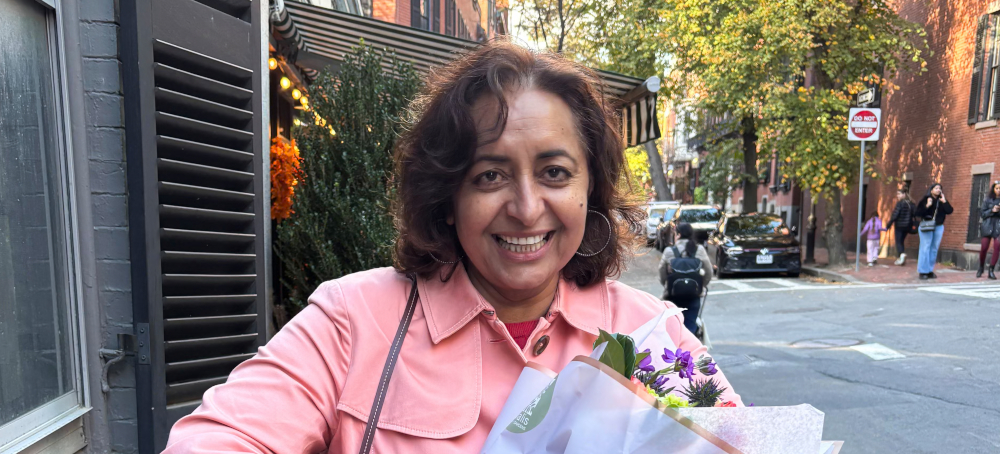 Meenu Batra has served as an interpreter for hundreds of people in immigration court. (photo: Courtesy Deepak Ahluwalia)
 Texas Immigration Court Interpreter Detained by ICE Says ‘They Want to Make Me Disappear’
Maanvi Singh Guardian UK
Meenu Batra, the state’s only licensed Punjabi, Hindi and Urdu interpreter, says she was treated ‘like a criminal’
Meenu Batra is the only licensed Punjabi, Hindi and Urdu court interpreter in the state, and has served as an interpreter for hundreds of people in immigration court.
Then, last month, immigration agents at Harlingen international airport stopped her and put her in handcuffs, and transferred her to El Valle detention facility in Raymondville.
“It feels bizarre,” she said. “I don’t know how else to put it. Here I am just staring at the wall wondering what exactly I’m doing here but also what is anybody doing here.”
Batra, 53, had spent almost her entire adult life in south Texas, raising four children there. She had fled Indian pogroms against Sikhs in Punjab, and had arrived in the US in 1991. In 2000, an immigration judge granted her a “withholding of removal” to India, concluding she was likely to face persecution there.
Now her lawyer worries the government plans to send Batra to a “third country” where she has never been.
“I haven’t been able to cry much because nothing is making sense,” she told the Guardian, calling from the El Valle detention center where she has been held without explanation for a month.
In the interim, she said, she has to live in the horror movie version of Groundhog Day – each day, she wakes up in a windowless warehouse block. Because of her fluency in English, and her familiarity with many immigration policies, Batra said she had been trying to help some of the other women who are detained with her to request confidential calls and access to attorneys.
Batra had been on her way to Milwaukee, Wisconsin, for work on 17 March when an Immigration and Customs Enforcement (ICE) officer stopped her at the airport and asked: “Do you know that you are here illegally?” In a sworn deposition, Batra said that she responded, “No” – and clarified that she had a valid status and a legal work permit. She was taken away in an unmarked SUV, she said.
In a declaration filed as part of a petition for habeas corpus challenging her detention, Batra said that she was initially detained without food or water for 24 hours, and denied medication that she takes for her cholesterol for several days. She alleged that after she was arrested, officers made her pose for photographs with her hands behind her back to give the impression she was still handcuffed and told her the images were “for social media”.
“This made me feel humiliated and treated like a criminal,” she said.
Deepak Ahluwalia, a California and Texas-based immigration attorney representing Batra, said that the government had not told him or Batra why she was detained or where she would be sent.
Because Batra was granted “withholding of removal” – a humanitarian protection based on the fact that she was likely to face persecution and harm based on her religion or ethnic group – the government cannot send her to India unless it reopens her immigration case. But the US government has not done that, said Ahluwalia – leading him to suspect that the government plans to send her to a third country.
The US has already cut deals with dozens of countries, including Cameroon and Rwanda, to accept US deportees, and has sent migrants to Equatorial Guinea, Eswatini and South Sudan under such agreements. An appeals court last month reversed an order requiring the administration to give deportees “meaningful notice” before sending them to an unfamiliar country, and since then Costa Rica and Uganda have started to receive US deportees who are not from those counties.
“It’s been a month since Meenu was detained and they still haven’t told her where they want to send her,” Ahluwalia said.
The Department of Homeland security said Batra “was issued a final order of removal from an immigration judge in 2000”.
A withholding of removal is not a final order of removal, Batra’s attorney said; rather, it is a deferral of removal.
The agency did not clarify where it intended to send Batra, and a spokesperson did not respond to multiple queries about Batra’s treatment inside the El Valle detention center.
Batra, meanwhile, said her life – and her children’s lives – had been put on an indefinite hold.
After her work trip to Milwaukee, Batra had planned to meet up with her children, and meet her eldest daughter’s boyfriend for the first time. “Instead he met the family at the detention center when they all came to visit me,” she said. One of her sons, meanwhile, had to cancel a work trip. Another son, who is enrolled in college, left his studies to come see her. And she worries her youngest, who is 18, will have trouble concentrating on finishing up his final projects in high school.
The 18-year-old, who had enlisted in the military, had also recently filed a parole application for his mother, via a program that allows the parents and spouses of service members a path to permanent residency.
It hurts, Batra said, to have her children see her in detention. “It’s dehumanizing,” she said.
Inside El Valle, she told the Guardian, she had been trying to comfort a young woman who recently turned 21 inside the detention center. “Since getting here she has been suffering from sleep paralysis,” she said. “I don’t know how to help her. When I look at her, I see my child.” Another detainee, who is in her 60s, suffered a stroke while in detention – so Batra and others have been helping her do physical therapy to regain her mobility.
Batra has also witnessed multiple fellow detainees being whisked away by medical workers after attempting suicide, she told the Guardian. Sometimes she worries about what has happened to people who are suddenly gone – have they been released, or deported? Or something worse?
“People just disappear,” she said. “And I know they want to make me disappear. I don’t know where they want to send me.”