
‘Temporary Evacuation’ of West Bank Camps Nears 2 Years, With No Return in Sight
Nagham Zbeedat Haaretz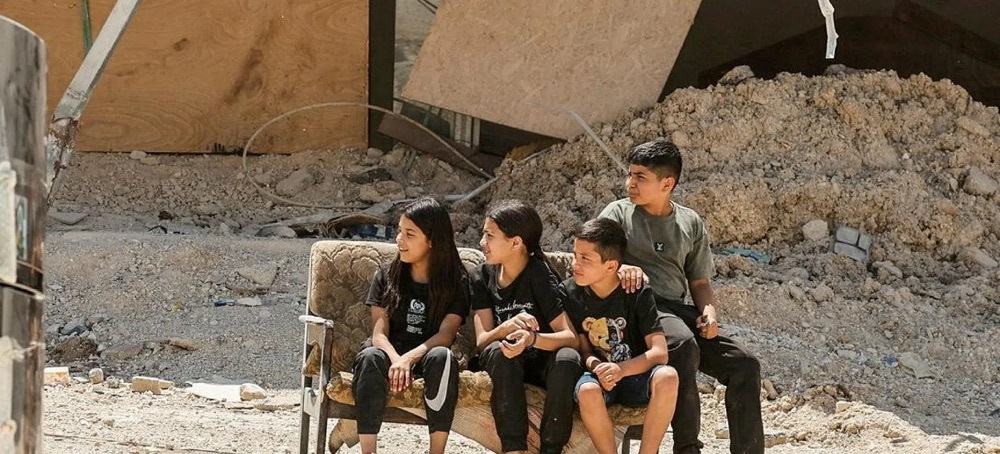 Children in Nur Shams refugee camp ahead of demolitions carried out by the IDF. Families were sometimes permitted to enter to retrieve belongings, in May 2025. (photo: Raneen Sawafta/Reuters)
 ‘Temporary Evacuation’ of West Bank Camps Nears 2 Years, With No Return in Sight
Nagham Zbeedat Haaretz
Palestinians from Nur Shams refugee camp can see their homes from the surrounding hills, but cannot return to them, as the IDF extends closure orders in the area. 'We are waiting only to learn how long the next extension will be,' one resident says
For Qasem Abu Sarris, 30, the extension in Nur Shams prolongs a reality he has endured for more than a year and a half. "It is painful and devastating," Abu Sarris tells Haaretz. "I am only 100 meters away from my home, yet I cannot go inside. Next February will mark two years."
The order declaring the camp a closed military zone, issued on February 9, 2025, was extended until 11:59 P.M. on November 30. After repeated extensions, the camp's 13,700 Palestinian residents have little hope that they will be allowed back anytime soon, if at all.
The Israeli government told the High Court of Justice last month that the military continues to oppose allowing residents of Nur Shams and the nearby Tulkarm and Jenin refugee camps to return. According to the Israel State Attorney's Office, the army is preparing to maintain long-term operational control in the area, although the state emphasized that the forces "do not seek to remain in the refugee camps permanently."
UN data submitted to the court shows that more than 33,000 Palestinians from the three camps remain displaced, including 13,700 residents from Nur Shams. Families who initially believed they would be gone for days or weeks have spent more than a year and a half moving between relatives' homes, communal shelters and rented apartments they increasingly cannot afford.
The military says the closure is necessary to preserve its freedom of action and prevent armed groups from rebuilding infrastructure dismantled during Operation Iron Wall, launched in January 2025 in the West Bank.
The IDF Spokesperson's Unit did not respond to a request for comment by publication time.
Abu Sarris was arrested in May after entering the camp without permission. During his detention, soldiers used his phone to post an image of him blindfolded beneath an Israeli flag, alongside a warning that anyone entering Nur Shams without military coordination "will pay the price."
"We have a saying: If it were going to rain, it would have clouded over," says Mohammed Sleit, a 30-year-old photographer from Nur Shams who has documented the camp's destruction and volunteers with a local committee that assists displaced families. "Here, there is not even one cloud."
"There is no indication that the army is preparing to withdraw," he says. "We are waiting only to learn how long the next extension will be – one month, two months or three."
From the hills surrounding Nur Shams, displaced residents can see how these preparations have altered the camp as they try to identify what remains of their homes.
Sleit spent months taking photographs and videos of Nur Shams from one of the overlooking hills. Residents would message him asking for images of particular streets or buildings, hoping to determine whether their homes were still standing.
During Eid al-Fitr in the spring of 2025, while volunteering at an activity for displaced children, Sleit received word that another house was burning inside the camp. He went to the overlook near sunset but could not identify the building through the smoke. He returned the following morning. The house he had photographed burning was his own.
During a later arrest, Sleit says, soldiers confiscated his cameras, computers, hard drives and the photographic archive stored on them. He was not given a confiscation document, and his equipment has not been returned. All that remains of his archive are the images he had already posted online.
These show demolished and burned buildings and wide roads the army opened through what had been densely built sections of the camp. Residents say some of the roads are approximately 12 meters wide. From a distance, Sleit says, the pattern is now several homes, followed by a road, then several more homes and another road.
Before the operation, Nur Shams' main street functioned as a commercial center for the surrounding area. Mohammed Shehadah, 40, member of the camp's emergency committee, says his family owned a three-story building there, with a bakery and metal workshop below it.
"If you had visited before 2025, you would have thought the main road was part of a city rather than a refugee camp," Shehadah says. "Life continued, the economy functioned and people were able to make a living."
His family's building was among those destroyed, he says. His parents, two sisters and married brother moved into his home outside the camp, joining Shehadah, his wife and their four children. Residents and local volunteers estimate that hundreds of homes and other buildings have been demolished, burned or rendered uninhabitable.
Twelve square meters for the whole family
In the first weeks after residents were displaced from Nur Shams, families crowded into relatives' homes, mosques, schools and community halls.
In some shelters, Shehadah says, pieces of cloth were hung across large rooms to separate women and girls from men. Dozens of people shared a single bathroom. Families had little privacy, no income and no indication of how long they would remain there.
Local committees eventually urged residents to rent apartments after Palestinian officials and aid organizations indicated that financial assistance would be provided. "We told them, 'Go and rent homes, and God willing, funding will be provided,'" Shehadah says. "People thought they would need to rent for only one or two months." Some families rented small apartments for approximately 1,500 shekels ($495) a month; others paid close to 2,000 shekels ($660). Nearly 20 months later, many are still paying rent.
Shehadah says approximately 2,500 displaced households were registered for assistance. Since the displacement began, he says, UNRWA has made a single payment of 3,000 shekels ($991) to each registered family toward housing costs. The Palestinian Authority has made two smaller one-time payments: 600 shekels ($198) around Ramadan in early spring last year, and a further 450 shekels ($144) recently.
Although UNRWA and the PA have reported additional rounds of assistance across the three refugee camps, Shehadah maintains that these are the only payments these families received.
The payments have covered only a fraction of what they had spent. Residents have exhausted their savings, accumulated debt or moved back into overcrowded homes shared with relatives. Some landlords have asked families to leave after they fell behind on rent, Shehadah says.
Sleit, his wife and their two daughters spent almost a year and a half living in a single unfinished room at his brother's home. It has no plaster, tiles or proper windows, and nylon sheets covered the openings until he received funding that allowed him to seal them against the winter rain and wind.
One family he photographed – a couple, their four daughters and a teenage son – was living in a single room measuring approximately three by four meters. It served as their kitchen, bathroom and sleeping area. "That represents perhaps one percent of the suffering here," he says.
Even the assistance that does arrive is often too limited to distribute to everyone. Shehadah says aid organizations sometimes deliver 500 or 600 food parcels for approximately 2,500 registered families, leaving local volunteers to decide who receives them. "People ask, 'Why did you give him a parcel and not me?'" he says. "Everyone believes they have a right to assistance."
The state told the High Court that displaced residents continue to receive adequate humanitarian assistance and that their access to housing, water, food, medical services and education does not differ materially from that of other West Bank residents.
For Shehadah, the prolonged displacement has also damaged residents' trust in the local committees, which have been left to answer for promises they did not make and cannot fulfill. Residents rarely confront UNRWA or Palestinian officials directly, he says. Instead, they confront the volunteers who persuaded them to leave the shelters and rent homes. "This has damaged the trust between us and the people," he says. The loss of hope is visible in what residents no longer ask for.
At the beginning of the displacement, Sleit says, families contacted him almost daily asking for photographs of particular streets and homes. Those requests have dwindled. "It is as though people have begun focusing more on surviving their current lives," he says. "They have lost hope of returning."
The latest extension, announced Thursday, bars residents from returning until November 30, more than a month after Israel's October 27 election.
Speaking before the extension was announced, Abu Sarris said he expected the closure to be prolonged because of the election. "We need someone to raise our case. Most people do not know what is happening or even realize that the camp has been empty for a year and a half."
Shehadah also anticipated another extension. He believes the decision is being made at the political level and that allowing thousands of Palestinians to return during the election campaign could be treated as a security concession.
The Association for Civil Rights in Israel, which has petitioned the High Court to allow displaced residents to return, argues that under international law, a permitted evacuation must remain temporary and reversible, and that an occupying power is required to return civilians to their homes as soon as possible.
"The state cannot have it both ways," it said in its filing in the ongoing case, arguing that Israel cannot describe the displacement as temporary while paving roads, planning long-term military control and refusing to set a date for the return of tens of thousands of residents.
For Sleit, the clearest measure of how long the displacement has lasted is now the camp's cemetery, one of the few places residents are still permitted to enter.
"We are returning to Nur Shams," he says, "but we are returning one by one – to the Nur Shams cemetery."
"We are returning dead," he says, "one at a time, to be buried there."