
Switzerland Breaks Tradition of Neutrality, Freezes Russian Assets
Bill Chappell NPR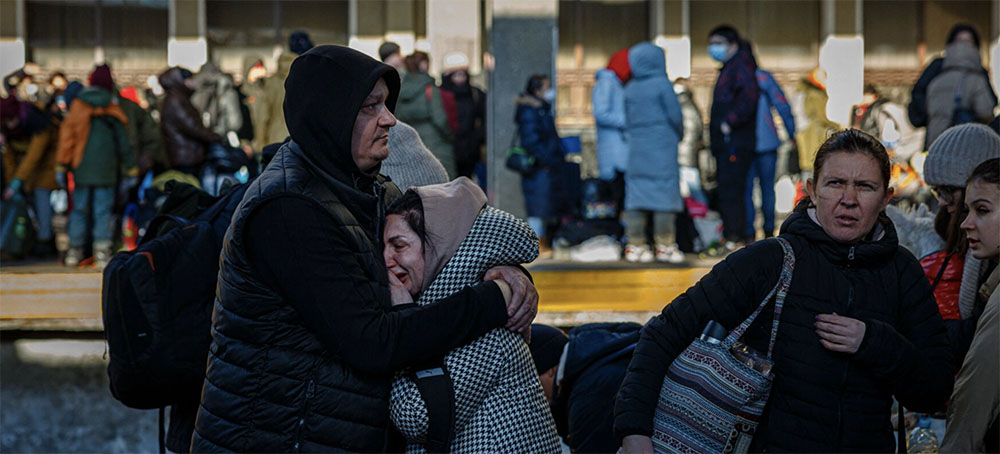 A man hugs his wife before she boards an evacuation train at Kyiv central train station on Monday. (photo: Dimitar Dilkoff/AFP/Getty Images)
Switzerland Breaks Tradition of Neutrality, Freezes Russian Assets
Bill Chappell NPR“Russia’s ongoing military attack on a sovereign European country is an extremely serious violation of international law,” government spokesman Andre Simonazzi said. “The Federal Council is therefore changing Switzerland’s stance on sanctions.”
The EU hit Putin and more than 650 other people with sanctions on Friday, freezing the Russian president’s assets under its jurisdiction along with those belonging to foreign affairs minister Sergey Lavrov. It also targeted politicians who supported Russia’s recognition of two Ukrainian territories as breakaway “republics.”
Switzerland is now joining those sanctions, saying it is freezing assets “with immediate effect.”
“Switzerland reaffirms its solidarity with Ukraine and its people,” the government said, adding that it is sending relief supplies to help Ukrainians who have fled to Poland.
Swiss banks have long been famous for their discretion and security, making the country a haven for stashing wealth. But while today’s decision could alter that perception, it’s unclear how it might impact Putin personally.
Putin relies on Russian oligarchs to store parts of his fortune, according to Bill Browder, a longtime critic of the Russian leader. Browder is the CEO of Hermitage Capital Management; he also leads the Global Magnitsky Justice Campaign. Over the weekend, Browder told NPR how difficult it can be to hold Russia’s super-rich to account, much less to trace their money.
“They hold it in London and New York and Switzerland and France. They buy properties," Browder said. "And so when we're talking about going after Vladimir Putin, it's absolutely great and symbolic and very essential to put him at the top of the sanctions list. But unless you put the people holding his money on the sanctions list as well, it's just a symbolic move, not a practical move.”