
Switching from ICE to DoD Custody: An Alarming Violation of Court Order on Deportations to El Salvador
Ryan Goodman Just Security Keep your eye on the ball: Which department had custody of the individuals following the court’s order. (photo: Getty)
 Switching from ICE to DoD Custody: An Alarming Violation of Court Order on Deportations to El Salvador
Ryan Goodman Just SecurityALSO SEE: Just Security (Ryan Goodman Substack)
Keep your eye on the ball: Which department had custody of the individuals following the court’s order.
On March 28, the court ordered the defendants in the case – the Department of Homeland Security including ICE and the Department of Justice – not to deport any individual with a final removal order “UNLESS and UNTIL Defendants provide that individual, and their respective immigration counsel, if any, with written notice of the third country to where they may be removed, and UNTIL Defendants provide a meaningful opportunity for that individual to submit an application for CAT [Convention Against Torture] protection to the immigration court” (capitalization emphasis in original).
The government now says it did remove these individuals to El Salvador after the court’s order! The government’s excuse: The removal to El Salvador was carried out by the Department of Defense (DOD) rather than DHS/ICE, and the former is not a named defendant in the case. An example from the government’s Wednesday night filing:
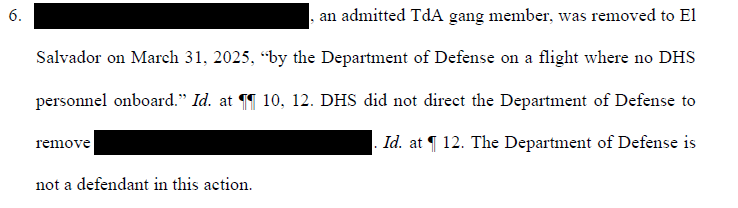
The flaw in this attempted excuse is obvious. What that statement leaves out is which agency had custody of the detainees after the court’s order.
And what the accompanying ICE official’s affidavit makes clear is that the DHS was directly involved in their removal. That’s because DHS had custody of several of the individuals after the court’s order, and then transferred them to DOD after the court’s order. Indeed, DHS apparently transferred some individuals to the DOD base in Guantanamo. The base served as a very temporary holding place until their transportation by DOD to El Salvador a few days later. Here’s an example from the affidavit:

This switch from one department (a named defendant) to the other is not cunning. It appears to be a violation of the court’s order both in the spirit and in the letter of the law.