
Surprising Discovery About Corals’ Resilience Could Help Them Survive Climate Change
Cristen Hemingway Jaynes EcoWatch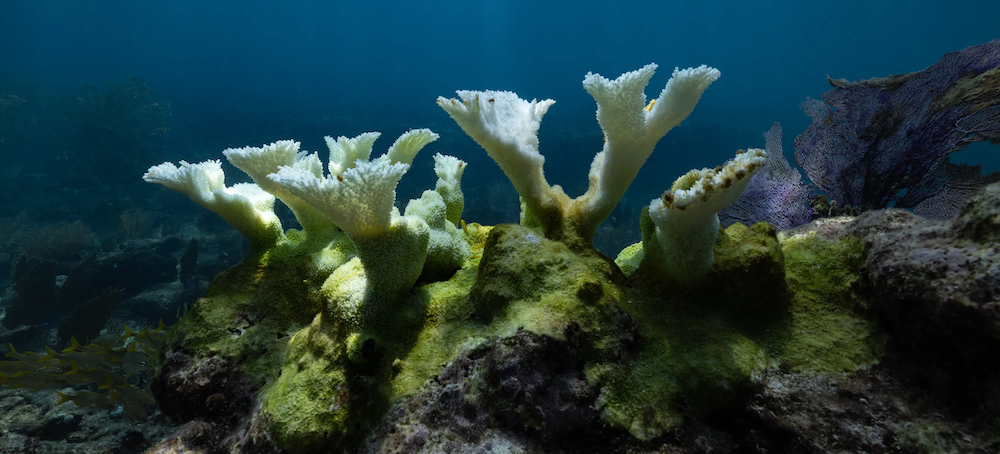 Bleached elkhorn coral at Pickles Reef in the Florida Keys. (photo: Jennifer Adler/Vox)
 Surprising Discovery About Corals’ Resilience Could Help Them Survive Climate Change
Cristen Hemingway Jaynes EcoWatchThe research team was led by assistant professor of biological sciences Carly Kenkel at the USC Dornsife College of Letters, Arts and Sciences. In order to find out if coral populations that have been able to survive in higher temperatures could pass on their heat tolerance to their offspring, the team focused on Orbicella faveolata, mountainous star coral, USC Dorsife said.
The scientists were surprised to find that the offspring of a less heat-tolerant population fared better under exposure to high temperatures than those from a heat-tolerant population.
The findings contradict the commonly held belief by scientists that the offspring of corals that are heat-tolerant should be tolerant too.
“The study findings have significant implications for how we think about saving coral reefs,” Kenkel said in the press release. “It’s not as simple as just breeding more heat-tolerant corals.”
The study, “Performance of Orbicella faveolata larval cohorts does not align with previously observed thermal tolerance of adult source populations,” was published in the journal Global Change Biology.
Coral bleaching due to rising ocean temperatures weakens coral, making them more vulnerable to disease.
In order to find out which corals would be able to more readily handle increased temperatures, the research team collected coral reproductive cells, or gametes, from two coral reefs in the Florida Keys. One is located closer to shore and the second farther out.
The team used a controlled environment to breed the corals, exposing the larvae to simulated conditions of heat stress. After measuring how well the corals survived, as well as their gene activity, they were surprised to find that the larvae of the population known to be less heat tolerant had better survival rates and fewer signs of stress. This suggested that coral offspring’s ability to handle higher temperatures could be influenced by a number of factors, including if and how often their parent corals have bleached before or encountered other environmental stressors.
The scientists said more research was needed, since they focused on a specific coral species, while different species could have distinct responses. Factors other than temperature also affect reefs in the wild that were not present in the controlled laboratory setting.
The team hopes to delve more deeply into how corals adapt and pass on their resilience to offspring, taking into account how their history and relationships with other marine life, as well as overall reef health, affect them.
Kenkel said the preservation of corals may need an approach that is more comprehensive.
“Instead of focusing solely on breeding more heat-tolerant corals, we might need to consider other factors affecting coral survival and more diverse interventions,” Kenkel said in the press release, including their genetic diversity, as well as the external stressors that affect their overall health.
“We believe that this study opens up promising avenues for future research, which is critical to the success of reef management and restoration practices for this charismatic Caribbean coral species,” said first author of the study Yingqi Zhang, who contributed to the research while a Ph.D. student in Kenkel’s USC Dornsife lab, in the press release.