
Supreme Court Lifts Restrictions on ‘Roving’ ICE Raids in Los Angeles
Josh Gerstein and Kyle Cheney POLITICO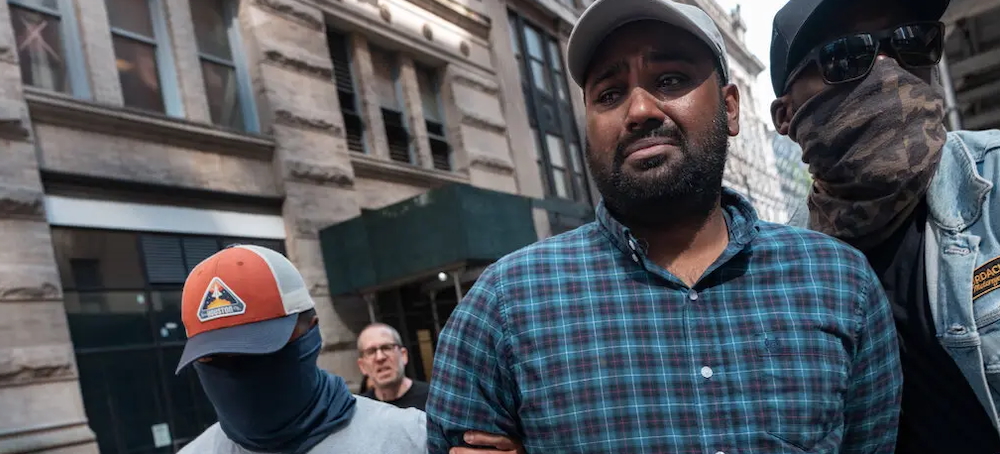 Federal immigration agents often wear masks to conceal their identities. (photo: Todd Heisler/NYT)
 Supreme Court Lifts Restrictions on ‘Roving’ ICE Raids in Los Angeles
Josh Gerstein and Kyle Cheney POLITICO
The ruling blocks a lower court’s order that found the enforcement operations were based on impermissible factors.
The justices, who apparently pided 6-3 along ideological lines, put on hold a federal district judge’s order that reined in what critics called “roving” raids by Immigration and Customs Enforcement. That judge had found the tactics were likely unconstitutional because agents were detaining people without probable cause at car washes, bus stops and Home Depot parking lots based on stereotypes.
The high court’s majority offered no explanation for its decision to grant the Trump administration’s emergency appeal to block the district judge’s order. However, Justice Brett Kavanaugh wrote separately in support of the decision, saying it was reasonable to briefly question people who meet multiple “common sense” criteria for possible illegal presence — including employment in day labor or construction, and limited English proficiency.
The court’s three liberal justices dissented.
“We should not have to live in a country where the Government can seize anyone who looks Latino, speaks Spanish, and appears to work a low wage job,” Justice Sonia Sotomayor wrote, joined by Justices Elena Kagan and Ketanji Brown Jackson. “Rather than stand idly by while our constitutional freedoms are lost, I dissent.”
The Justice Department complained in an emergency appeal filed last month that the court-ordered limitations amounted to “a straitjacket” for law enforcement officers carrying out President Donald Trump’s mass-deportation policy.
However, immigrant rights and civil liberties advocates accused federal officers of stopping Latinos solely because they were speaking Spanish or present at home improvement store parking lots or car washes. With nearly half the population in L.A. of Hispanic origin, such a broad-brush approach is certain to sweep up many U.S. citizens and legal immigrants, the advocates said.
In July, U.S. District Judge Maame Ewusi-Mensah Frimpong ruled that ICE agents were conducting “roving patrols” of L.A. and making arrests without “reasonable suspicion” that their targets were in the country illegally. Instead, she found, they appeared to be relying on legally dubious factors such as race, accent and line of work that “seem no more indicative of illegal presence in the country than of legal presence.”
Frimpong, a Biden appointee, prohibited immigration officials in the Los Angeles area from using those criteria to choose targets for enforcement.
The Trump administration asked the 9th Circuit Court of Appeals to halt Frimpong’s order pending appeal, but a three-judge panel unanimously rejected that request, making only a small tweak in Frimpong’s directive.
The appeals judges also expressed concerns about reports that the White House set a quota of 3,000 immigration arrests per day and that such a target might be spurring unlawful arrests. The Justice Department denied to the court that any such quota existed, even though White House Deputy Chief of Staff Stephen Miller confirmed the 3,000-arrest target in a televised interview on Fox News in May.
The “roving” raids Frimpong sought to rein in took place amid a broader battle over immigration enforcement in L.A., including Trump’s deployment of thousands of National Guard troops to the city over the objection of California Gov. Gavin Newsom. Another federal judge declared that deployment illegal, but that ruling was put on hold by the 9th Circuit. A separate ruling that those troops illegally engaged in law enforcement is presently on appeal.