
Socialists Are Winning Because They Listen to People
Tressie McMillan Cottom The New York Times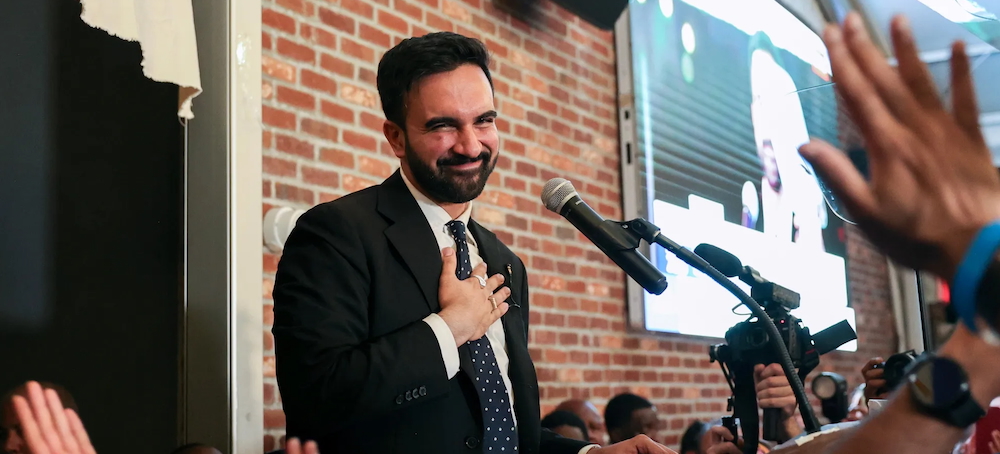 Mayor Zohran Mamdani addresses a crowd of people. (photo: Bloomberg)
 Socialists Are Winning Because They Listen to People
Tressie McMillan Cottom The New York TimesALSO SEE: Abdul El-Sayed Talks About His Victory, the Establishment and His Mom
A mash-up of political analysis since Zohran Mamdani was elected mayor of New York City would have you believe that we are living in either the golden age of leftism or that the communists are coming.
That might one day be our electoral reality, but not today. Yes, a lot of left-leaning candidates did well this week, with notable primary victories in Michigan and Kansas. But a lot of moderate Democrats also won their races. Some of the winning candidates had a lot of money to spend. Others were running at an extreme financial disadvantage. But the best of them are running campaigns that acknowledge that to win, Democrats are going to have to organize voters — not just fund-raise off them.
The Democratic Party has a deep structural problem. It is standing in the shadow of a past it yearns for and a future it has not yet built, and, at the moment, the progressive wing appears to be the only side that realizes it.
Establishment Democrats may want to fight about the electability of left-wing candidates, but the party has bigger fish to fry. Labor unions and civil rights organizations are the twin engines of Democratic electoral power. Labor reliably delivered working-class men in the decades after the New Deal, serving as Democrats’ arterial vein in rural areas and the industrial Rust Belt. Civil rights organizations have, of course, reliably and relentlessly delivered the Black vote — and kept Democrats competitive in the South — since Lyndon B. Johnson, a Democrat, signed the Civil Rights Act. Those two groups have long been a stopgap for middling Democratic candidates and muddled Democratic messaging.
What’s most important to understand is that, now, six successive decades of economic, legal, political and cultural challenges have made it difficult, if not impossible, for unions and civil rights groups to do that job.
Black civil rights organizations, in particular, have long worked hard to organize for the Democratic Party. They don’t just march to the polls. They cultivate voters, translate national platforms into local messaging and train candidates and staffers. The party’s electoral workhorses have been the Black women who keep the lights on in churches, drive the vans, canvass the communities, turn out the rallies and reliably deliver on Election Day. Black organizers in the South expected a Democratic cavalry after the Voting Rights Act was gutted by the Supreme Court. Instead, they feel abandoned. They look at conservative groups like Heritage Action and Turning Point USA and wonder what they could do with that kind of support.