
Sikh Separatism and the Brewing Conflict Between Canada and India
Isaac Chotiner New Yorker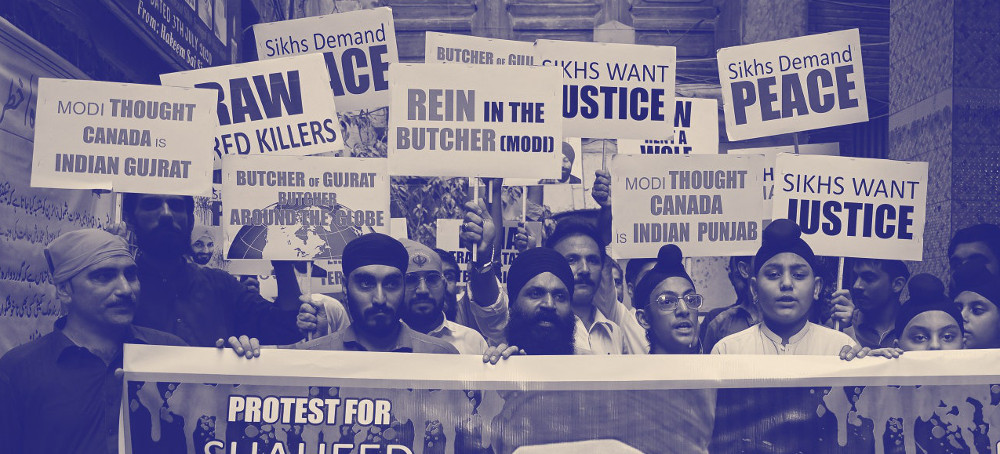 March calling for justice for the killing of Shaheed Hardeep Singh Nijjar. (photo: Abdul Majeed/AFP)
 Sikh Separatism and the Brewing Conflict Between Canada and India
Isaac Chotiner New YorkerALSO SEE: Murtaza Hussain| FBI Warned Sikhs in the US
About Death Threats After Killing of Canadian Activist
Did India carry out or abet the assassination of a Sikh leader on Canadian soil?
India’s Ministry of External Affairs has denied having anything to do with the murder, but also said that Canada’s approach to terrorism, which it characterized as laissez-faire, would “continue to threaten India’s sovereignty and territorial integrity.” Trudeau’s allegations coincide with an attempt by Narendra Modi, India’s Prime Minister, to portray the country as an increasingly important player on the global stage; this era, in his words, marks “the first time the world has come to know that India can take a stand for herself.” The allegations also coincide with a general willingness by the Biden Administration to overlook India’s worsening human-rights record during Modi’s nearly decade-long premiership, in part because the U.S. values India’s role as a counterweight to China.
To talk about the history of Sikh separatism and the Indian government’s response to it, I recently spoke by phone with Gurharpal Singh, an emeritus professor at the University of London’s School of Oriental and African Studies and the author of many books on the subcontinent, including “Sikh Nationalism: From a Dominant Minority to an Ethno-Religious Diaspora.” During our conversation, which has been edited for length and clarity, we discussed why the Indian government is so concerned about Sikh separatism, the development of Sikh political identity in the West, and whether Western governments are doing enough to protect their own citizens.
How did there come to be large Sikh communities in countries such as Canada?
Sikhs have been migrating overseas in significant numbers since the late nineteenth century. As part of the imperial expansion of Britain, they were principally involved in the armed services and later in the security forces as policemen. So, wherever the Empire expanded, especially in the Far East—China, Singapore, Fiji, and Malaysia—and East Africa, that’s where the Sikhs went. They started arriving in North America, and particularly the Pacific Coast, following Queen Victoria’s Golden Jubilee, in 1887. Citizens of the Empire technically had the right to travel and settle throughout it. And since then there have been significant settlements of the Sikh community in British Columbia, California, and, of course, Britain, where they have been permanently settled since the nineteen-twenties in large numbers, and more since the Second World War.
At the same time that Sikhs are migrating to different areas of the world, there is a huge Sikh community in the Indian state of Punjab, which was one of the two states split in half during Partition. There is a movement there for some sort of independent Sikh homeland. Can you talk about how that movement got started and what its role was in Indian politics after Partition?
At Partition, the Sikh community saw itself as being very vulnerable. It was a small community in the united British Punjab—less than about fourteen per cent of the population. Sikhs tried to come up with various schemes to keep the community together, to keep Punjab together, but unfortunately that did not come to pass, as the British wanted to exit India and Punjab quickly. Thereafter, Indian states or provinces were organized along linguistic lines. One way the Sikh leadership thought that it could protect the community’s rights and identity was to campaign for a Punjabi-speaking state. This led to a great deal of bitterness and resentment among the Punjabi-speaking Hindu community, who opted for Hindi as a way of opposing that demand. They thought that a Punjabi-speaking state would largely be a Sikh-dominated state.
After about two decades of campaigning, that demand was conceded in 1966, but reluctantly. There was another campaign, between 1973 and 1984, for greater economic and political autonomy for Punjab. And that eventually culminated with the Indian Army entering the Golden Temple, in Operation Blue Star, in 1984. That was a traumatic period, which then was followed by a decade-long troubles.
Can you talk more about that event, which was followed by the assassination of the Indian Prime Minister, Indira Gandhi, also in 1984, and more broadly about how the push for Sikh autonomy became in some cases more violent?
There was a prolonged period of negotiation between Sikh moderate leaders and Indira Gandhi and the Congress Party in Delhi between 1980 and 1982. However, the two sides were unable to reach an agreement on the demands, and gradually the militant element within the Sikh leadership outmaneuvered the more moderate members, leading to polarization between the Indian government and the militants. That eventually climaxed in Operation Blue Star, an operation to remove Sikh militants from the Golden Temple, the most sacred site in Sikhism, which was followed by the assassination of Indira Gandhi in October, 1984, and the killing of almost three thousand Sikhs in Delhi in the backlash that followed. That led to almost a decade of Sikh militancy and counterinsurgency operations, conducted by the Indian Armed Forces, which cost, on conservative estimates, around thirty thousand lives. These events cast a long shadow on the Punjab problem, which has continued to haunt all governments in Delhi since then.
When did the Indian government begin to get so concerned about Sikhs on foreign soil advocating for Sikh issues in India?
It has been monitoring the activities of overseas Indians on a regular basis. The first time it specifically started noting the activities of Sikh militants was in the early seventies, when Jagjit Singh Chohan, a Sikh political leader who left India, and who’s often referred to as a father of Khalistan, started a quixotic campaign for a Sikh state. More specifically, it was in the early eighties, 1980 to 1984, when the government of India and the Congress Party in particular was very, very focussed on monitoring the activities of Sikh militants.
Before we started the interview, you mentioned that you were interested in comparing Sikhs to the Jewish community. What did you mean by that?
Well, you’ll see that the comparison comes in the sense that Sikhs are small, they’re religious, and they’re roughly the same size as the Jewish community. [Worldwide, there are about twenty-five million Sikhs and fifteen million Jews.] They’re both a diaspora and a nation and an ethnicity and can be read as such. They are a complex minority, which are often seen in terms of religion only, but seeing them just as a kind of dedicated religious community overlooks the more complex dimensions of the community. They have fought for autonomy and the right to govern themselves, and as a minority to have their identity rights safeguarded in the West. For example, Sikhs and Jews in Britain were the only two communities in England who were recognized as ethnic groups in legal proceedings following the Race Relations Act of 1976.
How important is the push for a Sikh homeland to Sikh identity in many of the Western Sikh communities you study?
It ebbs and flows. The idea of a Sikh homeland has not had many takers for most of the post-1947 period, but what happened in 1984 led to a reaction against the government of India, which enabled militant groups to come to the fore. And when the militancy in Punjab died away, the hold of these groups on Sikh organizations also dissipated. So, since the early two-thousands, and for most of the last decades, homeland issues have not been very much at the forefront for most of the Sikh diaspora. In fact, they have been largely focussed on host-country issues, especially after 9/11 and the targeting of many Sikhs who were often, particularly in America, identified with militant Islam.
What’s happened qualitatively in the last few years is the large outflow from Punjab of young people because of an economic crisis in the state and also because of the impact of protests by Indian farmers. Between 2020 and 2021, the state of Punjab in particular was very much the focus of the farmers’ agitation against the government of Narendra Modi and the B.J.P., which wanted to deregulate the farming sector. And that agitation created a groundswell of mobilization in the diaspora, which rekindled some of the old networks of militancy and homeland politics. But over all, in my recent work, I have suggested that the separatists do not command much more than about twenty-five per cent of the loyalties of the diaspora Sikhs. And that’s the maximum and the most optimistic estimate.
There are many examples of a political struggle by a community that tends to share the same religious faith. And the people who were the most hard-core fighters in those struggles tended to preach a very strict doctrine or vision of that religion. To what degree are the more violent elements of the push for a Sikh homeland connected to a harsh or strict interpretation of Sikhism itself?
That’s an interesting question, because in the eighties it was associated with the equivalent of religious fundamentalism that was pervasive throughout many of the faith traditions, especially after 1979. But in recent years, that relationship has, to some extent, broken down, because some of the hard-core faith groups have become, in some ways, apolitical. They’ve become much more spiritually oriented. They are still there in the background, but not in any great strength.
Do you think the Indian government has any legitimate case that there is Sikh militancy in Canada and that there are connections between that militancy and things going on in India? The Indian government claims that they sent Canada an extradition request for Nijjar, and have done so for others, and that those were ignored. Is the Indian government right to be frustrated by this?
I think the problem here arises from the fact that the arguments that are made for extradition by the government of India have to meet a certain threshold—judicial and legal—in the West. And these levels are often not met. This not only applies, for example, in the case of Sikhs and militancy but also in the efforts to extradite many leading businessmen and billionaires who have absconded with significant loans and funding in the last ten years and have not returned to India, partly because of judicial issues. So while countries have intergovernmental arrangements to extradite fugitives, in the case of demands for citizens of Canada who may or may not be involved in militancy in India, the onus of proof is on the Indian state.
But no doubt in some cases the extradition requests are valid, and if it is the people they are requesting need to face executive and judicial actions. But there is also widespread fear, particularly since the period of counterinsurgency, of the Indian authorities using indiscriminate force to eliminate Sikh youth and also using the judicial and state processes arbitrarily. This is particularly the case with the Modi government when it comes to its domestic critics.
Is there concern among Indian-origin communities in the West about surveillance being done in Western countries by the Indian government?
Certainly. Just to go back to the early eighties, when there was widespread concern that communities and groups were being monitored and people would face retribution, potentially, if they returned to India for family matters. And certainly now there is widespread fear and concern in Sikh communities, in Canada in particular, but also in certain areas in the U.K., that they are being monitored.
I think this episode will bring into public domain the extent to which some Western governments are seeking to court the government of India, and how those actions are compromising citizen security. The desire to court India for defense and trade reasons comes at the expense of some elements of basic security for citizens who happen to be Sikhs.
Certain Indian media sources have blamed Nijjar for the murder of a man in India that took place in 2021. What do we know about that case?
The life and times of militants are not without past histories of radicalism and engagement in violence. And it may well be that he was a party to it, but it may well also be that the case against him is fabricated. So I cannot comment with any confidence on that.
Is your sense that Modi’s government is more concerned about movements that threaten India’s political future, such as the farmers’ protests, than it is about separatism?
My own feeling is that the events that happened in Punjab this year are more connected to something else. In March, there was a wholesale mobilization in the state when Amritpal Singh, a separatist preacher, was on the run. He was eventually arrested, as were his followers, and there was a lockdown for almost two weeks. That was followed by a mobilization of groups in the diaspora. There were violent demonstrations outside the consulate in San Francisco, the High Commissions in Canada, and in the U.K., which were then relayed back to the media in India. After that, I think they decided to take a tough line against separatists. We may now be seeing the outcome of those decisions.
If the allegation that India was involved in the assassination in Canada is true, how much of a break would that seem to you from previous Indian policy regarding issues of Sikh separatism? As you said, thousands of people were killed in the eighties. So, in one sense, this seems like we’re going back to an earlier time. But anything that occurs on foreign soil goes beyond that.
I don’t think it’s much of a break. These things have happened before: the downing of the Air India flight off the coast of Ireland, in 1985, for example. There was a huge row between India and Canada that cast a shadow for nearly a decade and a half.
This is when Canadian Sikh separatists were suspected of blowing up a passenger airplane, killing more than three hundred people?
Yeah. Compared to those events, what’s happened recently is not as important or significant. But it comes at a time when the government in India is trying to project India as a global player and offering trade deals and negotiations on arms projects and so forth. So this could become a significant challenge if it turns into an issue of human rights and interference in the domestic affairs of other states.