
Should Big Oil Pay for Climate Change? A Supreme Court Case Will Help Decide.
Justin Jouvenal Washington Post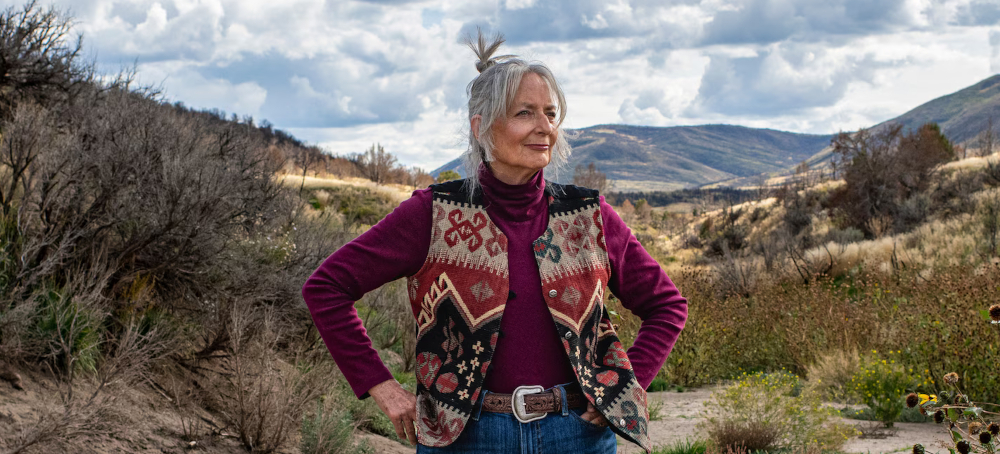 Kathleen Kelley stands in what used to be a stream that watered her 400 cattle. It was turned to dust in August 2025 by the Lee Fire. (photo: Kelsey Brunner/The Washington Post)
 Should Big Oil Pay for Climate Change? A Supreme Court Case Will Help Decide.
Justin Jouvenal Washington Post
Boulder, Colo., is hoping its novel lawsuit will be the environmental equivalent of the landmark litigation that produced billions in damages and settlements against Big Tobacco and opioid makers.
The Lee Fire in August 2025 was so massive that Kelley said it looked like a “giant, slow-motion” tornado of flame.
It roared in amid a relentless drought that has stretched over two decades. Kelley’s late father, who lived through the Dust Bowl, said he had seen nothing like it. A stream that watered her 400 cattle turned to dust. Kelley, a fourth-generation rancher, was forced to sell her cows.
The sound of the fire ripping through the desiccated brush was like a “jet engine breaking down,” Kelley said. All told, 98 percent of her ranch was scorched. In one spot, all that stood was a single tree surrounded by acres of blackened earth.
“In that moment, you look at it and say, ‘Is this the future? Is this what we are stuck with everywhere?” Kelley said.
To Kelley, there was a clear culprit pushing her way of life to the brink: climate change. Kelley’s uncle had worked for Chevron and her family once had plans to drill on the ranch, but the Lee Fire marked a tipping point for her.
Kelley, 71, decided to back a novel type of lawsuit targeting some of the world’s biggest oil companies over climate change. The Supreme Court will take it up Monday as the first case of its new term.
The city and county of Boulder are seeking damages from ExxonMobil and Canada’s Suncor Energy, alleging they intentionally misled the public for decades about the impact of climate change and the role fossil fuels play in global warming.
The companies deny any wrongdoing, saying Boulder is using Colorado state courts to pursue climate policy that is rightly in the purview of the federal government and Congress. They say the Supreme Court should toss out the suit.
The case is the first test of roughly 60 similar suits brought by cities, counties and states. Many are hoping they will be the environmental equivalent of the landmark litigation against tobacco companies and drugmakers that produced billions in damages over smoking and opioids.
At their heart, the suits begin to try to answer a vexing question that only grows more urgent with each new wildfire, flood and hurricane: Who should pay for the effects of global warming?
Answering that question requires grappling with complexities far more daunting than anything in those earlier rounds of litigation over tobacco or opioids, including whether it is even possible to tease out the role of climate change in any particular wildfire or weather event and assign responsibility to a particular industry.
Paul Chinowsky, a University of Colorado at Boulder professor who produced a report on the costs of climate change locally, said no city, county or even state is going to be able to foot the burden for global warming alone.
“Boulder just happens to be on the forefront,” Chinowsky said. “But they are representative of literally hundreds and hundreds of cities across the country that are experiencing the same thing and trying to figure out the same question.”
A new front for climate change
Tucked against soaring Rocky Mountain peaks, the landlocked city and county of Boulder might not seem like a major front in the battle over global warming.
The affluent area that is home to the University of Colorado’s flagship campus does not contend with sea-level rise or hurricanes, but in 2021 the Marshall Fire destroyed more than 1,000 homes and caused about $2 billion worth of damage.
The lawsuit against the oil companies had already been filed, but the destruction dramatically illustrated the rising stakes of climate change in the area. The lawsuit lists wildfire, drought, health impacts and infrastructure damage among the impacts of global warming.
All 25 of the largest or most destructive wildfires in Colorado’s history — including the Marshall and Lee fires — have occurred in the last quarter-century, according to the state. Studies have shown climate change has made wildfires more frequent and larger.
The “megadrought” that has gripped the Southwest since 2000 has shriveled the Colorado River by two-thirds and pushed reservoirs to record lows, prompting drastic cuts to three states and warnings a source of water for more than 40 million is close to collapse.
Climate scientists have said the state may be witnessing a new normal.
Chinowsky’s report estimated it could cost Boulder city and county $96 million to $157 million to mitigate some of the effects of global warming through 2050.
That includes big projects like hardening homes against wildfires and finding new sources of water, but also myriad smaller things such as fixing more potholes on roads, combating growing infestations of pine beetles and operating more cooling centers.
Boulder is not alone. Dozens of cities, states and tribes are seeking damages from major oil companies as the world warms. Vermont, San Francisco, New York, Honolulu and D.C. are among them.
Many of the suits rest on claims that oil companies privately pursued studies that showed oil and gas use was contributing to global warming, but downplayed such science publicly.
The allegations rely on internal reports and memos from oil companies that have been made public in recent years.
The Boulder suit claims as early as the 1950s the American Petroleum Institute (API), the oil industry trade group, began research on the effects of burning fossil fuels. Both ExxonMobil and Suncor are members.
The efforts culminated in a 1968 report that said carbon dioxide was rising in the atmosphere and burning fossil fuels was likely the main driver. It found that “there seems to be no doubt that the potential damage to our environment could be severe.”
Even more dire warnings followed. An API task force concluded in 1980 that climate change could effectively “halt” world economic growth by 2025, according to the lawsuit. The lawsuit says Exxon recognized it would cost billions to adapt to climate change.
Despite the studies, the API and oil companies spent millions on advertising and public relations to discredit climate change research or cast doubt on the effects of global warming, according to the lawsuit.
Mobil, a precursor to ExxonMobil, ran an ad in the New York Times in 1997, saying “we still don’t know what role man-made greenhouse gases might play in warming the planet.” Another Exxon ad in 2000 called climate science “unsettled.”
Boulder city and county officials declined to comment, but Mayor Aaron Brockett (D) said in a statement in February the case is about making amends for the alleged deception.
“Local communities are living with the mounting costs of climate change,” Brockett said. “The Supreme Court should affirm Colorado’s right to hold these companies accountable for the harm they have caused.”
The oil companies dismiss allegations they misled the public about global warming. They argue the Boulder suit and others are part of a coordinated campaign by environmentalists to impose a carbon tax on the oil industry.
The Supreme Court case will not test Boulder’s allegations of a cover-up of climate change impacts, but rather whether the case can go forward in Colorado state court or should be tossed out.
Colorado’s Supreme Court ruled last year Boulder’s suit could continue, before the oil companies appealed to the Supreme Court.
The oil companies did not offer comment, but say in filings Boulder’s state claims are preempted by federal law. They argue greenhouse gas emissions are inherently a federal issue under the Constitution because the pollution crosses state lines.
Allowing the case to go forward would open the floodgates to thousands of similar suits and potentially billions in damages that could bankrupt the oil industry and could wreak havoc with federal policy, the companies say.
“In these cases, state and local governments are attempting to assert control over the Nation’s energy policies by holding energy companies liable for worldwide conduct in ways that starkly conflict with our constitutional structure, as well as the policies and priorities of the federal government,” the companies wrote in a filing.
Supreme Court Justice Samuel A. Alito Jr. recused himself from the case in September. He did not offer a rationale, but environmentalists and court watchdog groups urged him to step aside because he owned stock in two oil companies that are not part of the case.
The Trump administration has sided with ExxonMobil and Suncor, arguing in a friend-of-the-court brief the Colorado Supreme Court’s decision was “manifestly wrong on a question of vast nationwide significance.”
President Donald Trump has referred to global warming as “a hoax.” He has eased rules on oil and gas drilling.
Eight counties in northwest Colorado, whose economies rely on oil and gas, also want Boulder’s suit thrown out. They include Rio Blanco, where Kelley lives, and Mesa counties.
Cody Davis, a Mesa County commissioner, said he was skeptical you could pin legal responsibility for the issues Boulder is facing on one actor that is part of a global problem with myriad sources. Even if you could, it would ultimately be counties like his that would pay the price.
“Rural Colorado is driven heavily by energy production, so the impact of a lawsuit like this is going to economically depress rural Colorado while hardly having an impact on Boulder,” Davis said.
Fleeing the flames
The panicked call from Kelley’s nephew came on Aug. 3, 2025. Kelley was incredulous when he told her to evacuate soon after the Lee Fire was sparked by lightning. He had worked incident teams on other major fires.
“I said, ‘Kyle, it’s 18 miles away what’s the big deal? We’ll be fine,’” Kelley recalls saying. “He said, ‘We’ve never seen a fire burn downhill the way this one has. … You gotta go.’”
Kelley said she was used to the wildfires of the past that typically burned a handful of acres before rain extinguished the flames, but the Lee Fire was different.
Fed by 40 mph winds, record drought and exceptionally dry air — the kind one fire expert said was typically seen in the Mojave Desert — it exploded.
The ash came first, falling gently like snow on the ranch, Kelley said. Then the flames appeared in the hills nearby. “It was like somebody had taken a saber ... and cut open the crust of the Earth,” Kelley said. “Every piece of hell was pouring out.”
Kelley and her husband gathered up three horses, three cats, two dogs and a bearded dragon lizard named El Guapo and fled.
When they finally returned several days later, the couple found the flames had leveled buildings and fences. Neighbors lost cattle to the blaze.
The fire had swept over her home, but it was largely spared because it was constructed of concrete. Still, there was about $1.5 million worth of damage to the ranch.
Kelley has spent down her retirement savings to rebuild. She hopes to plant grasses that will suck more carbon dioxide out of the atmosphere to help combat climate change. She’d like to eventually bring back cattle.
But the future remains uncertain. Even if Boulder prevails in its lawsuit, she wouldn’t directly benefit. But she said it was important to file a friend-of-the court brief in the case to highlight the plight of ranchers.
On a recent day, she stood at the center of her ranch, amid acres of grassland as a thunderstorm flashed in the distance. She pointed to a large truck tire she once used as a trough to water cows. It was bone dry.
Scientists said the dry spell was the Southwest’s worst in 1,200 years.
“I’m terrified for next summer,” Kelley said of the drought. “It’s not just me that’s going to be out of business. It’s going to be multiple ranchers.”