
Ships Keep Moving Through Hormuz Despite Strike and Suspension of IMO Exit Strategy
Joshua Minchin Lloyd's List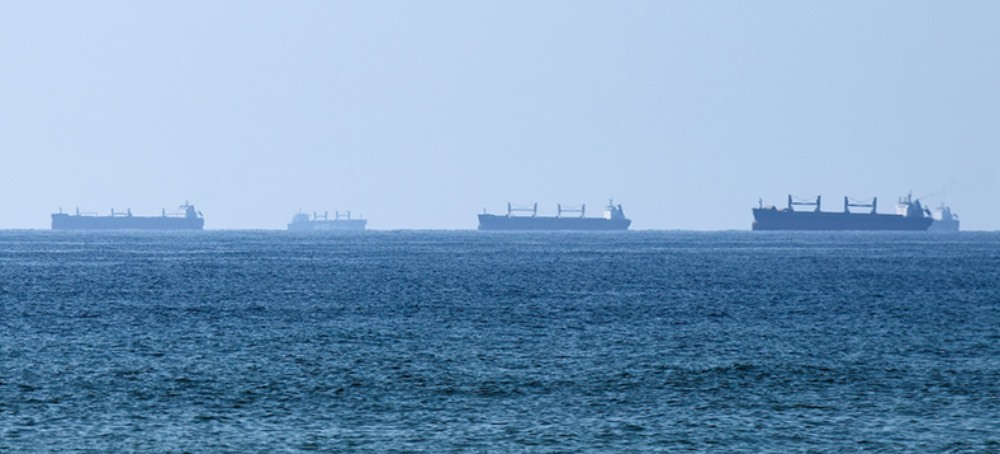 Ships moving through the Straight of Hormuz. (photo: Getty)
 Ships Keep Moving Through Hormuz Despite Strike and Suspension of IMO Exit Strategy
Joshua Minchin Lloyd's ListALSO SEE: Iran Attacks Bahrain and Kuwait Following US Strikes
and Threatens to Halt Talks to End the War
- Discussions between the foreign ministries of Iran and Oman on Monday helped finalise the IMO plan before its abrupt suspension
- The IRGC continues to insist that the only legitimate passage through the strait is the northern route under its control
- At least four vessels reversed course after the IRGC Navy reiterated its position on the northern route
- Traffic through the Omani lane nevertheless continued on Thursday and Friday despite the attack on the Ever Lovely, Iran’s warning and the IMO’s pause on the evacuation plan
THE International Maritime Organization’s evacuation plan — developed with Oman, Iran and the US — remains suspended as secretary‑general Arsenio Dominguez again seeks firm assurances that ships using the corridor will not be attacked. Yet traffic through the Strait of Hormuz has continued largely unabated, even after the strike on Ever Lovely and despite the IMO’s decision to pause the initiative.
Singapore-flagged, 2015-built, 8,488 teu Evergreen containership Ever Lovely (IMO: 9629110) was struck by a projectile while transiting the southern route, which hugs the Omani coastline, on Thursday (June 25).
That incident followed a statement by the Islamic Revolutionary Guard Corps Navy issued that morning, reaffirming that the only legitimate route through the Strait of Hormuz was the northern route it controls.
Speaking to reporters in a press conference on Friday, Dominguez confirmed that Ever Lovely was not transiting as part of the evacuation plan and did not contact Omani authorities as part of that framework.
Instead, it made its own risk assessment to transit the corridor, he said.
Nevertheless, the attack on Ever Lovely was enough to bring the plan to a screeching halt, just days after it began, although vessels continued to sail through the Omani lane on Thursday and Friday despite the attack and the IMO’s decision to pause the plan.
Dominguez confirmed that 115 vessels and around 2,500 seafarers had been able to exit the Middle East Gulf during its short lifespan, though he said those figures did not include some transits that had taken place on Friday morning.
At least four vessels that were heading towards the strait turned back shortly after the IRGC Navy statement on Thursday morning. Three others changed course but ultimately completed their transit, including Panama-flagged, 13,086 dwt product tanker SG Pegasus (IMO: 9494876), which actually switched from the southern, Omani-controlled route to the northern, Iranian-controlled route hours after the IRGC statement began circulating.
Two vessels heading towards or through the Iranian lanes made U-turns on Friday, Lloyd’s List Intelligence data showed.
US President Donald Trump addressed the attack in a social media post on Friday, calling it a “foolish violation” of the ceasefire. He said that Iran shot at least four one way attack drones at ships transiting the strait. Three were intercepted by US forces while a fourth was “solidly hit the upper deck of a large and very expensive cargo carrying ship”, Trump said.
Where does the IMO plan go from here?
Dominguez told reporters he was again seeking the same guarantees from Oman, Iran and the US that vessels will not be targeted, no matter which route they decide to take.
He said talks on Monday between the foreign ministries of Oman and Iran were why the IMO decided to move forward with its evacuation plan. Yet Ever Lovely was attacked in spite of guarantees provided by Iran just days later.
Dominguez said he was still trying to find out “what happened” in relation to Thursday’s incident, given the position “that was taken at foreign affairs level and then the actions that were taken by the IRGC”.
Until the IMO receives guarantees that vessels can transit without fear of being targeted, the plan will remain paused, he said.
When asked by Lloyd’s List how shipowners could trust any guarantees, given the attack on Ever Lovely just days after they were first provided, Dominguez said he needed to work “on the trust and the continuous exchange of information and negotiations that are being carried out”.
“We’re not going to put the seafarers at risk, and I’m hoping that this is an isolated incident that we can then again reiterate those guarantees of safety and the need for the flow of transit to continue in line with the MOU that was signed.”
He said if there were concerns, he’d prefer to have “those conversations in advance and address them as soon as possible”.
Traffic continues
Despite the pause, ships continued to move through both the Omani and Iranian lanes on Thursday and Friday. Several vessels that initially turned back after the IRGC Navy statement later resumed their voyages and completed their transits.
Lloyd’s List Intelligence data shows at least 26 vessels of over 10,000 dwt transiting with AIS on using the southern route from 1410 hrs on June 25, when Ever Lovely was hit, to 1200 hrs on June 26, excluding vessels that were mid-transit when the attack took place. Eleven used the Iran-approved northern route.
Four vessels that originally U-turned went on to complete their transits of the strait, including SG Pegasus (IMO: 9494876), which switched from the southern to northern route. Togo-flagged, 2001-built, combined chemical and oil tanker Blue Star I (IMO: 9215115) completed its transit using the southern route at around 0100 hrs on June 26, despite U-turning following the IRGC Navy statement yesterday.
Klaveness Combination Carriers’ Marshall Islands-flagged, 2001-built, 72,562 dwt Banastar (IMO: 9228045) was another that U-turned shortly after the IRGC Navy statement at 1023 hrs, but then continued to use the southern route a couple of hours later.
A US sanctioned, 72,807 dwt tanker that appeared to be heading inbound through the Iranian lanes U-turned in the early hours of Friday, Lloyd’s List Intelligence data showed.
Meanwhile, Umm Slal (IMO: 9372731) a Nakilat-owned Qatarmax liquefied natural gas carrier that was sailing through the Iranian lanes, also made a U-turn about 15 nautical miles southeast of Larak Island on Friday morning.