
Senate With Cassidy’s Vote Advances Resolution to Block Further Strikes on Iran
Theodoric Meyer Washington Post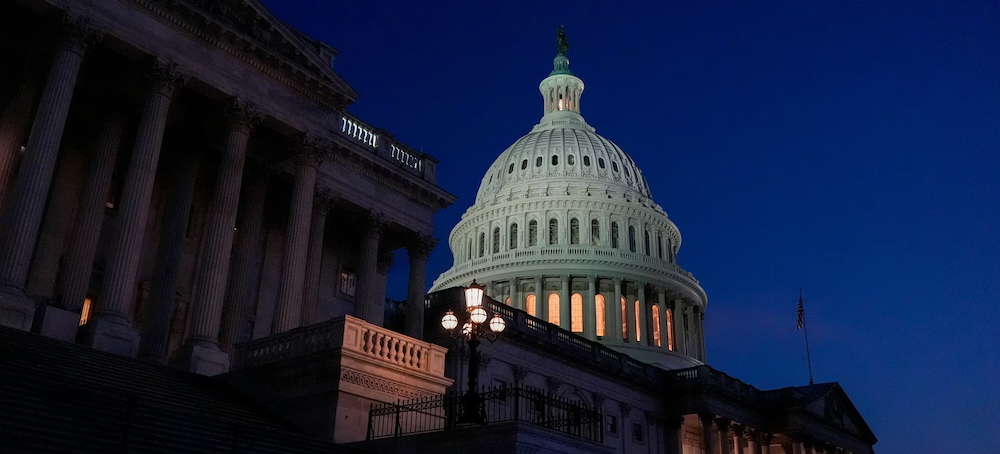 The United States Capitol building. (photo: Kent Nishimura/Bloomberg/Getty Images)
 Senate With Cassidy’s Vote Advances Resolution to Block Further Strikes on Iran
Theodoric Meyer Washington Post
The vote was a breakthrough for Democrats, but the measure faces considerable hurdles before it could force President Donald Trump to end the war.
Four Republicans — Sens. Rand Paul (Kentucky), Susan Collins (Maine), Lisa Murkowski (Alaska) and Bill Cassidy (Louisiana) — joined Democrats in voting to discharge a war powers resolution from committee, the first step toward forcing Trump to end a war that Congress never authorized. Sen. John Fetterman (Pennsylvania) was the lone Democrat to vote no.
The 50-47 procedural vote was a breakthrough for Democrats, but the measure still faces considerable hurdles before it could force Trump to end the war.
Democrats have forced votes on seven similar resolutions with Paul’s support since the start of the war, all of which have failed. But several Republican senators who voted against the resolutions at first have switched their votes as the war has dragged on.
Cassidy, who lost his primary Saturday after Trump endorsed one of his challengers, voted for the first time Tuesday to advance the resolution. He said that while he supported efforts to dismantle Iran’s nuclear program, the White House and the Pentagon had left Congress in the dark about the war.
“In Louisiana, I’ve heard from people, including President Trump’s supporters, who are concerned about this war,” Cassidy said in a statement. “Until the administration provides clarity, no congressional authorization or extension can be justified.”
Senate Minority Leader Charles E. Schumer (D-New York) argued before the vote that Trump’s comments that he was an hour away from ordering new strikes on Iran on Monday was reason to rein the president in.
“This president is like a toddler playing with a loaded gun,” Schumer said on the Senate floor. “If there was ever a time to support our war powers resolution to withdraw troops from hostilities with Iran, it’s now.”
The vote came after the Trump administration blew past a legal deadline earlier this month.
The War Powers Resolution of 1973 — the law Democrats used to force the vote — requires presidents to remove U.S. forces from any conflict that Congress has not authorized within 60 days. Trump hit the deadline May 1 but evaded it by claiming that hostilities have “terminated,” even as the United States continues to enforce a naval blockade of Iran.
Some Republicans have echoed Trump’s argument that the war is effectively over.
“Those hostilities do not exist today and have not existed for some time,” Sen. James E. Risch (R-Idaho), the chairman of the Senate Foreign Relations Committee, said last week on the Senate floor.
Democrats have rejected the argument that hostilities have ceased. Sen. Tim Kaine (D-Virginia), who has spearheaded Democrats’ strategy, argued that the current lull in the conflict provided an opening for Congress to reassert itself.
“If we’re in a ceasefire where we are trying to find a diplomatic path forward, rather than precipitously start a bombing campaign again, this is exactly the time where Congress should be having a debate about the rationale for the war,” Kaine said on the Senate floor before the vote.
Polling shows the war is unpopular. A New York Times-Siena poll conducted last week found that 64 percent of registered voters think Trump made the wrong decision in going to war, and 30 percent believe he made the right decision.
The resolution still faces a tough road before it could take effect. Following Tuesday’s procedural vote, the Senate still needs to take at least two more votes to pass the resolution, which may be more difficult if every senator is voting.
Three Republicans who opposed taking up previous resolutions to withdraw U.S. forces from Iran — Sens. John Cornyn (Texas), Thom Tillis (North Carolina) and Tommy Tuberville (Alabama) — missed Tuesday’s vote. If all of them vote no on the next vote to advance the resolution, it will fail 50-50.
The measure would also need to pass in the House, which last week narrowly rejected a similar resolution. And Trump would almost certainly veto it, forcing the Senate and the House to override his veto before it could take effect. No war powers resolution has ever overcome a presidential veto.
The Senate voted to advance a war powers resolution in January that would have prevented Trump from striking Venezuela again, only to block it days later after two Republicans flipped under pressure from Trump.
In an interview after the vote on Tuesday, Kaine said he did not expect the Senate to take the next vote to advance the resolution until early next month, after the Senate returns from its Memorial Day recess. He said he expects Trump to put heavy pressure on Republican senators to avoid more defections.
Kaine is aware of the hurdles to forcing Trump to end the war, but he said passing a war powers resolution could send a message to Trump about the conflict’s unpopularity even if the president vetoes it.
“With each additional vote, it’s revealing to the president how unpopular this is with the American public,” Kaine said. “He is a more sensitive reader of his own popularity than any person on planet Earth — and that’s what matters to him.”