
Scott Bessent Fails to Gaslight the Market
Paul Krugman Substack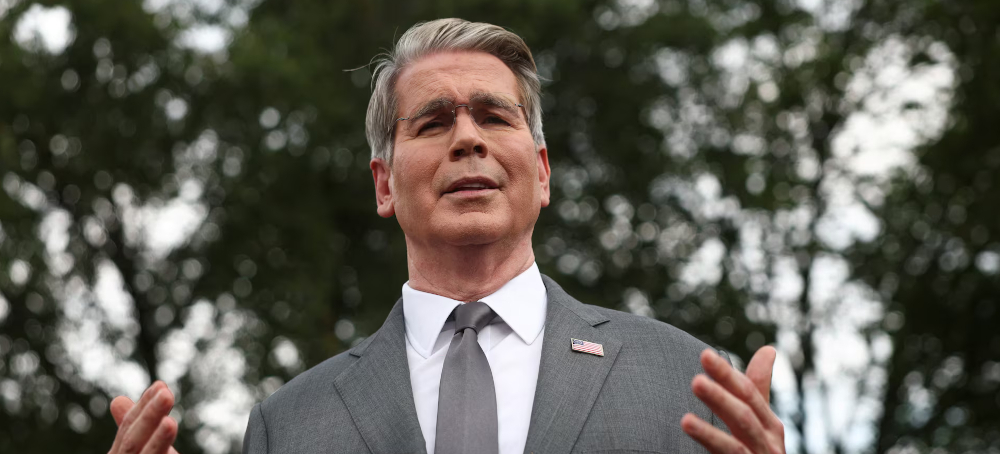 U.S. Treasury Secretary Scott Bessent speaks to reporters at the White House in Washington, D.C., U.S., August 20, 2026. (photo: Kevin Lamarque/Reuters)
 Scott Bessent Fails to Gaslight the Market
Paul Krugman Substack
What doth it profit a man if he sell his soul and can’t even manipulate the 30-year?
’Sigh of relief: Wall Street welcomes Donald Trump's pick
"In choosing somebody who essentially could have been the Treasury secretary in an ordinary Republican administration, there is a sigh of relief that at least there'll be one economic adult in the room," said David Wessel, a senior fellow at the Brookings Institution.
Jason Furman, a Harvard professor and former White House economic adviser, described Bessent as a "credible Treasury secretary who has a real understanding of the global economy”.
Credible Treasury secretary, my, um, assets. In office, Bessent has been a consummate Trump sycophant. For example, in March 2026 the Treasury announced that henceforth Donald Trump’s signature would appear on paper currency — a first for any sitting president. Bessent’s prepared remarks ran as follows:
Under President Trump’s leadership, we are on a path toward unprecedented economic growth, lasting dollar dominance, and fiscal strength and stability. There is no more powerful way to recognize the historic achievements of our great country and President Donald J. Trump than U.S dollar bills bearing his name, and it is only appropriate that this historic currency be issued at the Semiquincentennial.
This kind of “Dear Leader” rhetoric coming from the nation’s top economic official is far worse than just embarrassing. In times of crisis, the Treasury secretary’s credibility is a critical asset for dealing with financial markets. So when Bessent talks like a love-struck Natalie Harp, it carries the potential for enormous financial and economic costs for the country.
Moreover, Bessent routinely makes assertions about the state of the economy that are manifestly, glaringly untrue – as if he can gaslight the professionals who closely track economic data. A couple of weeks ago, for example, Bessent rejected the widespread view that we have a “K-shaped economy” in which a few people are doing well but many are falling behind:
I get sick of hearing about this K-shaped economy, I can say here definitively, the K-shaped economy is over.
Bessent tried to back up his claim by pointing to data on wages, which showed that those in the top 25 percent had slightly lower wage gains than those in the bottom 25%. But nobody familiar with the data was fooled. High-income Americans receive much of their income from capital, not labor, while many lower-income Americans rely on food stamps and other programs that are facing savage cuts under Trump. Here’s what after tax-and-transfer real income looks like for the 1 percent and the bottom half of the population since Trump II began:
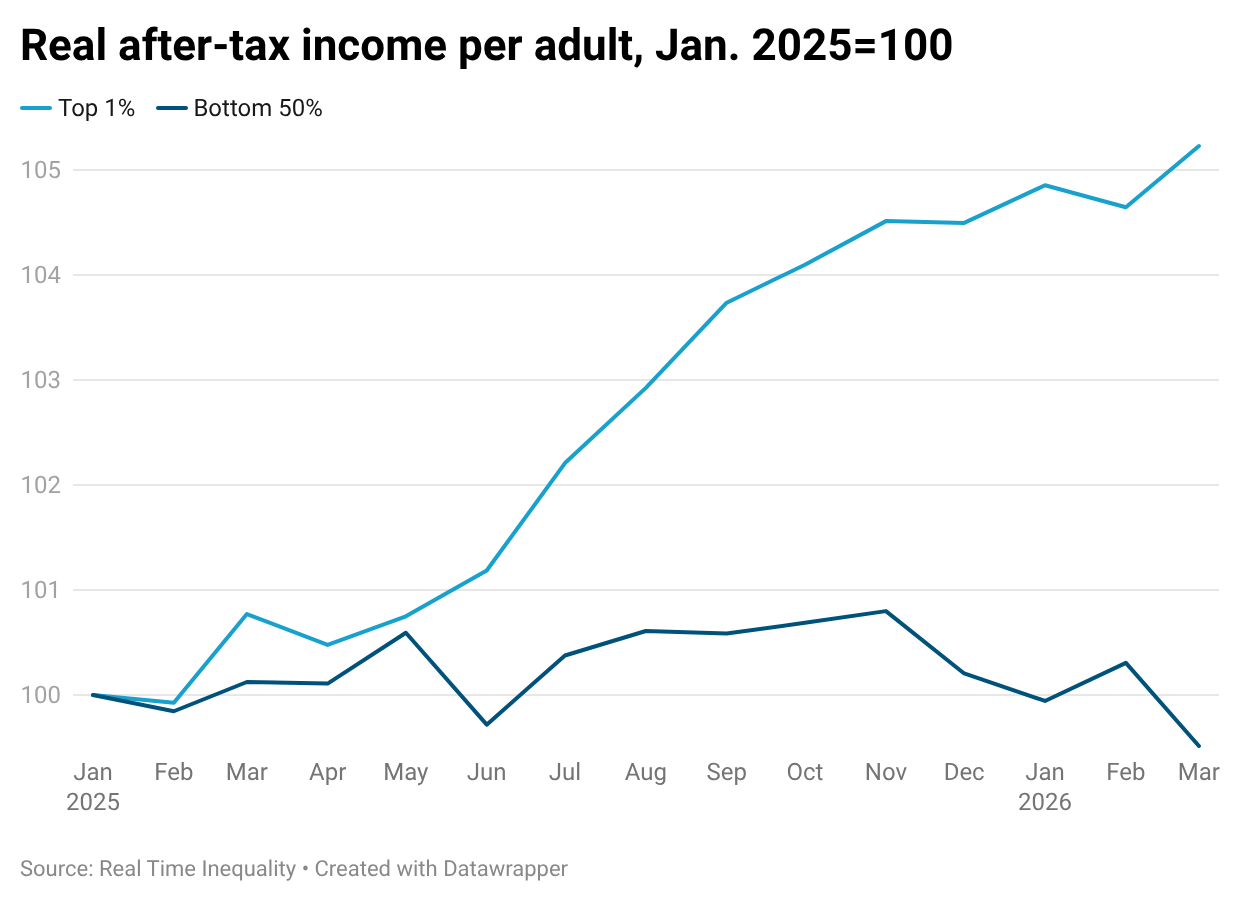
Looks pretty damn K-ish to me.
So it’s clear that Bessent’s pronouncements are geared to an audience of one: Donald Trump. He doesn’t mind sounding like a fool and a liar to the financial markets and to the American public as long as it pleases Dear Leader.
But Bessent’s betrayal of the trust that was placed in him by the American public to be a competent steward of the nation’s economy goes beyond public pronouncements. Something very troubling is happening inside the Treasury department as well. According to the Partnership for Public Service, a nonpartisan watchdog, 7 out 16 Trump Treasury appointees confirmed by the Senate — that is, the very top Treasury officials — have left since the start of Trump II. That’s 44 percent, an astonishingly high percentage. According to NOTUS, which reported on the study,
At least four of the seven top Treasury officials left after disagreements with the White House over demands to stretch, if not violate, tax law. Those disputes included Treasury resistance to a controversial push to use taxpayer data as part of the administration’s immigration crackdown, as well as the president’s push to establish a $1.8 billion fund to compensate allies as part of a deal with the IRS to drop any past or future tax audits of the president and his family. (The “anti-weaponization” fund was later dropped due to resistance from Senate Republicans.)
NOTUS quotes Mark Mazur, a former senior Treasury official, who suggests that some of the departing officials may be leaving rather than commit illegal acts:
A lot of these people expect to have a career after this administration, and being disbarred would be a bad thing for them.
And aside from apparently demanding that Treasury officials act in ways that would put them in legal jeopardy, Bessent has been deploying the financial resources of the Treasury in ways that have little relationship to U.S. national interest, but are clearly in the service of Trump’s political goals.
One example was a large financial intervention in October 2025 to support the Argentine peso. The U.S. has no obvious economic or national security stake in Argentina. The obvious goal, however, was an attempt to rescue the right-wing, Trump-friendly government of Javier Milei. While this intervention bought Milei some time, it didn’t revive his political fortunes: Milei’s approval ratings are at Trump-like levels.
Which brings me to Bessent’s most recent interventionist move: An attempt to reverse the recent spike in U.S. long-term interest rates by buying back 30-year Treasury bonds. It’s actually an almost pitifully small move:
The US Treasury is buying long bonds, but not very many
Speaking loudly but wielding a teeny-tiny stick
Still, where does the money for the buyback come from? From sales of government issued shorter-term debt, largely Treasury bills.
This is just a swap of longer-term government debt for shorter-term, riskier government debt. It does nothing to resolve the underlying U.S. fiscal problems that caused the spike in the 30-year debt. Some analysts call Bessent’s strategy“rearranging the deck chairs on the Titanic.”
But it’s actually worse than that. I won’t go into all the wonky details here, but Bessent’s bond move is functionally equivalent to “quantitative easing,” the policy the Federal Reserve followed in the early 2010s.
Back then the Fed was trying to boost an economy that was still deeply depressed in the aftermath of the 2008 financial crisis. So it tried to reduce long-term interest rates by buying long-term federal debt, paid for by effectively issuing short-term debt in the form of interest-paying deposits.
The Fed did quantitative easing in the early 2010s for good reasons: to resuscitate a moribund economy. But conditions are completely different now: Unemployment is fairly low and the economy is suffering from above-target inflation. Indeed, there’s a live debate within the Fed about whether to tighten money to fight inflation. So why is the Treasury engaging in an end run around the Fed, conducting its own de facto expansionary monetary policy?
The answer is clearly political: High long-term interest rates are an embarrassment for the Trump administration, and Bessent is trying to make the picture look prettier, even though this means undermining the people who are supposed to be making monetary policy.
The maneuver is failing: 30-year yields fell briefly on Wednesday, when the policy was announced, but bounced back on Thursday and were higher as I write this than they were a week ago. — clear proof that you can’t gaslight the bond market.
So Bessent, a former bond trader himself, has squandered all of his credibility with his sycophancy, his apparent demands that top officials engage in unethical and probably illegal conduct, and his abuse of the Treasury’s financial power for clearly political goals.
And his ruined reputation will be a real problem if and when, like many of his predecessors, he encounters a crisis in which we really need a credible Treasury secretary with competent subordinates.