
Schools, Hospitals, Playgrounds: Iran's Civilian Sites Hit by US-Israeli Strikes
Katherine Hearst Middle East Eye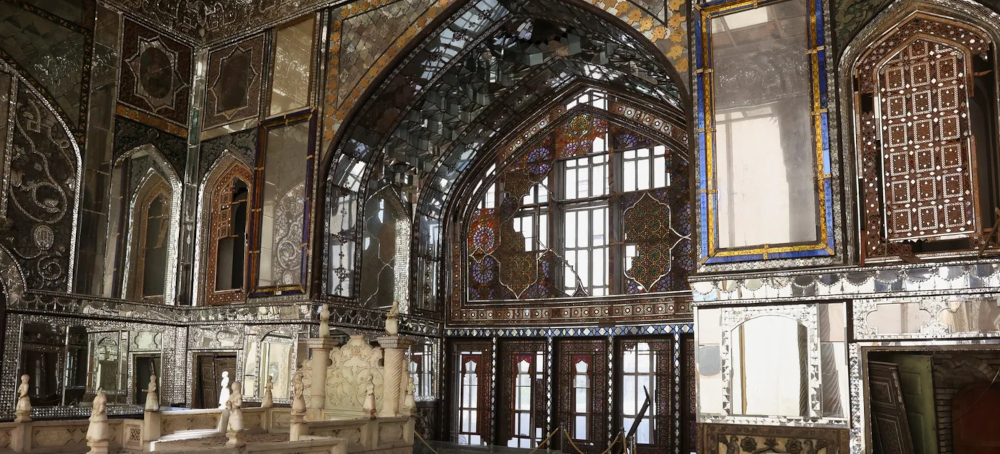 The interior of UNESCO registered Golestan Palace after it was damaged in an Israeli and US strike in Tehran, Iran, 3 March 2026. The Palace dates back to the early 15th Century. (photo: Majid Asgaripour/Reuters)
 Schools, Hospitals, Playgrounds: Iran's Civilian Sites Hit by US-Israeli Strikes
Katherine Hearst Middle East Eye
A 12,000-seat stadium, Unesco world heritage site and children's parks are among places attacked in the last week
Despite claims by the US and Israel that strikes are solely targeting Iran’s leadership and military infrastructure, Iranians on the ground are seeing their homes, hospitals and schools bombarded.
Many civilians are also dying in the onslaught.
Tasnim news agency puts the civilian death toll at more than 1,230 since the war began on Saturday.
Middle East Eye delves into the damage and death tolls resulting from the attacks:
Schools, kindergartens and parks
Shajareh Tayyebeh primary school, Minab, 28 March, 165 killed.
The war on Iran broke out on Saturday and within hours news broke of a deadly strike on the Shajareh Tayyebeh primary school in the city of Minab, in southern Hormozgan province.
According to local authorities, at least 165 people were killed, most of them girls and boys between the ages of 7 and 12.
Witnesses who spoke to MEE revealed that the school was hit with two strikes, the second of which killed sheltering survivors.
Two attacks on the same target are often characterised as “double-tap” strikes, particularly if there is a brief pause between them and medics and other civilians arriving at the scene are killed in the follow-up attack.
Iranians elsewhere in the country have also reported attacks that resembled double-tap strikes.
The US and Israel said they are investigating the incident.
US investigators probing the attack reportedly said they believe that the US military was probably responsible for the strike.
Sports Hall, Lamerd, Fars Province, 28 February, 18 killed.
Hours after the Minab school strike, a missile targeted a sports hall on the outskirts of Lamerd, where dozens of teenagers were gathered for training.
Local officials cited by Iranian media reported that 18 people were killed in the attack, most of them teenage girls.
The missile struck the hall's roof, reducing the main court, spectator stands and changing rooms to rubble.
Mohammed Saed Khorshedy, a 29-year-old worker at the gym, told Drop Site News: "Sports equipment, balls, tables, barriers flew through the air. Black smoke filled the space. The smell of gunpowder made breathing almost impossible. The screaming began immediately, layered with the sound of debris collapsing and concrete falling from the ceiling."
Hossein Gholami, whose 16-year-old daughter Zahra was killed in the attack, described how "the smell of blood and burns covered everything".
“Every time I close my eyes I see her face, her smile, and I hear the sound of the explosion,” Gholami said.
The US and Israel did not issue a statement regarding the attack.
Narmak school, Tehran, two killed
An air strike targeting 72 Square in Tehran's eastern neighbourhood of Narmak damaged a high school, according to Al Jazeera. Authorities reported that at least two children were killed in the attack.
Kindergarten, Narmak neighbourhood, Tehran, no casualties known
Children's park, Tehran, no casualties known
Iranian commentator Trita Parsi reported on X on 5 March that an attack targeted a public park in Tehran called "Police Park".
"It has nothing to do with the police," Parsi said, suggesting that the attack was evidence that Israel was using AI to identify targets "as it is bombing all government-related buildings".
"No one in Israel brothered to check and find out that it is just a park," Parsi added.
Similarities between Israel's bombing of Gaza and Tehran are growing stronger.
— Trita Parsi (@tparsi) March 5, 2026
In both cases, it appears Israel is using AI without any human oversight.
For instance, Israel has bombed a park in Tehran called "Police park." It has nothing to do with the police.
But it appears… pic.twitter.com/vWBTHlIiNT
Hospitals and medical facilities
Gandhi Hospital, 1 March, Tehran, no casualties known
Ganghi hospital was struck on the second day of the assault, causing “very serious damage” to its fertility clinic.
Couples who were undergoing IVF at the clinic after spending 10 years trying to conceive told MEE that they do not know what happened to their samples.
“We don’t know if all these years of effort and hope are gone,” they said.
The centre is among at least 13 hospitals and other health facilities verified by the World Health Organization (WHO) to have been targeted in the US-Israeli attacks, resulting in four healthcare worker deaths and 25 wounded.
The Israeli military issued a statement claiming that the hospital suffered only “minor and collateral damage” and that the intended target was military infrastructure located near the building.
No military use of the hospital has been alleged.
Salmaz, a nurse at the hospital, told MEE that the force of the blast "threw me into the corner of my office". She added: "The building caught fire. Everyone was screaming and trying to escape."
In the chaos, nurses scrambled to evacuate newborns from the facility.
Hospitals near Red Crescent building, Tehran, no casualties known
On Sunday, the Iranian Red Crescent released a video showing plumes of smoke spreading from an attack near one of its buildings in Tehran.
The attack, which appeared to target the Iranian police headquarters, damaged several nearby hospitals, including Khatam al-Anbiya Hospital, the Motahari Hospital, and the Valiasr Hospital.
Abuzar Hospital, Ahvaz, 1 March, two wounded
Hossein Kermanpour, an Iranian health ministry spokesperson, reported on 1 March that 12 patients, including ICU cases, were evacuated after an attack on Abuzhar Hospital in Iran's Khuzestan province.
He added that two emergency services staff were wounded in the strike.
Emergency centres, Sarab and Hamedan, at least two wounded
WHO chief Tedros Adhanom Ghebreyesus reported that two emergency centres in the central Iranian city of Sarab and western city of Hamedan sustained damage in the attacks, with at least two medical staff wounded.
Baqaei Hospital, Ahvaz, no casualties known
Amneh Neonatal Care Center, Tehran, no casualties known
Shahid Rajaee Heart Hospital, Tehran, no casualties known
Hazrat Abolfazl Hospital, Minab, no casualties known
Residential areas
Niloofar Square, Tehran, 1 March, 20 killed
A least 20 people were killed when explosions struck Niloofar Square, a middle-class residential neighbourhood in eastern Tehran. Families had gathered in cafes to break their Ramadan fast on Sunday night.
Witnesses reported that the area had been hit by two explosions, indicating another “double-tap” strike.
Videos circulated online showing bodies strewn across blood-soaked cafe floors and the streets outside.
Witnesses who spoke to Drop Site News described “blood spraying everywhere”, severed limbs scattered across the floors and “scalps torn off”.
Three-story building at Third Circle, Tehranpars, Tehran, no casualties known
Residential complex, Sanandaj, no casualties known
Residential homes around Sepah Square, Tehran, no casualties known
Residential areas in Maragheh, Tehran, 27 killed
Residential homes in Narmak, Iraaghi Street, Marzdaran Boulevard, Tehran, no casualties known
Shahid Falahi residential buildings, Tehran, 5 March, no casualties known
Images circulated online appeared to show the aftermath of an attack the Shahid Fallahi residential complex near Babayi Highway in northeast Tehran.
Journalist Babak Taghvaee reported on X that the top floor of the residential block was targeted by the Israeli air force.
Residential buildings, Mir Damad Boulevard, Tehran, no casualties known
Historical and cultural sites
Golestan Palace, 2 March, Tehran, no casualties known
Tehran’s 400-year-old Golestan Palace, the city’s only Unesco world heritage site, sustained damage from a nearby strike on 2 March.
Ahmed Alavi, who heads Tehran’s tourism committee, told local media that the blast had damaged mirrors, windows and the building's historic Orsi doors.
Alavi reported that the blast was so powerful that it had lifted the tarmac outside the palace.
He emphasised that, given the site's Unesco status, the “world should be concerned” about its protection.
Tehran Grand Bazaar, no casualties known
Ba'ath Stadium, Tehran, no casualties known
Azadi sports complex, Tehran, 5 March, no casualties known
A strike levelled Tehran's 12,000-seat indoor stadium on Thursday morning.
Footage of its smoking remains showed that changing rooms and a newly constructed building used by the cycling federation were razed in the attack, and the swimming pool sustained damage.
"The destruction of sports, educational, and healthcare spaces is explicitly forbidden by the Red Cross in wartime, yet today we witnessed a direct attack on a sports venue at Azadi Stadium," said Alireza Sohrabian, president of Iran’s rowing federation.
Sports Minister Ahmad Donyamali condemned the attack as a violation of international law and the Olympic Charter.
#Iran condemns U.S. and Israeli strikes on the 12,000-seat stadium at Tehran’s Azadi Sports Complex. Minister Ahmad Donyamali visited the site, calling the attack a violation of international law and the Olympic Charter and urging global accountability. https://t.co/pfmbarR0cV pic.twitter.com/P8mfveluvv
— Government of the Islamic Republic of Iran (@Iran_GOV) March 5, 2026