
Russian Attacks Destroy Millions of Books, the Heart of Ukrainian Culture
Kim Barker and Oleksandra Mykolyshyn The New York Times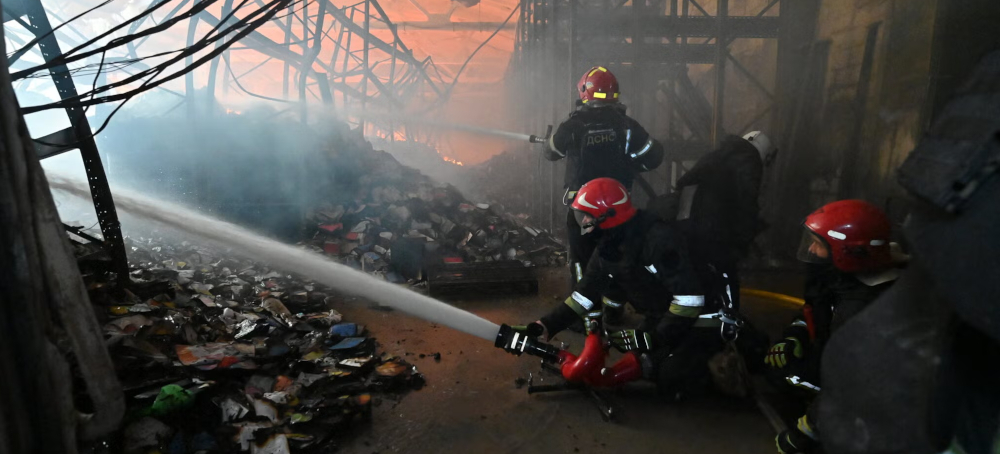 The Ranok Publishing warehouse in Kharkiv, Ukraine, after it was struck twice by Russian drones in August. (photo: Sergey Bokok/Getty)
 Russian Attacks Destroy Millions of Books, the Heart of Ukrainian Culture
Kim Barker and Oleksandra Mykolyshyn The New York Times
A publisher whose warehouse was hit twice said Moscow “thinks that books are more dangerous for them than military equipment.”
This was no weapons depot, no drone manufacturer, no cog in the war machine. Instead, the warehouse targeted by the drones belonged to Ranok Publishing, one of the largest children’s book publishers in Ukraine. The company, based in the northeastern city of Kharkiv, was attacked during one of its busiest times, when it was preparing textbooks for the new school year.
“It’s such a disaster,” said Viktor Kruglov, the publishing house’s chief executive, who was working at the warehouse with about 50 employees — all of whom escaped injury — when it was hit.
“Russia thinks that books are more dangerous for them than military equipment,” he said. “They deliberately damage, erase, extinguish everything which is connected with Ukrainian culture.”
All eight million books inside the warehouse were destroyed, including 620,000 textbooks. Though the strike was the worst attack on books this summer, it was far from the only one. All told, Russian shelling has destroyed as many as 15 million new books in recent months, almost half of Ukraine’s annual production, said Artem Bidenko, chief executive of the Ukrainian Publishing Association.
The Ukrainian Culture Ministry, which is now trying to raise money for independent publishers, estimates that the Russian attacks have cost the Ukrainian book industry almost $40 million.
The strikes are part of an escalating air war that has left publishing houses scrambling to find warehouse space in western Ukraine, which has been less affected than the area around Kyiv, the capital. Russia has intensified the targeting of warehouses — sites storing not only books but also a range of other consumer goods — after Ukraine began a campaign of strikes on two Russian e-commerce giants.
The Russian assaults have damaged the Ukrainian economy, leading the European Bank for Reconstruction and Development to lower its forecast for economic growth in Ukraine this year to 1.5 percent, from 2.2 percent.
The list of products destroyed this summer in the Russian attacks is long: fresh produce, meat, buckwheat, Coca-Cola, vodka, wine, baby milk, toys, Puma tennis shoes, high heels, designs from fall clothing lines, packages and mail sent from near and far, Toyota car parts and hundreds of tons of pharmaceuticals, including lifesaving ones.
Russian attacks have destroyed about 40 percent of Ukraine’s modern warehouse capacity, according to a major industry leader, though the Ukrainian agriculture minister has given a higher figure. More than 60 workers have been killed.
While Ukrainians may miss the peas and barley that have vanished from some grocery store shelves, books are a different matter. They represent ideas, transport readers to other worlds, open minds to different perspectives and build empathy. And Ukrainian books are tied to Ukraine’s desire for independence from Russia like almost nothing else.
In defending his crusade to bring Ukraine under Moscow’s dominance, President Vladimir V. Putin of Russia has claimed that Ukraine is not an actual country, that the whole country speaks Russian, that Ukrainian is a dialect of Russian and that his war is intended to defend the rights of oppressed Russian speakers.
It’s true that most Ukrainians speak or understand Russian, especially in eastern Ukraine, which is now mostly occupied by Russia. But most Ukrainians speak Ukrainian as their primary language.
Using the Ukrainian language instead of Russian has long been a political statement, especially among intellectuals. Talk to book lovers in Ukraine and they will bring up historical events from the 1600s such as Russia’s burning of books in the Ukrainian language and limits on their printing, or the Soviet repression of Ukrainian books in the western city of Lviv in the late 1930s.
After the breakup of the Soviet Union in 1991, Russia undermined the Ukrainian book industry for decades by selling Russian-language books much more cheaply.
The resurgence took time. In the early 2000s, Harry Potter books that were quickly published in Ukrainian — before Russian translations — were best sellers. In 2014, the covert war started by Russia in eastern Ukraine stoked the embers of Ukrainian cultural nationalism.
But Mr. Putin’s decision to fully invade Ukraine in February 2022 cemented the shift. Russian-speaking Ukrainians living in unoccupied Ukraine learned Ukrainian. Speaking Russian in public often got a side-eye or worse.
Last month, a ballistic missile destroyed much of the Pochaina market, Kyiv’s oldest and largest book market. A sprawling maze of stalls sold secondhand Russian books, books from the Soviet Union and older books from Ukrainian authors.
“People came to us from all over the country,” said Natalia Sotnyk, who worked at a store in the market that she said had maybe 70,000 books, including Russian and Ukrainian editions from before the Soviet Union existed. “There were many copies that you simply won’t find anywhere anymore, and we never again will.”
Nevertheless, the strike made some book lovers feel ambivalent, because of the large numbers of Russian books. Some said that while they would not deliberately set Russian books on fire, they did not mourn the entirety of Pochaina.
Russia has also struck the warehouse of the children’s publisher that put out the Harry Potter books, destroyed almost all the books of small publishing companies — putting them in danger of bankruptcy — and seriously damaged one of Ukraine’s largest printing companies, Konvi Print.
Viktoriia Haidai, who runs Konvi, was camping when an employee called her in the middle of the night about a ballistic missile that had hit the plant. In flip-flops, jeans and a T-shirt, she drove back to Kyiv to see firefighters battling flames.
“I remember an enormous amount of water pouring in from every direction,” she recalled. “It was awful because the water was ankle-deep. And I understood that all of that water was pouring onto the books, onto the products stored there. It was horrifying. But I didn’t feel like crying or anything like that. Inside, it was just pure anger.”
More than 600,000 books, mostly textbooks for students, were damaged or destroyed. Ms. Haidai decided to keep one: a Ukrainian literature textbook with a shrapnel hole through the middle.
Ukrainian bookstores are still selling books, with no noticeable shortages yet. But in parts of the country, children started school this month bookless, particularly in the fourth and ninth grades, which were required to have new books this year.
Mr. Kruglov, 56, the chief executive of Ranok Publishing, said that he was trying to find money and printers to reprint burned textbooks, along with everything else he lost.
He said his favorite book was “The Little Prince” by Antoine de Saint-Exupéry, a love he shared with his son, Ivan, who is almost 6. Mr. Kruglov recently ordered copies of a new Ukrainian edition of the book, the story of a lonely boy who leaves his asteroid kingdom to explore the universe and learn the meaning of love.
Those books were burned, too.
Mr. Kruglov told his son about what happened. Ivan asked his parents if they had grown up in war, too. He wondered whether they had to sleep on the ground in a shelter when they were his age. (Ivan also asks frequently if they will be killed by Russian drones.) War is all Ivan has known.
“It’s awful, actually, because of course this war changes his psyche,” Mr. Kruglov said. “That’s why I try to read to him every day, because I know that books give some calm, some normality.”
He is now reading his son one book about Paddington Bear and another about dinosaurs, depending on his mood. It is good to take him away from things in Kyiv.