
Russia Seizes Massive Ukrainian Nuclear Plant and Presses Siege of Southern Cities
David L. Stern, Alex Horton, Amy Cheng and Kareem Fahim The Washington Post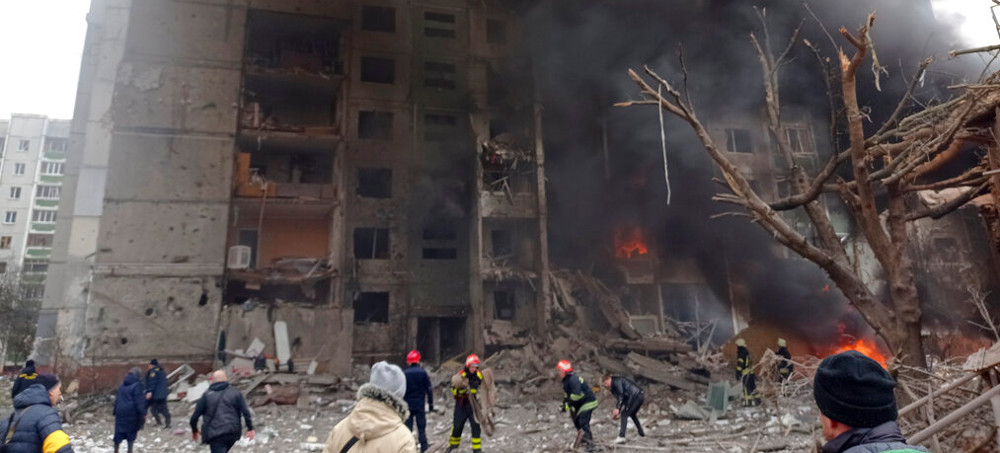 An apartment building hit by shelling in Mariupol, Ukraine, is seen on March 2. (photo: Evgeniy Maloletka/AP)
Russia Seizes Massive Ukrainian Nuclear Plant and Presses Siege of Southern Cities
David L. Stern, Alex Horton, Amy Cheng and Kareem Fahim The Washington Post
Mariupol mayor warns that his city faces a ‘humanitarian catastrophe'
West of Mariupol in Kherson, a regional capital and the first major city to fall to Russian forces, a city council member said Russian equipment and soldiers were “absolutely everywhere.”
And in Kharkiv, Ukraine’s second-largest city, Russian troops have fired cluster munitions into at least three residential neighborhoods, according to a Human Rights Watch report released Friday.
The number of casualties caused by more than a week of fighting has been impossible to verify. The U.N. human rights office said Friday that at least 331 civilians had been killed, while Ukraine’s emergency services put the number of civilian fatalities much higher, at more than 2,000. A U.N. statement said most of the casualties had been caused “by the use of explosive weapons with a wide impact area, including shelling from heavy artillery and multi-launch rocket systems, and missile and airstrikes.” Russia has acknowledged the deaths of about 500 of its troops, while Ukrainian officials claim that as many as 10,000 Russian soldiers have been killed or captured.
Russia’s seizure of the Zaporizhzhia nuclear power facility, Europe’s largest nuclear plant, came after shelling that set part of the complex on fire, raising fears across Europe of a catastrophic accident. The U.N. nuclear watchdog reported that the blaze had not affected “essential” equipment and that Ukraine’s regulator reported no change in surrounding radiation levels. U.S. Energy Secretary Jennifer Granholm tweeted that the Energy Department also had seen no elevated radiation readings.
“The plant’s reactors are protected by robust containment structures and reactors are being safely shut down,” Granholm wrote. Even so, the blaze sparked international alarm and underscored the perils of a war fought around nuclear sites.
In Mariupol, Russian forces have been engaged in a “bombardment of critical civilian infrastructure” aimed at forcing the city to surrender, a senior western intelligence official said.
The city’s mayor, Vadym Boychenko, said officials were hoping that talks between Russian and Ukrainian officials would establish a “period of silence” to restore utilities such as electricity and water. “Our key task is to provide Mariupol residents with food and essentials,” he said in a message posted online by the city council.
Kherson, meanwhile, faces a “global catastrophe” if a humanitarian corridor is not opened soon to allow civilians to be evacuated and for food and medicine to be delivered, the secretary of the city council said.
“In Kherson, we are running out of food — literally, we can still last for maybe three, four days,” the city council secretary, Galina Luhova, said by telephone. “We’re running out of medicines, we’re out of baby food, we are running out of diapers, and we are running out of first aid in hospitals.”
The Russian blitz to take Kherson may have revealed a larger strategy in southern Ukraine, where the Pentagon has said Russian President Vladimir Putin’s forces have been the most successful in gaining territory.
Clashes have spilled over into nearby Mykolaiv, a major city that feeds the Black Sea. Russians may want to capture Mykolain as a lane of advance to Odessa, the strategic port farther west. The Russian military may use the city as a way to support and reinforce any future amphibious landings at Odessa, a senior U.S. defense official said Friday, speaking on the condition of anonymity under ground rules set by the Biden administration.
With the conflict now in its second week and Russia sending nearly all of its assembled military power into neighboring Ukraine, satellite images are providing glimpses of the scale of the invading force, as well as the devastation the fighting has wrought. Analysis of satellite imagery by the U.S. firm Maxar Technologies shows bridges and roads damaged and homes destroyed in towns and cities across the country.
In Chernihiv, a strategic northern city on a highway that links the Ukraine-Belarus border with to Kyiv and where a fierce battle has been waged in recent days, the images show damaged roads, bridges and homes. Some factories appear to have been leveled. On Friday, Chernihiv’s regional authority said in a Facebook post that Russian strikes killed 47 people, including nine women.
The images also continue to show a long Russian armored column north of the capital, Kyiv. That enormous convoy has remained stalled because of what western officials say are logistical challenges and fierce resistance by Ukrainian forces
The column, consisting of combat and logistics vehicles, “is now likely supporting attacks directly into the city from positions that Russian forces maintain on Kyiv’s northwestern outskirts,” the senior western intelligence official said Thursday, adding that Russian forces were more likely “to prioritize encircling the city in the coming days rather than a direct assault on it.”
Alarm over the fate of Ukraine’s cities has intensified amid growing evidence that Russian forces are indiscriminately targeting urban centers.
“We have seen the use of cluster bombs and we have seen reports of use of other types of weapons which would be in violation of international law,” NATO Secretary General Jens Stoltenberg told reporters in Brussels on Friday.
In its report Friday, Human Rights Watch said it had documented the use of cluster munitions on the basis of two witness interviews and the analysis of 40 videos and images. Some of these sources show the “explosion signatures and rocket remnants” consistent with the delivery of cluster munitions from 9M55K Smerch rockets, the group added.
Because of the indiscriminate nature of cluster munitions — they scatter over a wide area small bomblets that could explode even after the fighting has ended — Human Rights Watch claimed that Russia may have committed a war crime by using them.
“Using cluster munitions in populated areas shows a brazen and callous disregard for people’s lives,” said Steve Goose, the arms director at Human Rights Watch. “If these deadly acts were carried out either intentionally or recklessly, they would be war crimes.”
The United States, which is out of step with many of its allies in abstaining from a treaty banning cluster weapons, has said for days it cannot verify they are being used by Russians in Ukraine.