
Russia: No Part of Our Country Is Safe From Ukraine’s Long-Range Strikes
Antonia Langford The Telegraph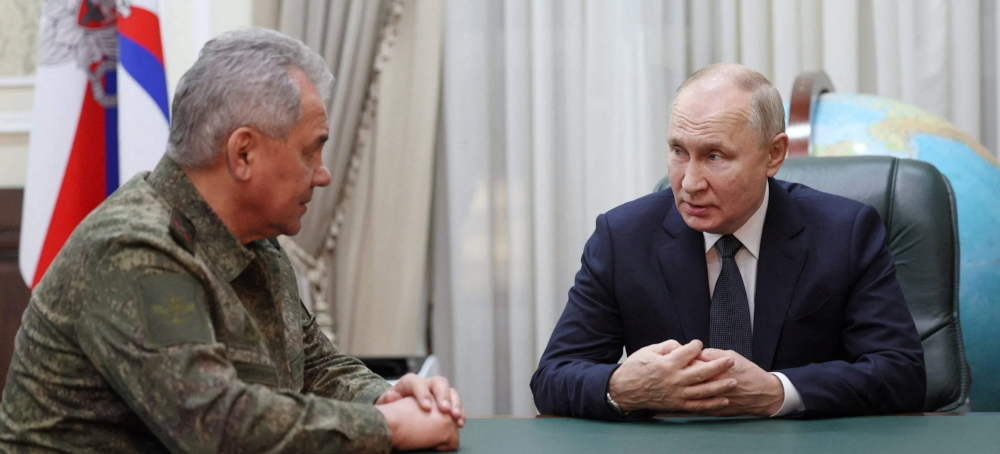 Sergei Shoigu (left), pictured with Vladimir Putin in 2023, warned that long-range strikes could now reach beyond Russia’s Ural region. (photo: Gavril Grigorov/AFP)
 Russia: No Part of Our Country Is Safe From Ukraine’s Long-Range Strikes
Antonia Langford The TelegraphSergei Shoigu, a former defence minister and current secretary of the country’s security council, said Kyiv’s air strikes on Russian infrastructure had surged almost fourfold to 23,000 last year. He also said such strikes were able to reach increasingly far-flung targets.
“The pace of weapons systems development, primarily that of unmanned drone systems, and the sophistication of the methods used to deploy them are such that no region of Russia can feel safe,” he told officials in the city of Yekaterinburg on Tuesday.
Mr Shoigu warned that long-range Ukrainian strikes could now reach beyond Russia’s mountainous and resource-rich Ural region, more than 930 miles from the border between the two countries.
Ukraine has repeatedly targeted the region, an industrial heartland crucial to Russia’s military capacity, with its improving missile capabilities making such strikes increasingly viable.
On Wednesday, Andrey Gurulyov, a state duma deputy and former army officer, backed up Mr Shoigu’s comments.
He said: “It’s impossible to cover everything. There simply aren’t enough [air defence] forces.” Mr Gurulyov called for a “continuous radar field” to detect incoming targets.
The concern among senior Russian officials has been sparked by a recent escalation in Ukrainian long-range strikes.
Attacks on Russia’s Krasnodar Krai in the past week caused fires at sites including the Afipsky oil refinery, Tikhoretsk oil pumping station and Port Kavkaz, which Russia uses to supply its forces in occupied Ukrainian territory.
On Monday, a strike on an oil depot in Labinsk almost wiped out its storage tanks, according to Telegram channels in the region.
Krasnodar’s city mayor said one person was also killed in a drone strike on a multi-storey residential building on Wednesday.
Kyiv has been increasingly ambitious in its almost daily strikes on targets inside Russia, and has developed its own cruise missile, the Flamingo, which has a range of more than 1,800 miles.
On Feb 12, a source from the security service of Ukraine said Kyiv had set a new range record after successfully bombarding the Ukhta oil refinery in the Komi Republic, more than 1,000 miles into Russia.
Ukrainian forces recently achieved their longest-range heavy missile strike on a Russian military facility, reportedly partially destroying a machine and ballistic missile production site in Votkinsk, in the central Udmurt Republic, around 800 miles from the border.
On March 16, monitoring channels said that drones had also targeted the Aviastar aircraft manufacturing plant in Ulyanovsk, around 1,118 miles from Ukraine’s border.
Kyiv also sent swarms of drones, sometimes more than 60 at a time, to Moscow on four consecutive days.
In autumn last year, it was reported that Vladimir Putin, the Russian president, was massing air defence systems around the capital in anticipation of a possible drone siege.
Moscow has suffered major internet blackouts since the first week of March, something the Kremlin has attributed to Kyiv’s “increasingly sophisticated attack methods”.
Ukrainian forces have also augmented their mid-range strike campaign against Russian logistics in order to interfere with Moscow’s preparations for a spring-summer offensive, according to the Institute for the Study of War.
On Tuesday, Volodymyr Zelensky, Ukraine’s president, raised the alarm about Russian aerial attacks, telling the New York Post that Moscow was preparing to increase its number of drone strikes on Ukraine to 1,000 per day.