
Russia Issues List of Demands It Says Must Be Met to Lower Tensions in Europe
Andrew Roth Guardian UK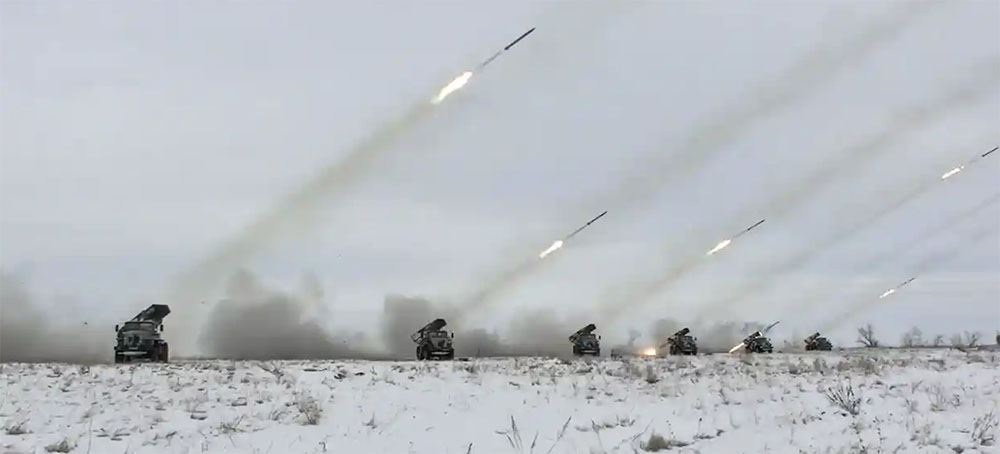 Russian truck-mounted rocket launchers during military drills near Orenburg. (photo: Russian Defence Ministry Press Service/EPA)
Russia Issues List of Demands It Says Must Be Met to Lower Tensions in Europe
Andrew Roth Guardian UKBiden Administration officials contend that Russia's aggression and abandonment of international norms preempt the need to give Russia's concerns serious consideration. In fact US Secretary of State Antony Blinken yesterday canceled a meeting with Russian Foreign Minister Sergei Lavrov planned for Thursday citing a Russian "invasion" of Ukraine as prohibitive.
US officials contend that appeasing Putin will not work and will only embolden him. However a structured negotiation need not lead to appeasement. Approaches such as incremental stages of compliance and independent verification are traditional, proven methods of giving negotiation weight and enhanced effectiveness. Techniques US officials are well aware of.
While Russia’s warlike conduct is alarming to international observers, a cold shoulder to Russia's concerns seems to preclude progress through negotiation. Further it raises concerns about US’s commitment to exhausting all avenues to a potential peaceful accord. That raises the additional question, if the US is not fully committed to diplomacy in an effort to avoid all-out war in Europe, then what are its own motives and objectives?
Independent, international observers warn of the potential for an ever widening human rights catastrophe if tensions between Russia and Ukraine spiral our of control. For the US to continue to refuse diplomatic contact undermines its credibility and intensifies the risk of a wider and more unpredictable conflict. — MA/RSN
Contentious security guarantees Moscow is seeking include a ban on Ukraine from entering Nato
The demands include a ban on Ukraine entering Nato and a limit to the deployment of troops and weapons to Nato’s eastern flank, in effect returning Nato forces to where they were stationed in 1997, before an eastward expansion.
The eight-point draft treaty was released by Russia’s foreign ministry as its forces massed within striking distance of Ukraine’s borders. Moscow said ignoring its interests would lead to a “military response” similar to the Cuban missile crisis of 1962.
Vladimir Putin has demanded that the west provide Russia “legal guarantees” of its security. But the Kremlin’s aggressive proposals are likely to be rejected in western capitals as an attempt to formalise a new Russian sphere of influence over eastern Europe.
The demands, spelled out by Moscow in full for the first time, were handed over to the US this week. They include a demand that Nato remove any troops or weapons deployed to countries that entered the alliance after 1997, which would include much of eastern Europe, including Poland, the former Soviet countries of Estonia, Lithuania, Latvia, and the Balkan countries.
Russia has also demanded that Nato rule out further expansion, including the accession of Ukraine into the alliance, and that it does not hold drills without previous agreement from Russia in Ukraine, eastern Europe, in Caucasus countries such as Georgia or in Central Asia.
Those proposals are likely to be viewed extremely negatively by Nato countries, in particular Poland and the Baltic states. They have warned that Russia is attempting to re-establish a sphere of influence in the region and view the document as proof Moscow is seeking to limit their sovereignty.
A senior US official said on Friday that the Kremlin knows that some parts of its proposals were “unacceptable”.
The Nato head, Jens Stoltenberg, has already ruled out any agreements denying Ukraine the right to enter the military alliance, saying it is up to Ukraine and the 30 Nato countries. There are already major obstacles to Ukraine entering the alliance, including its territorial dispute with Russia over annexed Crimea.
The Russia document also calls for the two countries to pull back any short- or medium-range missile systems out of reach, replacing the previous intermediate-range nuclear forces (INF) treaty that the US left in 2018.
The White House press secretary, Jen Psaki, said the US had seen proposals from Russia to start talks and was speaking with its European allies and partners, Reuters reported.
“There will be no talks on European security without our European allies and partners,” Psaki told reporters.
The Russian deputy foreign minister, Sergei Ryabkov, said on Friday that there was no deadline for talks but that Russia wants to begin negotiations “without delays and without stalling”.
“We can go any place and any time, even tomorrow,” he said in animated remarks.
Asked whether he thought the requests were unreasonable, he said no. “This is not about us giving some kind of ultimatum, there is none. The thing is that the seriousness of our warning should not be underestimated,” he said.
Dmitri Trenin, the head of the Carnegie Moscow Center, wrote that Russia’s public release of its proposed agreements “may suggest that Moscow [rightly] considers their acceptance by west unlikely”.
“This logically means that [Russia] will have to assure its security single-handedly, most probably by mil-tech [military technical] means,” he wrote.
Western countries have warned that Russia may be preparing an invasion of Ukraine in January as Russian tanks, artillery and missiles have massed near borders. The Ukrainian president, Volodymyr Zelenskiy, has called on the west for additional aid in case Russia decides to launch a broader offensive.
On Friday, Ukraine said one of its soldiers was killed during fighting with Russian-backed separatists in the east of the country. He was reportedly killed in an attack using grenade launchers and mortars.
The latest death brings Ukraine’s toll in the simmering conflict to 65 since the start of the year, according to an AFP tally based on official figures, compared with 50 in 2020. The conflict in eastern Ukraine has so far left more than 13,000 people dead.
Russia has massed about 100,000 troops on its side of the border. Joe Biden has warned Putin of “sanctions like he’s never seen” should his troops attack Ukraine. On Thursday, European Union leaders urged Moscow to halt its military buildup and return to talks led by France and Germany.