
Rubio Tries to Enlist Other Nations in Antifa Fight, but Some Allies Recoil
Ellen Nakashima, John Hudson and Adam Taylor The Washington Post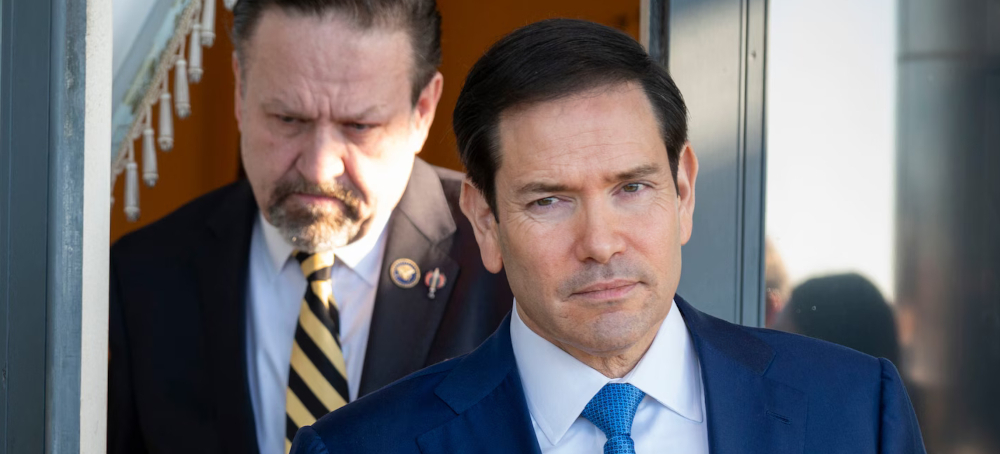 Secretary of State Marco Rubio, right, flanked by Sebastian Gorka, the Trump administration's counterterrorism czar, attends a State Department ceremony in March. (photo: Kevin Wolf/AP)
 Rubio Tries to Enlist Other Nations in Antifa Fight, but Some Allies Recoil
Ellen Nakashima, John Hudson and Adam Taylor The Washington Post
The secretary of state plans to convene foreign ministers in Washington next week. The event has unsettled some U.S. and European officials.
The meeting has prompted consternation among career and political U.S. officials, some European allies and independent analysts who do not see the threat in the same terms. Some U.S. officials told The Post that they worry it is part of a Trump administration effort to use powerful counterterrorism tools to crack down on U.S. activists they view as left-wing extremists.
The administration’s counterterrorism czar, Sebastian Gorka, has had discussions with colleagues about using foreign terrorism labels for antifa to justify going after Americans with links to the movement, a loosely knit association of far-left activists who militantly oppose fascism and right-wing ideologies, three current and former U.S. officials said.
A linkage to foreign terrorist groups “can unlock certain investigative tools,” such as surveillance, said one U.S. counterterrorism official, who like several other officials interviewed for this article spoke on the condition of anonymity to describe internal discussions and to avoid retribution.
Gorka did not respond to a request for comment.
State Department spokesman Tommy Pigott said the event was organized because far-left terrorism is “an old threat re-emerging with strong transnational links and new convergences.”
“Because this threat has not been adequately addressed in the past, each engagement, designation, or security assistance program creates a compounding effect supporting countermeasures at home and abroad,” Pigott said in a statement.
Some Trump administration officials fear that a future Democratic administration could use the tactic against conservative activists, one administration official said.
“The idea is you’re setting a precedent for a future Gavin Newsom administration to turn these authorities on conservatives,” the official said, referring to the California governor who is widely expected to make a 2028 White House run.
The use of these tactics has raised concerns among career and political officials inside the Justice Department and the White House Counsel’s Office, the administration official said, adding that some U.S. officials have decided not to attend the July 16 event at the State Department.
Asked for comment, a White House official said that the characterization of such concerns does “not represent the prevailing feeling in the White House” and accused Democrats of having weaponized national security tools against their conservative political opponents.
The White House official pointed to a passage in the Trump administration’s counterterrorism strategy‚ released in May, which states: “We will not permit the weaponization of America’s unparalleled CT capabilities for partisan purposes.”
That document also states that “our counterterrorism powers will not be used to target our fellow Americans who simply disagree with us.”
Like Gorka, White House Deputy Chief of Staff Stephen Miller is among those who have shown enthusiasm for taking a hard-line approach to left-wing extremists in the United States. During a White House roundtable last fall, he expressed support for designating antifa a foreign terrorist organization.
“It’s true,” Miller said when the president asked for his opinion, “there are extensive foreign ties. I think that would be a very valid step to take.”
But achieving that status for antifa would be a stretch, experts say.
U.S. law requires a group be foreign to be designated. “If it has any significant domestic presence, it cannot be designated,” said Jason Blazakis, who ran the State Department’s designation process for 10 years before leaving in 2018.
Elsewhere in the government, discomfort with the administration’s direction is such that at meetings of national security officials from various agencies, some intelligence analysts have declined to brief on antifa because they do not regard antifa as a serious counterterrorism threat, according to one person familiar with the matter.
Officials from some foreign governments, speaking on the condition of anonymity to avoid being seen as criticizing the administration, expressed dismay about the Rubio invitation, citing what they call its vague aims and the short notice. The invitation, a copy of which was shown to The Post, was issued last week with RSVPs due this Friday, they said. Several told The Post that their country’s foreign minister or interior minister was unlikely to attend, citing the busy diplomatic schedule over summer, which includes an annual security conference next week in Aspen, Colorado.
Some said, too, they were unsure why they had been invited. “We don’t have antifa,” said one European diplomat.
“I don’t think we can find any reason why we would be interested in attending such an event,” said another.
“Our law enforcement authorities have not focused on left-wing terrorism because this is not considered a high-priority threat in our country,” said a third.
The invitation list, reviewed by The Post, included most European nations, larger Latin American countries and several Asian states, including India, Indonesia and Singapore. The State Department did not respond to a request seeking to understand how the list of invitees was drawn up.
President Donald Trump has made no secret of his disdain for antifa, going so far as to issue an executive order in the fall branding it a “domestic terrorist organization,” a rhetorical label that experts say carries no legal weight.
Trump issued the order after the killing of conservative activist Charlie Kirk, whose mobilization of the youth vote helped propel Trump back to the White House. Legal proceedings began this week in the case of Kirk’s alleged killer.
The order was followed by the issuance of National Security Presidential Memorandum 7, which directed the Justice Department to “investigate and disrupt networks, entities and organizations that foment political violence.” The document states that Kirk’s alleged killer engraved the bullets used in the killing with “so-called ‘anti-fascist’ rhetoric.”
That led to a criminal investigation that culminated last month in lengthy prison sentences given to several members of what prosecutors called an “antifa cell” — one defendant received 100 years — for their roles last summer in a protest outside an Immigration and Customs Enforcement facility in Texas during which a police officer was shot. The person sentenced to 100 years was convicted of attempted murder. The others received prison terms of 30 to 70 years on charges such as rioting, providing support to terrorists and conspiracy to use and carry explosives.
Defense attorneys called the prosecution politically motivated.
Antifa, short for “anti-fascist,” is a decentralized movement without a clear command structure or leader, reflecting a range of ideologies mostly on the political left, from anarchism to communism and everything in between. Unlike left-wing extremist groups of the 1960s and 1970s, such as Weather Underground, antifa does not issue manifestos or claim responsibility for actions.
Analysts say it can be difficult to categorize left-wing violence. (Is the killing of a health care executive over perceived corporate greed — as the suspect Luigi Mangione is alleged to have done — a “left wing” act?) And though there is some upswing of political violence in the United States, “to date left-wing violent extremism has typically been less lethal than other forms of terrorism,” said Bruce Hoffman, senior fellow for counterterrorism at the Council on Foreign Relations.
A “concept note” sent to invitees and U.S. diplomats this week and reviewed by The Post characterizes next week’s event as a ministerial on the “resurgence of political terrorism.” But it makes clear that the focus is on “far-left terrorists” who, the note says, are “increasingly turning to organized, deadly violence to advance their political objectives.”
The ministerial is an opportunity to strengthen cooperation in intelligence-sharing and law enforcement, the note says.
But terrorism experts said that such framing inflates the threat posed by left-wing extremists and underestimates the true scope of the challenge in combating terrorism broadly.
“This is the politicization of intelligence, and it’s dangerous because what they’re doing is basically playing partisan politics with counterterrorism, and only looking at a sliver of the overall threat,” said Colin P. Clarke, executive director of the Soufan Center, who has testified before Congress on numerous occasions as an expert witness on terrorism issues.
Several current and former counterterrorism officials across Republican and Democratic administrations, as well as Europeans themselves, say the Trump administration’s emphasis is misapplied.
“The Europeans were much more concerned about right-wing terrorism than left-wing terrorism” in the first Trump administration and the Biden administration, said one former official who worked in both.
That is still where most Europeans are, according to U.S. and European officials.
In late May, the State Department held a meeting in The Hague on antifa and left-wing terrorism, convening law enforcement and counterterrorism officials from mostly European countries, according to two people familiar with the event. The Dutch declined to co-host, so it took place at the U.S. Embassy there, one person said.
The event, according to these people, fell flat. Many of the invitees’ view was “we don’t see it quite the way you do,” said one of the people.
That was followed in early June by a gathering at the U.S. Institute of Peace to try to convince State Department personnel that “far-left political terrorists” were a growing threat to the country, but that event apparently was also a “dud,” according to Puck News. About an hour into the event, organizers sent out an email blast telling people they could still join, if they wanted, Puck reported.
Undeterred, the State Department in mid-June sent a cable to more than 20 U.S. embassies — from Argentina and Mexico to Italy and Albania — seeking information on far-left extremist groups, according to two people familiar with the matter. Several have responded, but none has indicated they concur with the administration’s assessment of the threat, one person said.
In November, the State Department announced the designations of four European groups as foreign terrorist organizations, including a militant group in Germany that calls itself Antifa Ost. Two more were in Greece and one in Italy.
Designation, which is done by the secretary of state, is based on criteria that include the assessment that the group poses a direct threat to U.S. national security interests.
The designations of the four groups were met with skepticism among experts.
“They’re very peculiar,” said Blazakis, who is now a professor at Middlebury Institute and teaches about violent extremism. “Those groups have carried out acts of vandalism. They’ve harmed individuals. But they don’t have a casualty to their name.”
Authorities in Germany also did not see a significant threat. “The security authorities’ assessment is that the potential threat posed by the group has recently decreased significantly,” an Interior Ministry spokesperson told reporters in November, noting that Antifa Ost leaders and particularly violent members were either in custody or already convicted.
European governments have largely declined to label antifa as a terrorism organization, despite pressure from far-right parties. In the Netherlands, the center-right government rejected a parliamentary motion to designate antifa, with the country’s justice minister telling parliament in May that it did not meet the legal threshold because there was no evidence it was an organization rather than an amorphous movement.
That month, a State Department official told reporters that the agency had taken “unprecedented steps to dismantle transnational far-left and anarchist terrorism, including antifa-aligned groups,” asserting that the number of incidents involving these groups had increased “sharply” over the past decade in the United States and Europe.
The official, who spoke on the condition of anonymity under rules set by the department, said the administration had heard from foreign partners that they were seeing “different groups starting to converge.”
The administration’s rhetoric is consistent with the language of its counterterrorism strategy, which calls for the “rapid identification and neutralization of violent secular political groups whose ideology is anti-American, radically pro-transgender, and anarchist.”
The strategy directs the use of all tools “constitutionally available to us to map them at home, identify their membership, map their ties to international organizations like Antifa, and use law enforcement tools to cripple them operationally before they can maim or kill the innocent.”
It does not, as did the 2018 counterterrorism strategy issued in Trump’s first term, mention nationalist neo-Nazi groups with “anti-Western views” that have attacked Muslims and left-wing groups.
“We have to be objective about identifying threats, not politically selective,” Hoffman said.
“If I were to rack and stack priorities, left-wing terrorists wouldn’t be in my top three,” Clarke said.