
“Regime Change Came in Texas Before Tehran”
Ishaan Tharoor The New Yorker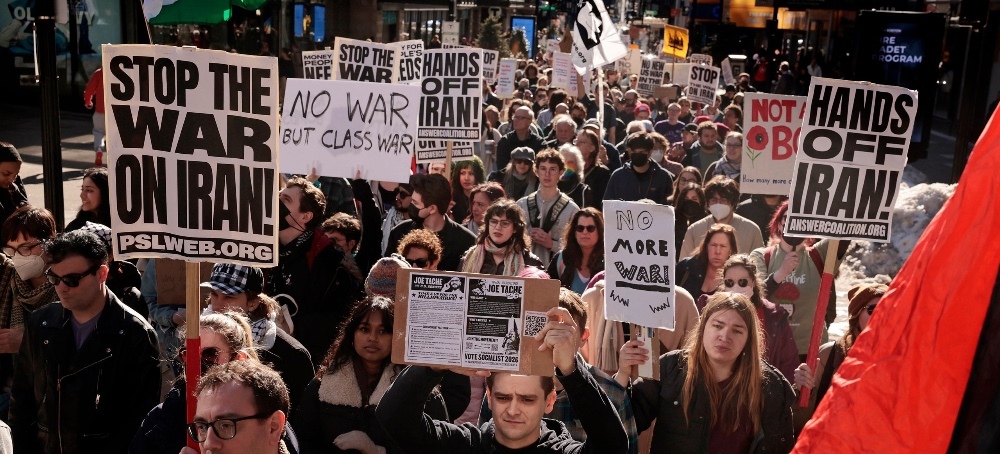 Demonstrators march with signs protesting the Iran War. (photo: By Craig F. Walker/Getty)
“Regime Change Came in Texas Before Tehran”
Ishaan Tharoor The New Yorker
Donald Trump’s war of choice with Iran—a strategic debacle that has hurt ordinary Americans—is at the heart of a historic rebuke to his Presidency and his party.
The military mission to defeat the regime in Tehran that both Trump and Graham championed earlier this year ended up being the Republicans’ undoing. That was the view of Vice-President J. D. Vance, who on Wednesday morning fired the first salvo in what may develop into an internecine G.O.P. war over foreign policy in the months to come. He said in a long post on X that “the reason we lost is the war.” (According to an NBC exit poll, sixty-three per cent of American voters disagreed with Trump’s taking the country into the war.) Trump, of course, has spent much of the past year engaging in conflict with the Islamic Republic, bombing it repeatedly, in coördination with the Israelis, while piling on economic and political pressure. But his decision to launch a war of choice—one that remains hugely unpopular, and one that failed to topple the regime as initially promised, triggered a spiralling set of geo-economic global crises, drove up gas prices and other daily costs for Americans, divided his own MAGA base, and still may flare up again in the coming days—is at the core of the historic rebuke that his Presidency and his party received on Tuesday night.
The Iranian speaker of parliament, Mohammad Bagher Ghalibaf, offered his reading of events: “Conscience or the cost of living, Americans said NO TO WAR, and we endorse this message.” His assessment was curiously echoed by John Bolton, the former Trump and Bush Administration official who has advocated the bombing of Iran and the defenestration of its regime for two decades. But this effort is too shambolic for his liking. “Our lengthy operation against Iran is a direct consequence of Trump surrounding himself with a cadre of yes-men,” Bolton observed, referring to the small circle of White House advisers who backed Trump’s instincts in starting a conflict in the Middle East that no regional power outside of Israel wanted. “Americans are not happy to be in another seemingly endless war, and they are placing the blame squarely on Trump.”
In conversations with reporters as news of Republican defeats tumbled in, Trump waved away accountability for the wipeout and defended the war. “I am totally convinced that my decision in Iran, for the long term good of the country and even the world, was an absolutely correct one,” he told Politico. The day before, the United States had carried out what officials described as “limited” strikes for “defensive” purposes on Iranian targets on Qeshm Island, in the Persian Gulf. Trump did not dismiss speculation, amid his electoral losses, that he could resume full-fledged hostilities. In the days before the midterms, Qatari mediators had plunged into a fresh round of furtive diplomacy between the United States and Iran, but talks are still at an impasse. Trump insists that Iran’s military capabilities have been thoroughly degraded, but the regime remains defiant, and has vowed a wider arc of retaliation should the United States and Israel restart their offensive, even threatening to hit U.S. assets based in Europe.
At a regional forum in Bahrain over the weekend, senior officials from the Gulf states were frustrated about the path forward. The war has exacted a toll on their economies and shattered illusions about their security. “We find ourselves drawn within a crisis that we worked diplomatically very hard to try to avert,” Anwar Gargash, a top adviser to the President of the United Arab Emirates, said in a speech. He added that his country was “braced for the worst,” even as it worked for a regional solution to the ongoing standoff. Elsewhere, there’s no sympathy for the complexity of the challenge facing the American and Israeli strategists who instigated the conflict. In June of last year, the United States and Israel launched the Twelve-Day War, an intense period of bombardments and missile strikes that led to hundreds of civilian deaths and the supposed crippling of Iran’s nuclear program. At the time, the German Chancellor, Friedrich Merz, praised the military campaigns against Iran, telling reporters that “that is the dirty work Israel is doing for all of us.” But that round proved insufficient from both Trump’s and the Israeli Prime Minister Benjamin Netanyahu’s perspectives. In February, Trump, possibly goaded into action by Netanyahu, launched a more open-ended operation. The ensuing months of chaos and spiking prices have punished countries everywhere, including in Europe. This past weekend, Merz lamented that “businesses and consumers in Europe have paid more than 100 billion euros extra because energy has become more expensive as a result of this conflict,” and insisted that there was no military solution to the conflict. He seemed to have had enough of the “dirty work.”
The midterms have also reflected a shift in Americans’ views on Israel, with candidates such as Abdul El-Sayed, Michigan’s new senator-elect, not shying away from denouncing its war on Gaza and its apparent role in provoking Trump’s Middle East imbroglio. Democrats in Congress are likely to restrict military aid to Israel, which this week Trump, perhaps in anticipation, said that he was considering sunsetting by the end of the year, anyway—a declaration that surprised many analysts in Washington, given existing agreements between the United States and Israel, which extend into 2028. Republican voters, especially younger ones, also increasingly oppose Israel’s actions, and don’t want to engage in wars on its behalf. Officials in Tehran have been paying attention. “The American public is tired of and angry about the Israeli regime’s parasitic behavior toward the United States,” Esmaeil Baghaei, Iran’s foreign-ministry spokesman, said ahead of the midterms. “The U.S. is devoting its credibility, wealth, and standing to a regime that thinks only about war.” Israel is itself in a political transition, with government-formation talks under way after an election last week delivered more seats to Netanyahu’s opponents than to his own party and its allies. Yair Golan, the leader of the Democrats, a center-left Israeli faction, said that the U.S. midterms revealed “just how toxic Netanyahu is among both Democrats and Republicans,” and argued that a coalition led by the opposition could help “restore Israel’s standing in the world.”
Trump endorsed Netanyahu in his reëlection bid, but it’s been obvious to most analysts that the President’s interests do not fully align with those of the embattled Israeli leader. “Netanyahu clearly wants to go back to war with Iran. It would help him politically in this moment of government formation,” Rachel Brandenburg, a former Pentagon official now at the Israel Policy Forum, told me. For Trump, she added, that makes far less sense. “It will be more a question of how he wants to frame victory, and if there is actually a case to be made that another round of military strikes can lead to some better sense of victory. I have not seen that case.” On Wednesday, as Trump gave reporters a look at the construction site of his White House ballroom, he claimed that he had had “no choice” but to hit Iran’s nuclear facilities and was unapologetic about the conduct of the war. But he showed little enthusiasm for an extended effort to finish the job.
Still, maybe there was another way he could win. On the morning of the midterms, he mused on Fox News that, even if the elections proved a rebuke to his Administration, he was still at a “ninety-nine-per-cent approval rating” among Israelis. “If people ever got tired of me in the U.S.,” he said, “I’ll move to Israel and become Prime Minister.”