
Refugee Detained by Ice Missed Vital Chemo Sessions and is Now on His Deathbed, Family Says
Rhian Lubin The Independent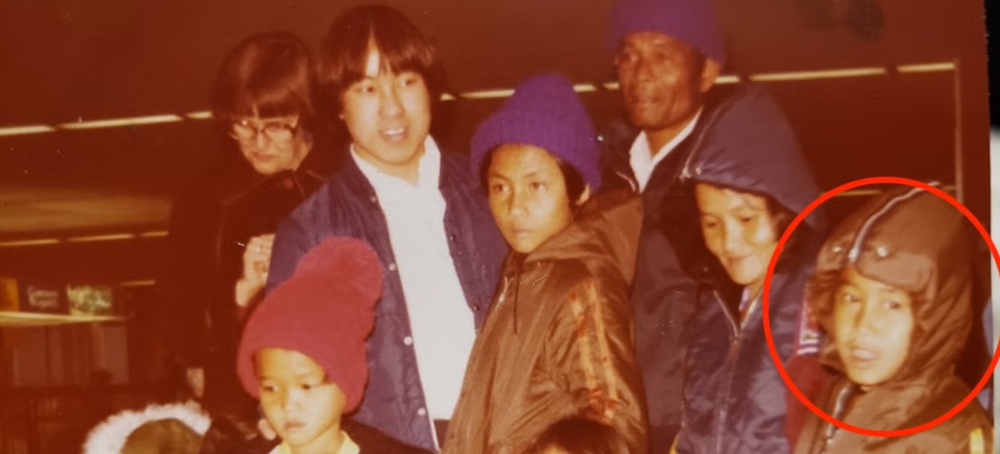 Lothirath, circled, pictured with his family shortly after arriving in the United States as a Laotian refugee in the early 1980s. He was detained by ICE in January and taken from his home in Minneapolis to Texas. (photo: AP)
 Refugee Detained by Ice Missed Vital Chemo Sessions and is Now on His Deathbed, Family Says
Rhian Lubin The Independent
A Laotian refugee whose family fled to America after the Vietnam War has just days to live after missing vital chemotherapy sessions while in ICE detention, his loved ones tell Rhian Lubin
But some 45 years later, while he was supposed to be undergoing life-extending chemotherapy for his terminal Hodgkin’s lymphoma, Lothirath found himself languishing in a federal immigration detention facility.
His loved ones now say that missing vital chemotherapy sessions in January cut the 57-year-old’s life even shorter, and he is now on his deathbed, receiving hospice care.
“He was responding quite well to the chemo,” Lothirath’s friend and care assistant, Christina Vilay, said. “He probably had another good year.”
Vilay spoke to The Independent in a phone interview Friday from her home in Minneapolis, Minnesota, where she and her husband are caring for Lothirath in his final days. Too sick to speak, Lothirath listened in on the call with Vilay at his bedside.
In early January, Lothirath was caught up in the Trump administration’s immigration surge in Minnesota, where agents swamed his Minneapolis home the day before Renee Good was shot dead by an ICE officer, the Minnesota Star Tribune first reported. He lived one block away from the street where ICU nurse Alex Pretti was killed by federal agents less than two weeks later.
Despite being gravely ill, he was taken to a detention facility more than 1,300 miles away in El Paso, Texas, where he mostly slept on an uncomfortable bunk bed in a large tent with approximately 60 other detainees, until he was sent back to Minnesota, his family said.
“It definitely got worse,” Vilay said of the cancer that has since spread to Lothirath’s bone marrow.
Vilay said she first met Lothirath three years ago at a local Buddhist temple she helps to run in Minneapolis. She has been by his side during his cancer struggle, and is sharing Lothirath’s story on behalf of the family.
Lothirath, who also requires insulin for diabetes and medication for a heart condition, did not receive medical care while in detention and missed two chemotherapy sessions, Vilay claimed. He was so weak after his release that he was immediately hospitalized, and subsequently missed two more chemotherapy sessions, according to the care assistant.
“He was too sick for the fourth session, and then ended up in the hospital again for eight days. So there went the fifth session,” Vilay said.
Had Lothirath undergone the five full rounds of chemotherapy he was due in January, he would’ve had “many more months” left to live, said Vilay, who added she is in regular contact with his oncology team.
“By then the cancer was growing and made it into the bone marrow. He's been doing life-sustaining chemo for almost two years. It's been a wonder,” Vilay said, and added Lothirath strived to live as normal a life as possible.
“As long as he didn't get side effects, he could go to temple, go to the store and live at home by himself.”
Lothirath was released from ICE detention and flown back to Minnesota after Vilay contacted his doctors and urged them to write a letter to the warden of the facility, detailing the urgency of his condition.
“After being in ICE custody, [seeing] him walking out of that Whipple building,” she said, referring to the notorious federal immigration center in Minneapolis, “This was not the same person.”
The Department of Homeland Security did not immediately respond to a request for comment.
In the early 1980s, Lothirath’s parents and their seven children were among the second wave of refugees from South East Asia to arrive in the U.S. after fleeing the violent communist government of Laos, which had taken control of the country in 1975 following the Vietnam War. They spent some time in a refugee camp in Thailand before being accepted to the U.S.
The family settled in Minnesota, which has the third-largest Lao population in America, according to the Lao Assistance Center of Minnesota.
“You escaped with literally your life,” Vilay said. “With whatever little you could carry in your hands…because if they caught you, they shot you on the spot,” she said of the communist regime that had taken charge.
The family was struck by more tragedy shortly after arriving in the U.S., when Lothirath’s father died from cancer.
“You're new to a country, you don't know enough English, and then your father passes,” Vilay said. “[He had] no father figure and mom had several kids to take care of on her own all of a sudden…so it was kind of a rough life.”
During January’s immigration surge, his mugshot was posted on the White House X account in a round up of “Minnesota worst of worst.” In it, the White House, said Lothirath was convicted of aggravated assault with a gun.
When he was 22, Lothirath was convicted in a drive-by shooting for aiding and abetting, according to Vilay.
“He was the only one out of the friends who had a driver's license, so they asked him to drive them somewhere, and it ended up being where they had planned a drive-by,” Vilay claimed. “So they shot a gun out a window. And because he was the driver, he got in trouble.”
According to a local report, his passenger shot from the car Lothirath was driving and struck the rear license plate of another car. He served six months in county jail for the crime, according to Vilay, which ended any path he may have had to become a naturalized U.S. citizen. Ever since then, he was required to regularly check in with immigration officials. His latest work authorization card was issued in 2023 by U.S. Citizenship and Immigration Services, according to documents reviewed by The Independent.
“He's just always worked, he's never married, never had kids,” Vilay said. “He ended up homeless for a while, just down on his luck…But he's always tried to do the right thing.”
Vilay said that caring for him at her home was “just a natural progression” after supporting Lothirath through his cancer diagnosis, and she launched a GoFundMe page to contribute toward his funeral and medical expenses.
He wishes to be cremated and his ashes interred with his late father.
Last week, Vilay and her husband hosted a Buddhist Baci ceremony for Lothirath at home. “The ceremony is like those final blessings…forgiving you for the things that you've done in the past and helping you move on to the future,” she said.
Asked if her friend has any regrets about coming to the U.S. nearly 50 years ago, despite his recent ordeal with immigration enforcement, Vilay paused.
“I know he's appreciative of the life that he's had here, the kind of the freedom… the friends, the family, just everything that he's been able to do,” she said. “It was not a life, living in a camp.”