
Reducing Gaza to a Charity Case or a Security Threat Is a Dangerous Mistake
Dahlia Scheindlin Haaretz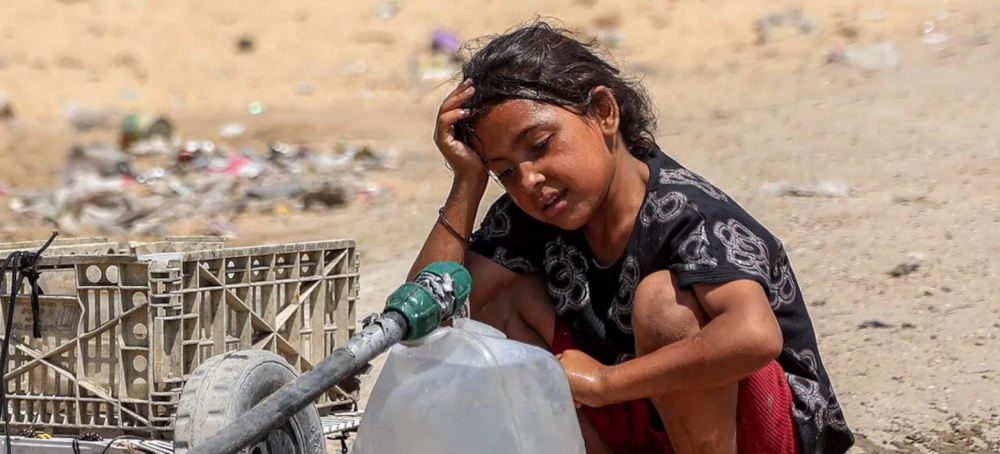 A child filling containers with water drawn from the leftovers of underground pipes at a displacement camp in the Sheikh Radwan neighborhood of Gaza City on July 6. (photo: Omar al-Qattaa/AFP)
 Reducing Gaza to a Charity Case or a Security Threat Is a Dangerous Mistake
Dahlia Scheindlin Haaretz
Palestinians in Gaza do need basic supplies desperately; but they need something beyond survival too: a political endgame. Without that, the Israeli government's plans for a total takeover are moving forward almost unchecked
Abu Safiya has been held in Israeli prisons for the last year and a half, like 13 other doctors from Gaza, without any charge. He's been beaten to a pulp, and has been held partly in solitary confinement – itself a form of torture and prohibited by the UN. Israel claims he's a terrorist, sparking epic online battles over which version is correct.
In addition to their own plight, the doctors Israel is holding in prison stand for the many layers of misery in Gaza. Israel crushed much of the health system during the war, noted Physicians for Human Rights in a statement; the group is petitioning for their release. Every missing doctor has enormous consequences on the wretched state of healthcare there.
Not on bread alone
The humanitarian situation in Gaza is abysmal overall. Israel's Coordinator for Government Activities in the Territories (COGAT) published a report last week boasting of the great volume of supplies going into Gaza. But critics say COGAT is using aggregate amounts of aid to distract from the fact that not enough of it actually reaches people. Others argue that Israel dehumanizes Palestinians by treating basic supplies for survival as a generous gift.
Palestinians in Gaza do need basic supplies desperately; but they need something beyond survival too. Similarly, if Israel or pro-Israel types argue that Dr. Abu Safiya and others are terrorists, the normal recourse should be due process, not summary arrest and detention without charge. But Israel – and too often, debates about Gaza at large – consider both to be luxuries that Gazans don't deserve.
With such dire emergencies wrought by the ongoing war, there is a risk that immediate issues will overshadow the reality that Gaza cannot be reduced to either humanitarian or security problems. Gaza needs political solutions, and who wants to talk about that? An end to the occupation, and a final status arrangement with Israel for a sovereign Palestinian state; that's where some people tune out.
Shortly after October 7, I advocated international intervention for Gaza the day the war would end. A colleague argued that it was wrong to focus on any "day after" plans, because a unified demand for a cease-fire was a higher priority. That deadly serious dilemma hasn't gone away. Just last week, the influential New York Times journalist Ezra Klein interviewed my colleagues, the co-directors of A Land for All, where I am an active member.
Klein introduced the interview by explaining his longtime reluctance to discuss solutions for Israel and Palestine: "I don't think any of the underlying conditions for a political solution are present. We're in a pre-solutionary space. I worry about [discussing solutions] as a form of escapism."
But when he pressed the two directors to say how the vision can address immediate problems on the ground, even partially, Rula Hardal objected: "I'm not sure that I do want to cooperate with you in this conversation, on this topic, because I think it needs to be in a different way. The Palestinians are not going now to accept or agree to actual partial steps on the ground until – I think there is a need for something dramatic. ... And people from both sides need to see a plan with a timeline."
She asserted that both sides need to know "where we are heading this time."
The case for an endgame
Without a destination, how does one know which immediate steps to take? Gazans need water today, but they need it tomorrow too; that can only happen if there is no next escalation that will destroy the water infrastructure again. Long-term political solutions aren't a luxury but a condition for immediate solutions to make sense.
Nor can real solutions apply to Gaza alone. If "Gaza first" becomes "Gaza only," you're following the Israeli government's long-term policy of pretending Gaza can be removed from Palestine, and perhaps foisted onto Egypt, just locked down and left to fester. The results were catastrophic.
An endgame based on peace and independence for Palestinians would inform policy in the immediate, medium and of course long term. Consider each stage as it's playing out in the absence of such a vision. Instead, the Israeli government's plans for total takeover are moving forward almost unchecked.
In the here and now, the original 20-point Trump plan has become a reality that enables Israel to keep attacking and occupying Gaza. Israel controls nearly 70 percent of Gaza, and the IDF keeps building military outposts during the cease-fire. Hamas is balking at disarmament under these circumstances, and the entire process seems stuck.
Jaser AbuMousa of the Middle East Institute and the International Peace Institute recently argued in Foreign Affairs that Hamas is in fact nearly moribund, but Israel is hyping up its resilience to "justify its continuing military operations – and avoid having to answer difficult questions about the future of Palestinians."
Israel could also be making the case for a resurgent, full-blown war in Gaza. If international actors leading the cease-fire were genuinely committed to Palestinian statehood as the endgame, Hamas' weakness could have been an opportunity – for example, to embrace upcoming Palestinian elections in late November, however fraught that process will be. They could be pushing Israel harder to let the Palestinian technocratic committee stuck in Cairo into Gaza.
In the immediate term, the hypothetical International Stabilization Force is effectively nonexistent. If it did exist, all experts on international intervention agree that without a political endgame, it won't work. "In order to gain buy-in and commitment from Palestinians, the deal's guarantors must make clear that the mission is laying the foundation for Palestinians to take over," wrote Jonathan Panikoff, who served on the U.S. National Intelligence Council, last October after the cease-fire was announced.
If there was a commitment to the final status of two states (in any configuration), the Trump plan should be prioritizing its own language rejecting any displacement or expulsion of Palestinians, or item 16 – "Israel will not occupy or annex Gaza." Instead, Israel's far-right fantasies are holding sway. The occupation of Gaza is growing, not shrinking.
In the medium term, Gaza must be rebuilt. But previous Gaza reconstructions have failed since resurgent wars ruined what had barely been built. If you really want to empower Palestinians, there are lessons to be learned: Abdalrahman Kittana, a Palestinian architect and academic, wrote an excellent chapter on reconstruction in a valuable dossier about the Palestinian National Movement post-October 7, edited by Omar Rahman and Mouin Rabbani at the Qatar-based Middle East Council on Global Affairs.
Kittana found that Gazans need to be part of the planning, not an implementation arm of foreigners – if the path is leading towards Palestinian independence. Other researchers in 2018 found that civil society NGOs relevant for reconstruction projects who are not connected to Hamas should be integral to the process; instead, in the past, international actors were driven by suspicion that Hamas could ultimately control these groups, and constrained their involvement. That undermined social forces not connected to Hamas, instead of empowering them. The 2018 study already pointed to social and economic deterioration alongside the lack of agency, which was fueling frustration back then.
Kittana found that earlier systems to reconstruct Gaza ultimately functioned as a "mechanism of containment, aiming to stabilize the crisis while leaving its colonial roots intact." To truly empower Palestinian society for eventual independence, Kittana's chapter provides an elaborate set of principles for the reconstruction of Gaza in ways that foster Palestinian political agency, sovereignty, and self-determination.
In the long term, even the Trump cease-fire and UN Security Council Resolution 2803 (which approved that plan) named the need for a future Palestinian state. They reference the French-Saudi initiative affirmed in the "New York Declaration." Ultimately, the international powerbrokers involved in Gaza – chiefly the United States – don't seem to care about their own words. This is not at all theoretical.
Israel is advancing its government's long-term endgame every day. Envisioning peace isn't escapism; it's the only way to actually get there.