
Records Reveal $600M Estimate for Trump’s Ballroom Project, With Half From Taxpayers
Sarah Blaskey and Jonathan O'Connell The Washington Post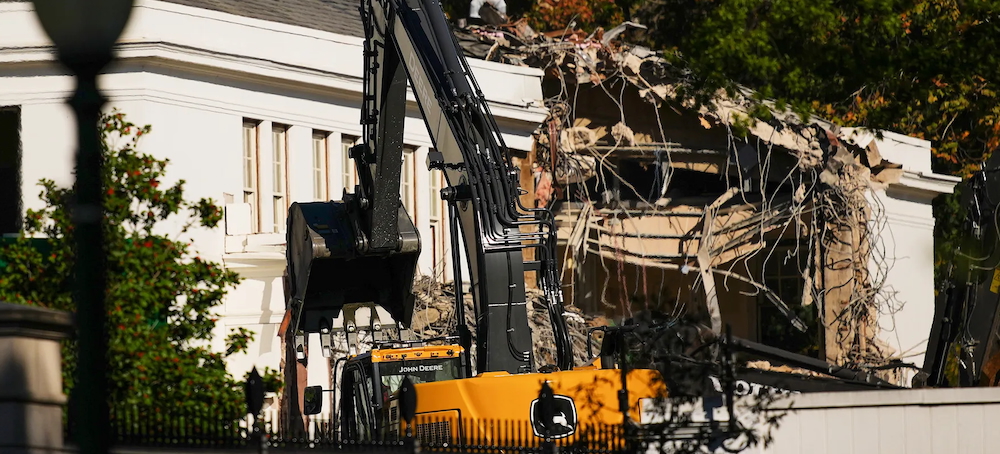 The facade of the East Wing of the White House is demolished by work crews. (photo: Andrew Harnik/Getty Images)
 Records Reveal $600M Estimate for Trump’s Ballroom Project, With Half From Taxpayers
Sarah Blaskey and Jonathan O'Connell The Washington Post
An internal cost estimate in March by the project’s contractor ran $200 million more than Trump has said publicly and counters his claims that no taxpayer money will be spent.
“This is taxpayer-free. We have no taxpayer putting up 10 cents,” Trump told reporters in the Oval Office on March 31, describing the project as including bomb shelters and major medical facilities.
But a detailed project summary prepared for the White House by the contractor more than three weeks before Trump’s comments estimated the total construction cost at $600 million — with more than half coming from taxpayers, according to a copy of the contractor estimate obtained by The Washington Post.
By the time Trump made his comments in March, the federal government had already approved more than a dozen payments to the contractor overseeing the work, Clark Construction, totaling tens of millions of dollars in public funds, according to a log of the contractor’s invoices obtained by The Post.
Since first announcing the East Wing project last July, Trump has repeatedly said that the price tag would not exceed $400 million and that private donations routed through a nonprofit would cover its entire cost. At other times, he has said that the Secret Service and the military would contribute security enhancements, without elaborating on the price of those upgrades.
Multiple project summaries provided to the White House by Clark Construction show that internal cost estimates have been significantly higher than administration officials have acknowledged in public comments or court filings. They also show that the work was projected to rely heavily on taxpayer dollars from the moment it was announced.
The White House did not answer questions about the internal cost estimates or taxpayer funding.
“President Trump and generous American patriots are funding the ballroom to the tune of approximately $400 million, which will be a secure and appropriate venue for Presidents for generations to come,” White House spokesman Davis Ingle wrote in a statement.
A spokesperson for McLean, Virginia-based Clark Construction said all project details are confidential and referred questions to the White House.
The Post obtained six cost estimates for the entire East Wing project, dated from July 2025 to March of this year, that show an increasing price tag as well as the expected sources of funding. Those records, as well as invoice logs and correspondence, provide the clearest accounting yet of Trump’s most ambitious construction project in the nation’s capital. The project is deeply unpopular with most Americans, and even some Republican lawmakers have balked at funding it.
When the White House first announced the plan to build a ballroom on July 31, 2025, it said in a news release that contributions from Trump and “other patriot donors” would cover the cost of the project, which it said would be $200 million. The White House added that the “United States Secret Service will provide the necessary security enhancements and modifications.” There was no mention of an underground military bunker.
The records obtained by The Post show that the administration and Clark worked hand in hand starting last June to determine the scope and cost of construction.
White House officials received a preliminary estimate, dated July 11, projecting that construction would cost $270 million, with over $100 million coming from taxpayers through the Secret Service and the White House Military Office, the records show.
Emails from that time show that administration officials planned to use $3.6 million of Secret Service money to cover initial expenses for site preparation before demolition.
A White House lawyer explained in an email to colleagues on July 30 that she had added a line to contract language “to tie the project more closely to security-related issues since USSS [U.S. Secret Service] is providing the funding.”
“We believe this edit is important to comply with fiscal law principles,” wrote Caroline C. Hunter, general counsel in the White House Office of Administration. Hunter did not respond to messages seeking comment.
More than $1.6 million in Secret Service funds was also budgeted to cover part of the demolition itself, according to a cost estimate. The U.S. Secret Service did not provide answers to questions before publication of this report.
Three contracting and procurement experts who reviewed the documents at The Post’s request said the demolition of the East Wing appeared to fall outside the scope of the Secret Service’s mission of protecting government leaders.
“That is a stretch,” said Anthony Costa, a former General Services Administration official who oversaw complex government real estate projects during a career that spanned four presidential administrations. “How is that something Secret Service should do and fund?”
On Oct. 22, in the same week Clark began demolishing the East Wing, Trump told reporters that the price had risen to $300 million. He said that the military was involved but that the project would be paid for “100 percent by me and some friends of mine.”
However, a project summary dated Oct. 20, the day the demolition began, shows that Clark expected the full project to cost $478 million. Taxpayers were expected to fund nearly half of that, the documents show.
Speaking at the White House in December, Trump said the cost could reach $400 million. “We’re donating a building that’s approximately $400 million,” he said.
By March, Clark had informed the White House that the projected cost had increased to $600 million. A project summary dated March 5 shows that nearly half of that, $293 million, was expected to come from “private sources.” The estimate said an additional $155 million would come from the Secret Service, $149 million from the White House Military Office and $3 million from the Executive Residence, all sources funded by taxpayers.
That month, the administration acknowledged that the project included underground security features, including what Trump has described as a hospital.
A court issued an injunction in March, pausing construction above ground but allowing work to continue on the secure underground bunker after a historic-preservation group filed a lawsuit arguing that the White House had failed to seek necessary reviews.
In April, an alleged would-be assassin attempted to access the White House Correspondents’ Association dinner before he was apprehended by law enforcement. Within days, the administration said that rebuilding the East Wing, including the ballroom, was a national security imperative.
Trump and some elected Republicans said a new ballroom could more securely host events like the correspondents’ dinner. Sen. Lindsey Graham (R-South Carolina) and others introduced legislation that would have authorized $400 million in spending “to upgrade the presidential ballroom and strengthen the White House’s security infrastructure.” Seven Republican senators joined Democrats to block the idea.
“President Trump indicated that the ballroom was going to be built with private donations,” said Sen. Susan Collins (R-Maine), one of the senators who opposed it. “I think that’s the commitment that should be kept.”
In May, with the legislative proposal pending, Trump provided reporters with another update, showing off the construction site and saying all the parts of the project were intertwined. “This is one well-knit building. One thing doesn’t work without the other,” he said.
This time the president made more of a distinction over who would pay for each part of the structure. The government would pay for part of the construction on the new East Wing, he said, describing that work as “for the security of that and the whole White House premises.”
“They have a budget in Secret Service and the military to do some of the work that you see right here,” Trump said. The ballroom itself, he said, “is not going to be paid for by the taxpayer. This is a gift to the United States of America.”
The Secret Service and the White House Military Office (WHMO) have long held roles in securing the White House complex for the president, his family and staff members.
The three experts who reviewed documents related to the project said it was appropriate for the Secret Service and the WHMO to pay only for parts of the project that fall within their mission. Trump said some security spending would go toward defenses including “the greatest drone empire … to protect Washington” on the building’s roof.
But the experts also said the project documents contradicted the administration’s statements claiming that the East Wing would be paid for by donors. Stan Soloway, a former Pentagon acquisition official who is board chair at the National Academy of Public Administration, said that from a contracting and budget perspective, “you can’t disentangle the entertainment space from all of the other parts that are in here.”
He said it was clear from the documents that taxpayers are footing the bill for parts of the ballroom: “I think it’s inevitable that it bleeds over. It’s one structure.”