
Quagmire of the Vanities
Paul Krugman Substack Trump's delusions are the reason the price of oil is back at around $100 a barrel. (photo: Getty)This undated photo provided by Michael Pretti shows Alex J. Pretti, the man who was shot by a federal officer in Minneapolis on Saturday, Jan. 24, 2026. (photo: Michael Pretti/AP)
 Quagmire of the Vanities
Paul Krugman Substack
Why the world economy is still at risk from the Iran debacle
Trump’s gratuitous war on Iran has turned into a remarkable quagmire — remarkable because the only thing keeping the war going is Trump’s vanity. He effectively lost the war in the first few days, when it became apparent that Iran’s hardline regime had survived the initial decapitation strike and that the U.S. military couldn’t keep the Strait of Hormuz open. But Trump is psychologically incapable of admitting failure. So the war goes on, weakening America by the day, as he searches for some way to spin his abject defeat as a victory.
And declarations that the economic fallout from the war had been contained now look dangerously premature.
It’s true that during the first closure of the Strait oil prices didn’t rise as high as many analysts — myself to some extent included — expected. Some Persian Gulf oil made its way to markets bypassing the Strait of Hormuz, notably via the Saudi pipeline to the Red Sea. China sharply reduced its oil imports. And the world offset a substantial part of the shortfall in supply by drawing down inventories.
The second Hormuz closure could be worse, for several reasons. Iran’s Houthi allies are now attacking shipping in the Red Sea, threatening that safety valve. Also, inventories are now much lower than they were when the conflict began, and can’t serve as a cushion going forward.
Perhaps the most important thing to realize about the current situation, however, is that oil is more expensive than it looks.
Nobody burns crude oil. Oil must be refined into usable fuels, mainly gasoline and diesel. And there’s a global shortage of refining capacity. This partly reflects the war in Iran, but it also reflects Ukraine’s stunningly effective campaign against Vladimir Putin’s energy infrastructure.
This shortage of refining capacity has helped keep crude prices down — why buy crude when you can’t refine it? More important, however, it means that prices of petroleum products to end users are much higher than one would have expected given the price of crude. The chart at the top of this post shows the wholesale price of diesel, which even during the failed cease-fire was far above its prewar level, and is now close to its previous peak.
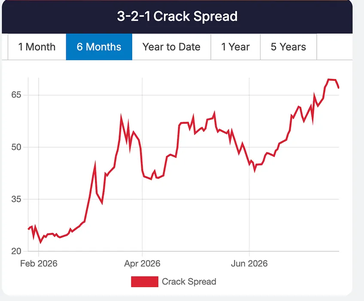
The overall “crack spread” — the difference in price between a barrel of crude oil and the price of the products into which that barrel is refined — has exploded, from around $25 a barrel before the war to more than $65 now:
RBN Energy
RBN Energy
From the point of view of end users, this is the same as if crude prices had risen an extra $40 per barrel. In effect, the world is coping with the equivalent of $140 oil even though the headline price is “only” around $100.
Does this portend economic catastrophe? No, not yet. But it’s not good.
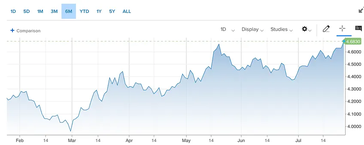
Last month’s easing in the inflation rate now looks temporary. With energy prices surging again — not to mention the inflationary impact of Trump’s new round of tariffs, imposed using the ludicrous excuse that nations aren’t doing enough to stop forced labor — interest rates will almost surely rise, intensifying the squeeze on families and businesses. Long-term rates, reflecting expected future Fed hikes, are already way up:
10 year bond, from CNBC
Still, things could be worse. And they may be about to get worse. The Wall Street Journal reports that Trump is in “revenge mode,” and the U.S. military is surging forces into the Middle East.
And if Trump doubles down on failure, drastically escalating his disastrous war, the economic, not to mention human, impacts will get much uglier.