
Production Agriculture Is Driving Grasslands Loss Across North America
Georgina Gustin Inside Climate News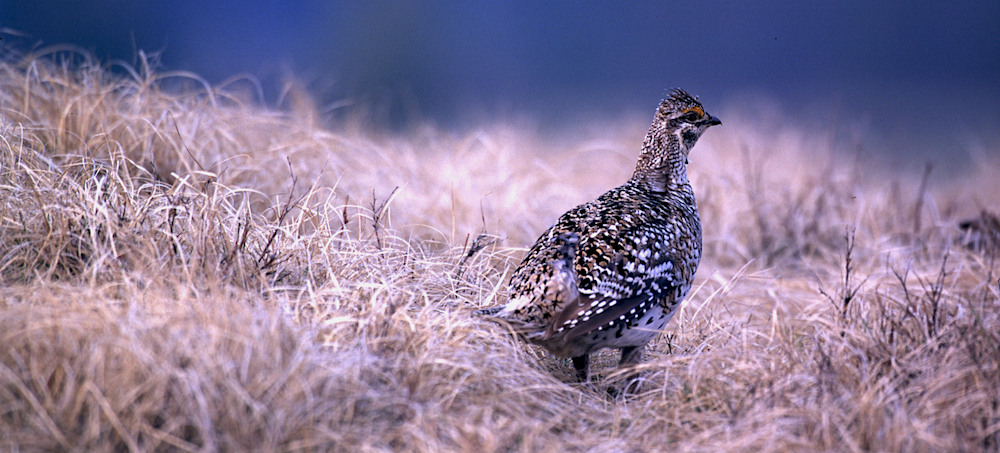 The sharp-tailed grouse is native to the northern prairies of the US. (photo: DNR)
Production Agriculture Is Driving Grasslands Loss Across North America
Georgina Gustin Inside Climate News
These vast carbon-storing regions aren’t getting the policy or popular attention they deserve, advocates say.
A survey, published this month by researchers at the World Wildlife Fund, analyzes for the first time the breadth of grasslands across three countries, from the Chihuahuan Desert in Mexico, across the Great Plains and other American regions, up to the Prairie Provinces of Canada. Using region-specific datasets, the researchers found a cumulative loss of about 1.8 million acres in 2023—roughly twice the size of Chicago.
Already the United States has lost roughly 70 percent of its grasslands to agriculture and development. These ongoing annual losses nibble away at the iconic landscape, which has seen fewer protections than other ecosystems, including forests. Advocacy groups say grasslands are the most imperiled ecosystems in the world.
“Grasslands get overlooked,” said Suzy Friedman, a senior director who oversees Great Plains policy at WWF. “They are not recognized for the value and benefits that they provide for agriculture, for carbon, for water quality, for wildlife, for recreation and for being a foundational and critical component for countless rural communities and tribal communities.”
The grasslands of the Great Plains contain about 34 percent of the region’s carbon. Because most of that is stored in deep roots, they are less vulnerable to fire than forests, which store most of their carbon above ground. But these soils lose about 70 percent of their carbon when cultivated.
WWF has produced its “Plowprint” analysis since 2014, but this year’s is the first to look at all three countries using data going back to the 1980s. It found that cropland expanded in all of them, but at different rates and for different reasons. In the U.S., corn and soybeans drove the conversion of more than 2 million acres between 2020 and 2024, roughly half of that in the Great Plains. Most of those corn and soybeans are fed to cattle or end up in gas tanks as ethanol or biodiesel. The report notes that the expansion in the U.S. has slowed compared to “earlier periods of agricultural expansion.”
“We’re seeing the most conversion exactly where you’d expect it to be, and that’s in the Great Plains and in the Corn Belt,” said Sarah Olimb, a spatial analyst with WWF. “It’s usually pretty predictable because we have a good idea of where the fertile lands are. Those are the ones that tend to be converted, but we’re also seeing marginal lands that are converted.”
Meanwhile Canada’s grasslands saw the greatest area of conversion: Between 2019 and 2023, 4.7 million acres were plowed under, mostly for wheat in the Prairie Provinces. Mexico saw the most relative growth, losing more than 1 million acres of grassland to crops, a rate of about 7 percent, suggesting rapid expansion of production agriculture there.
The researchers say they plan to make future analyses even more granular, looking into the drivers of grassland loss at the state and provincial levels. They plan to turn the data into interactive maps so people can pick an area and look at trends over time.
The map is part of a broader effort to draw more attention to grasslands conservation. The relative lack of attention, Friedman said, motivated the recent launch of the U.S. Grasslands Campaign, a public awareness effort to spur more policy protections, organized by the America’s Grasslands Coalition, a group of conservation organizations that came together in 2023.
The hope, advocates and researchers say, is for stronger policies to protect grasslands and weaker incentives to plow up more, including the U.S. Department of Agriculture’s crop insurance program.
A key area for conservationists is strengthening tribal leadership and food sovereignty efforts on tribal lands, where much of the country’s remaining bison herd graze. The Indian Buffalo Management Act would provide more funding to tribes and organizations that have buffalo herds and more resources for tribes to establish new herds, which would expand protected grazing areas.
“Tribes play an enormously important role in grassland conservation,” Friedman said. “They’re amazing stewards of bison, which support grassland health.”