
Plan to Kill 450,000 Barred Owls on West Coast Apparently Underway
Gosia Wozniacka Oregon Live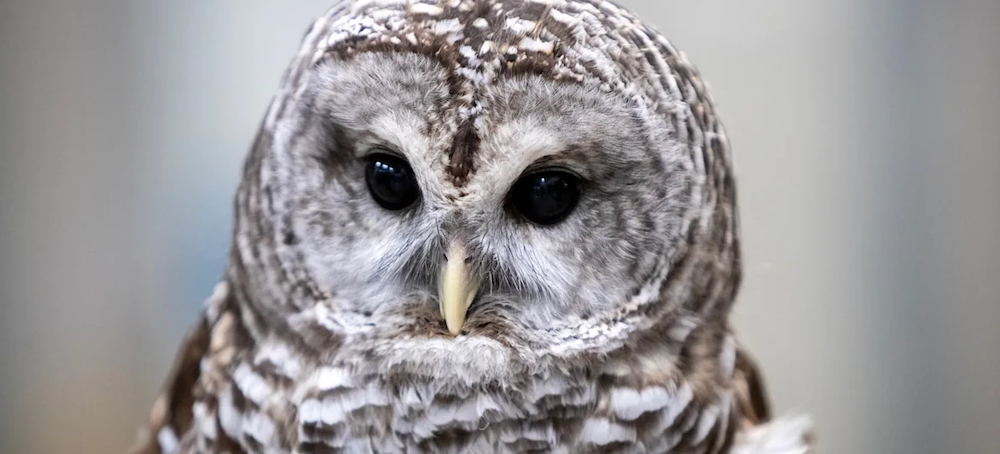 "A controversial federal plan to kill nearly half a million barred owls along the West Coast is now in a judge's hands." (photo: Oregon Live)
 Plan to Kill 450,000 Barred Owls on West Coast Apparently Underway
Gosia Wozniacka Oregon LiveFriends of Animals attorney Jennifer Best said the government "has indicated that it is moving forward" with the killing.
"Because there is not currently a court order in place to stop the killing of barred owls, the government may continue to kill them while we wait for a decision," Best said this week.
Court records don't specify where or when any owls have been removed so far, she said.
The U.S. Fish and Wildlife Service declined to comment because the issue involves "active or pending litigation," according to an emailed statement.
The federal government has argued that barred owl removal is needed to prevent the rapidly declining spotted owls from going extinct and to protect countless other species that barred owls prey on, including salamanders, flying squirrels and wood rats.
The plan, finalized in summer 2024, calls for specially trained shooters to kill more than 450,000 barred owls over 30 years in Oregon, Washington and California. That's up to 15,600 barred owls killed per year.
It was set to launch last spring but animal rights groups including Friends of Animals sued to block the plan, arguing the killing is inhumane and unnecessary.
Yakama Nation in Washington state publicly acknowledged that it has launched barred owl management on its reservation lands, according to recent news reports. The tribe's spokesperson Star Diavolikis did not reply to a request for comment.
Michelle Dennehy, a spokeswoman with the Oregon Department of Fish and Wildlife, said the state agency does not plan to participate in barred owl removal nor is it involved in the permitting of those who will be doing the removal. Dennehy said she was not aware of any other agency or landowner who is working on barred owl removal in the state.
In Oregon, the birds would be killed in the Oregon Coast Ranges, Western Oregon Cascades, Eastern Oregon Cascades and the Oregon Klamath region, the U.S. Fish and Wildlife Service has said.
The Oregon Department of Forestry, on the other hand, will work on barred owl removal, spokesperson Tim Hoffman confirmed.
The department won't start killing barred owls until it gets a permit and federal approval for its forest habitat conservation plan and for a barred owl management plan, Hoffman said. It has yet to figure out the details of who will do the removal or how they will be trained, he said.
During a hearing last Wednesday in Portland, U.S. District Judge Adrienne Nelson questioned lawyers representing animal rights groups and the U.S. Fish and Wildlife Service.
Federal officials have said the barred owl killing would not eliminate the species, which migrated into western forests from their historical range in eastern North America in the 1970s. Rather, the plan is intended to kill under 1% of the birds' U.S. population and would result in the removal of barred owls from less than half of the northern spotted owl's range in Oregon, Washington and California.
The spotted owl was listed under the Endangered Species Act as a threatened species in 1990 after decades of intensive logging had destroyed and fragmented its old-growth forest habitat. In the years since, federal scientists have said that competition from barred owls -- which U.S. Fish and Wildlife considers to be an invasive species – has become another major threat.
The judge is expected to issue a decision later this summer or fall.
The U.S. Fish and Wildlife Service has described the program as voluntary. It has said it would work with various landowners and land managers – including state and federal agencies, tribal governments as well as timber companies and other private forest owners. No public hunting of barred owls is allowed under the strategy.
The federal plan calls for specialty shooters trained under a special protocol to accurately identify spotted owls and barred owls using both visual and auditory means – to reduce the possibility of spotted owls being killed instead. The shooters will use shotguns at close range to shoot the barred owls, usually at dusk and at night when they are active.
The federal agency applied for and received a Migratory Bird Treaty Act special purpose permit to implement its removal strategy. The permit effectively allows the agency and its partners to legally kill barred owls under a federal law that otherwise prohibits harming migratory birds.
Animal rights groups say culling barred owls won't help because ultimately, the lack of habitat is the main culprit in the decline of spotted owls. They also say the killing could result in the wrong owls being shot and disrupt nesting behaviors.
Critics, including Oregon lawmakers, have said killing barred owls would be expensive and impractical and could cost more than $1 billion over three decades.